

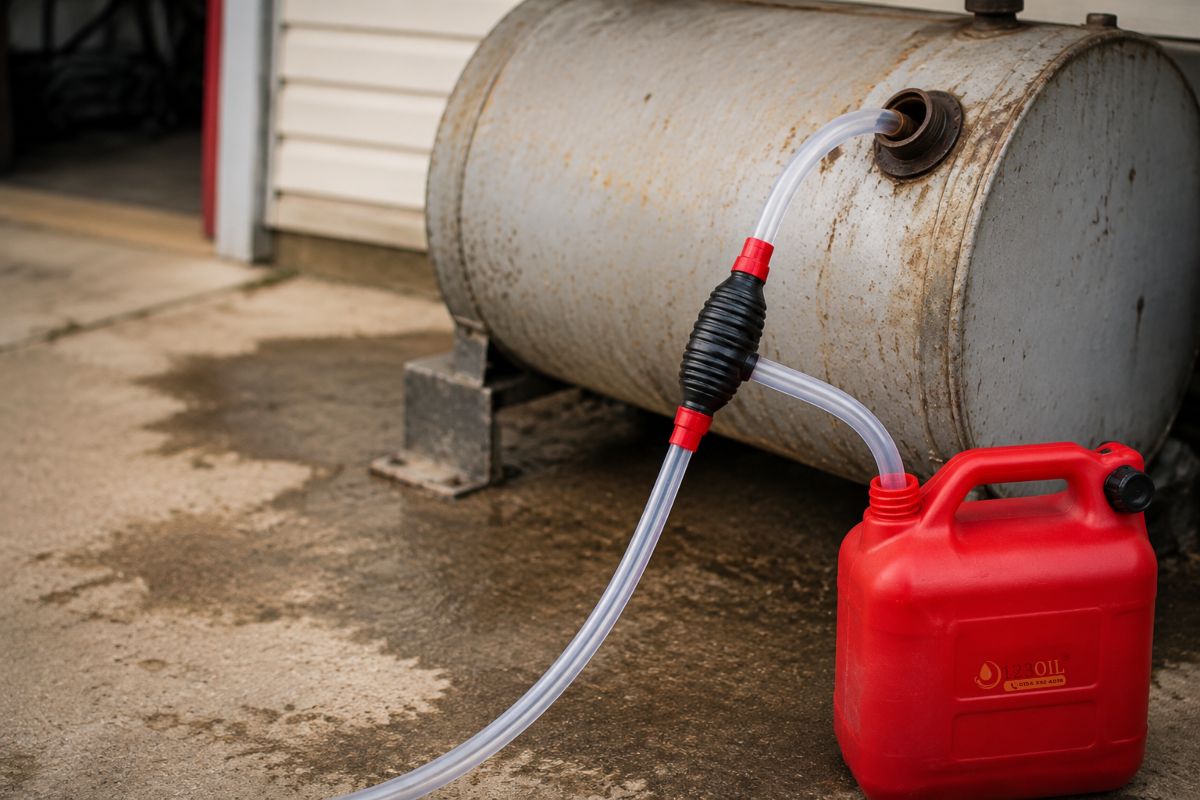
To drain a fuel tank with a hose, use a fuel-compatible siphon hose and an appropriate manual transfer pump. Place an approved receiving container below the fuel level, insert the hose correctly, and start the siphon using the pump. Never siphon fuel by mouth, use unsuitable electrical equipment, or dispose of fuel into drains or onto the ground.
Draining a fuel tank may be necessary when fuel has become contaminated, the tank needs maintenance, or old fuel must be removed before repair, replacement, or decommissioning. One of the simplest methods for transferring liquid from a suitable tank is to use a hose and siphoning equipment. However, petrol, diesel, heating oil and other fuels are flammable or environmentally hazardous, so draining a fuel tank requires considerably more care than siphoning water from a container.
If you are wondering how to drain a fuel tank with a hose, the basic principle involves placing a fuel-compatible hose into the tank and using a safe siphon pump to start the flow into an approved fuel container positioned below the fuel level. Never start a fuel siphon by mouth. Fuel vapours and liquids can cause serious harm, while spills can create fire, health and environmental risks.
This guide explains the process, the equipment involved, common problems and important precautions to consider when draining fuel from a tank.
What Does Draining a Fuel Tank with a Hose Mean?
Draining a fuel tank with a hose generally involves transferring fuel from one container to another using gravity and a siphoning system. Once a siphon has been safely established, gravity can maintain the flow provided that the receiving end of the hose remains lower than the fuel level inside the tank.
This approach can sometimes be suitable for accessible tanks containing manageable quantities of fuel. However, it is not appropriate for every situation.
Large commercial tanks, damaged tanks, underground installations, tanks containing unknown substances, or systems with significant contamination are better handled by appropriately trained professionals with dedicated fuel-transfer equipment.
Why Might You Need to Drain a Fuel Tank?
There are several reasons why fuel may need to be removed from a storage tank.
Old fuel can deteriorate over time, particularly when it has been stored for an extended period. Water, sediment and microbial contamination may also accumulate inside certain fuel storage systems. In other situations, the tank itself may require repair or replacement.
Fuel removal may therefore be necessary before:
- Replacing or decommissioning a fuel tank
- Carrying out repairs or maintenance
- Removing contaminated or degraded fuel
- Investigating water or sludge contamination
- Cleaning the inside of a suitable storage tank
- Relocating certain fuel storage equipment
- Correcting an accidental filling problem
Before removing anything, establish what fuel is present and why it needs to be drained. Unknown liquids should not be handled as though they were ordinary fuel.
How Does a Fuel Siphon Work?
A siphon uses differences in height and gravity to move liquid through a continuous length of hose. Once the hose is filled with liquid and the flow has started, gravity pulls fuel down towards the lower receiving container.
For this to work effectively, the receiving end generally needs to be positioned below the level of the fuel being removed.
The important part is starting the siphon safely. Older advice sometimes recommends sucking on a hose to draw liquid through it. Never do this with fuel. Swallowing or inhaling fuel can cause serious injury.
Instead, use equipment specifically designed to transfer the type of fuel involved, such as an appropriate hand-operated siphon or transfer pump.
Equipment You May Need
Before beginning, make sure the equipment is compatible with the particular fuel being handled. An ordinary garden hose, for example, is not automatically suitable for transferring fuel.
Depending on the tank and fuel, suitable equipment may include:
- A fuel-compatible siphon or transfer hose
- A compatible manual siphon or transfer pump
- Approved, properly labelled fuel containers
- Appropriate fuel-resistant gloves
- Suitable eye protection
- Absorbent spill-control materials
- A funnel designed for fuel transfer, where appropriate
- Suitable tools for accessing the tank, if permitted by its design
Do not improvise with electrical pumps, household vacuum cleaners or other equipment that is not designed for fuel. Vapours from some fuels can ignite.
How to Drain a Fuel Tank with a Hose Safely
The exact procedure varies depending on the type of tank, fuel and siphoning equipment. Always follow the tank manufacturer’s instructions and the directions supplied with your transfer equipment.
1. Identify the Fuel First
Before attempting to drain the tank, confirm exactly what it contains.
Petrol, diesel and heating oil have different properties and risks. You should also establish whether the fuel is clean, contaminated or mixed with another substance.
If you cannot confidently identify the contents, stop and seek professional assistance.
2. Choose a Safe Working Area
Ventilation and ignition control are particularly important when fuel is involved.
Keep cigarettes, naked flames, heaters, sparks and other potential ignition sources well away from the working area. Avoid carrying out fuel-transfer work in a poorly ventilated enclosed space.
The surrounding ground should also be protected against accidental spills where appropriate.
3. Inspect the Tank
Before inserting equipment, check the accessible exterior of the tank and its connections for obvious signs of deterioration, leakage or damage.
A basic Tank Inspection can reveal corrosion, cracks, unstable supports or leaking fittings that could make fuel removal considerably more hazardous.
Do not disturb a tank that appears structurally unsound. Moving hoses, opening fittings or applying pressure to a badly corroded tank can potentially worsen an existing leak.
4. Prepare an Approved Receiving Container
Never drain fuel onto the ground, into a drain or into an unsuitable household container.
Use a container that is approved and compatible with the fuel being transferred. Make sure it is stable and has sufficient capacity.
Do not assume that one container will hold everything in the tank. If several containers are required, plan how you will safely stop the flow before changing them.
5. Position the Receiving Container Correctly
For gravity siphoning, the receiving container normally needs to sit below the fuel level in the source tank.
Place it on stable ground where it cannot easily tip over. Avoid unnecessarily increasing the vertical drop or using a makeshift arrangement simply to accelerate the transfer.
6. Insert the Fuel-Compatible Hose
Carefully place the appropriate end of the hose into the fuel according to the siphon manufacturer’s instructions.
Avoid forcing the hose against components inside a tank. Some vehicle fuel systems, for example, contain anti-siphon devices, valves, filters or complex filler-neck arrangements. Forcing a hose through these components can cause damage.
If the hose cannot be inserted normally, do not force it.
7. Start the Siphon with an Appropriate Pump
Use the manual siphon or fuel-transfer equipment according to its instructions to establish flow.
Do not use your mouth to create suction.
Once fuel begins flowing continuously and the siphon is established, gravity may continue moving it through the hose.
Remain with the equipment throughout the transfer. Never leave flowing fuel unattended.
8. Monitor the Fuel Transfer
Watch both the tank and receiving container carefully.
Stop the transfer well before the receiving container becomes full. Leaving sufficient headspace where required can reduce the risk of overflow and accommodate fuel expansion.
Also watch for:
- Hose movement
- Leaks around connections
- Unexpected changes in flow
- Fuel odours becoming unusually strong
- Container instability
- Spillage
If anything appears unsafe, stop the transfer.
9. Stop the Siphon Carefully
Follow the siphon equipment manufacturer’s instructions for stopping the transfer.
Control the hose carefully because residual fuel can remain inside it even after the main flow has stopped. Keep the hose ends positioned so remaining liquid cannot spill onto the ground.
10. Secure the Removed Fuel
Seal approved containers correctly and label them where necessary. Keep them away from heat and ignition sources and comply with applicable storage requirements.
If the fuel is contaminated or no longer usable, it should be handled through an appropriate disposal or recovery route rather than poured into drains, onto soil or into ordinary waste.
Can You Completely Empty a Fuel Tank with a Hose?
Not necessarily.
A basic siphon often removes most accessible liquid but may leave a residual layer at the bottom of the tank. The hose may also be unable to reach the lowest point because of the tank’s shape, internal baffles or access arrangement.
Water, rust, sediment and sludge tend to accumulate near the bottom, making the final portion particularly important when contamination is the reason for draining.
If a tank needs to be genuinely empty for maintenance, removal or decommissioning, professional extraction equipment may be required.
What Happens If There Is Sludge in the Bottom?
Fuel tanks can accumulate sediment and contamination over time. Simply removing the liquid above this material does not necessarily leave the tank clean.
In some circumstances, Fuel Tank Cleaning may be needed after the usable or contaminated fuel has been extracted. Professional cleaning can address deposits that ordinary siphoning cannot remove effectively.
Avoid stirring sludge unnecessarily while siphoning. Disturbing bottom deposits can mix contaminants into the remaining fuel and make removal more difficult.
Is Siphoning Suitable for an Oil Storage Tank?
The principle of siphoning may work with some accessible oil storage arrangements, but the size, condition and construction of the tank matter.
Domestic heating oil tanks, for example, can contain substantial volumes of liquid. Attempting to empty a large tank into small containers can create unnecessary handling and spill risks.
If an oil tank is being replaced, decommissioned or has significant contamination, specialist Oil Tank Cleaning and fuel-transfer services may provide a safer and more controlled solution.
Common Mistakes When Draining a Fuel Tank
One of the biggest mistakes is treating fuel as if it were an ordinary liquid. A siphon may look simply, but the consequences of a spill, vapour exposure or ignition can be serious.
Other mistakes include using an incompatible hose, trying to start a siphon by mouth, using inappropriate electrical equipment, draining into an unsuitable container and leaving the transfer unattended.
Another common problem is assuming that a tank is empty simply because the hose has stopped flowing. The siphon may have broken because air entered the hose or the hose end moved above the fuel level.
Why Does the Siphon Keep Stopping?
A siphon that repeatedly loses flow may have several causes.
The receiving end might not be sufficiently below the fuel level, air may be entering the hose, the hose may be kinked, or its inlet may no longer be submerged.
Debris can also restrict flow. If contaminated fuel contains sludge or sediment, repeatedly forcing a blockage through the hose is not advisable.
Stop the process and determine the cause rather than improvising a more aggressive transfer method.
Can You Use a Garden Hose to Siphon Fuel?
You should use a hose specifically suitable for the fuel being transferred.
Ordinary garden hoses are designed primarily for water and may contain materials that are unsuitable for prolonged contact with petrol, diesel or heating oil. Fuel exposure may cause some materials to soften, swell or deteriorate.
A purpose-made fuel-transfer hose is the more appropriate option.
Can You Siphon Fuel from a Modern Car?
Not always.
Many modern vehicles use filler-neck designs, anti-siphon devices and valves that make direct hose siphoning difficult or impossible. Attempting to force a hose down a filler neck can damage components.
If fuel must be removed from a modern vehicle because the wrong fuel has been added, a repair is required or the fuel is contaminated, professional recovery is generally preferable to forcing equipment into the filler system.
What Should You Do with Old or Contaminated Fuel?
Do not pour unwanted fuel down a household drain, into a sewer, onto soil or into general rubbish.
Fuel can pollute soil and water and may also present a serious fire hazard. Disposal requirements vary depending on the type and quantity of fuel and whether the waste originates from a household or commercial activity.
If you are uncertain, contact an appropriate waste facility, fuel recovery company or local authority service for guidance.
When Should You Call a Professional?
DIY siphoning is not appropriate in every situation. Professional assistance is sensible where the tank is large, damaged, leaking, underground, difficult to access or contains an unknown or heavily contaminated product.
You should also consider specialist assistance when a tank needs to be completely emptied before removal or decommissioning.
Professional fuel-transfer equipment can control larger quantities more effectively and help minimise the risk of spills. For substantial oil tank work, a specialist provider such as 123 Oil may be more appropriate than attempting to transfer a large volume manually.
How to Reduce the Risk of Fuel Spills
Preparation makes a substantial difference. Have enough approved containers available before beginning, and make sure the receiving container is stable.
Keep appropriate spill-control materials nearby and avoid transferring fuel in circumstances where a small leak could immediately reach a surface-water drain or watercourse.
If a significant spill occurs, particularly one that could affect drains, soil or water, professional environmental assistance may be necessary.
Final Thoughts
Learning how to drain a fuel tank with a hose starts with understanding that siphoning fuel is not the same as transferring water. The underlying principle is straightforward: a fuel-compatible hose and appropriate siphon equipment move fuel from a higher source tank into a lower approved container.
The safety considerations are the important part. Identify the fuel, eliminate ignition sources, use compatible equipment, never siphon by mouth, prevent spills and store or dispose of the removed fuel correctly.
For a small, accessible and suitable tank, a purpose-designed manual siphon may provide a practical solution. Large tanks, leaking systems, contaminated fuel and tanks requiring complete decommissioning should generally be left to appropriately equipped professionals.
Frequently Asked Questions
Use a fuel-compatible hose and a purpose-designed manual siphon or transfer pump. Transfer the fuel into an approved container, keep ignition sources away and never start the siphon using your mouth.
A gravity siphon can maintain fuel flow once properly established, but an appropriate manual siphon device is a safer way to initiate the transfer. Mouth siphoning should never be used.
The hose may contain air, be kinked or blocked, or its inlet may not be submerged. The receiving end may also be positioned too high for gravity siphoning to work effectively.
No. Fuel should be transferred into an approved container that is compatible with the particular fuel. Ordinary household containers may leak, deteriorate or create additional hazards.
Usually not. Tank shape, internal components and hose position can leave residual fuel, sludge or water at the bottom. Complete emptying may require specialist extraction equipment.
Keep it securely contained and use an appropriate authorised disposal or recovery route. Never pour unwanted fuel into drains, onto the ground or into ordinary household waste.
Direct siphoning may not be suitable because many modern vehicles contain anti-siphon valves and complex filler systems. Forcing a hose can cause damage, so professional fuel removal may be the safer option.