


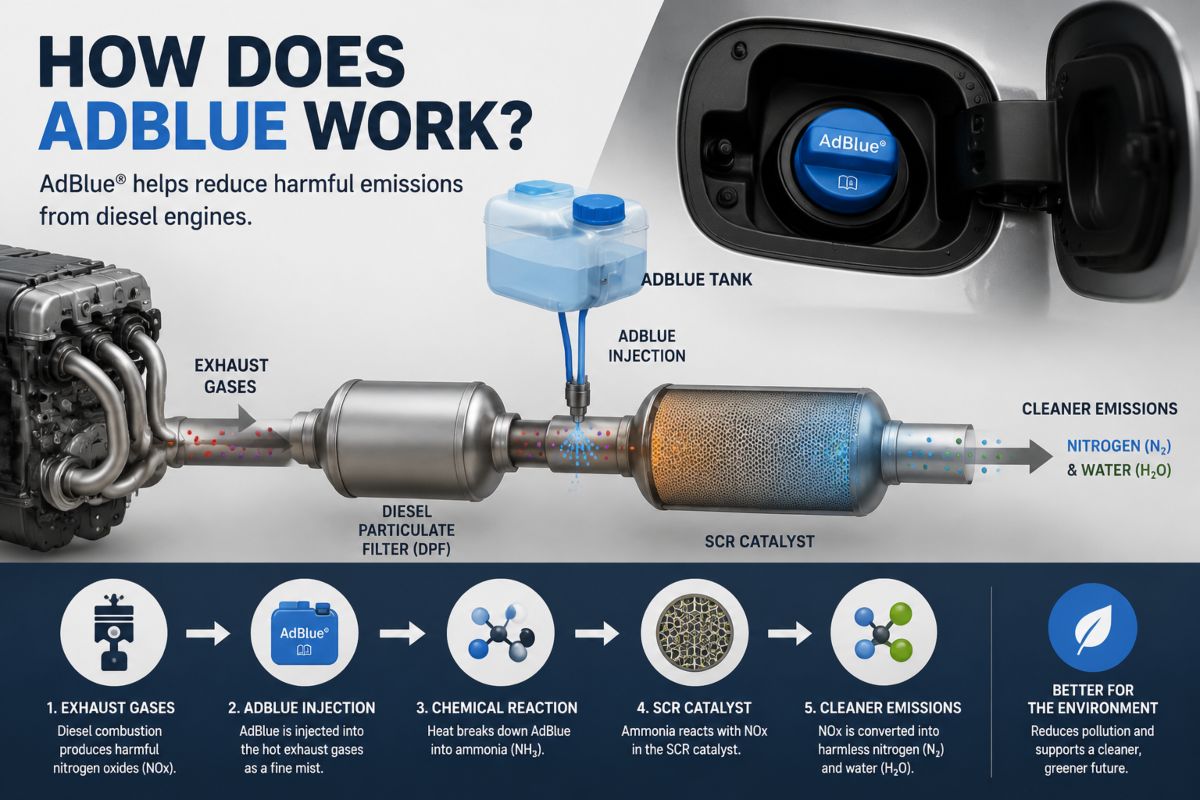
AdBlue works by being injected into the hot exhaust gases of an SCR-equipped diesel vehicle. Heat converts the urea solution so that it ultimately produces ammonia, which reacts with harmful nitrogen oxides (NOx) inside the SCR catalyst. This process converts much of the NOx into nitrogen and water, helping the vehicle reduce harmful exhaust emissions.
Modern diesel vehicles are designed to produce fewer harmful exhaust emissions than older models. One of the technologies that helps achieve this is Selective Catalytic Reduction (SCR), which works alongside a fluid known as AdBlue.
If you drive a newer diesel car, van, lorry or commercial vehicle, you may already be familiar with the blue AdBlue filler cap or dashboard warnings telling you when the fluid is running low. But how does AdBlue work, what is actually inside it, and what happens if you run out?
AdBlue is not a fuel or fuel additive. It is a separate fluid used within an SCR exhaust treatment system to help convert harmful nitrogen oxides (NOx) into less harmful substances before exhaust gases leave the vehicle. Understanding how the system operates can help you maintain your diesel vehicle correctly and avoid preventable warning lights or starting problems.
What Is AdBlue?
AdBlue is a clear, non-toxic solution consisting of 32.5% high-purity urea and 67.5% demineralised water. In Europe, products sold as AdBlue should meet the relevant ISO 22241 specification.
Although urea is one of its main ingredients, automotive-grade AdBlue is manufactured to strict purity requirements. It should therefore not be replaced with homemade mixtures, agricultural urea solutions or ordinary water.
The fluid is stored in a dedicated AdBlue tank, completely separate from the diesel fuel tank.
During operation, a controlled quantity is injected into the hot exhaust gases before they pass through the vehicle’s SCR catalyst. This starts a chemical process that helps reduce NOx emissions.
How Does AdBlue Work?
The easiest way to understand how AdBlue works is to follow what happens after fuel is burned inside the diesel engine.
Diesel combustion produces several exhaust gases, including nitrogen oxides. NOx emissions are associated with air pollution and can have harmful effects on human health and the environment.
An SCR-equipped vehicle uses AdBlue to treat these gases after combustion.
The basic process works like this:
- Diesel burns inside the engine and produces exhaust gases.
- Exhaust gases travel through the exhaust treatment system.
- The vehicle’s control system determines how much AdBlue is required.
- AdBlue is injected into the hot exhaust stream.
- Heat causes the AdBlue solution to decompose and ultimately produce ammonia.
- Exhaust gases and ammonia enter the SCR catalyst.
- Chemical reactions within the catalyst convert much of the NOx into nitrogen and water vapour.
This happens automatically while you drive. You do not manually activate the system or mix AdBlue with diesel.
Why Do Diesel Vehicles Need AdBlue?
Diesel engines offer advantages such as fuel efficiency and strong torque, which is why they remain common in commercial vehicles, vans, agricultural machinery and some passenger cars.
However, diesel combustion can generate substantial quantities of nitrogen oxides.
Increasingly strict vehicle emission standards have required manufacturers to develop technologies capable of reducing these pollutants. SCR has become one of the most widely adopted methods for controlling NOx emissions from diesel engines.
AdBlue enables the SCR system to perform this function effectively.
Not every diesel vehicle requires AdBlue. It is mainly associated with diesel vehicles equipped with an SCR system. If you are uncertain, check your owner’s manual rather than assuming your vehicle needs it.
What Is an SCR System?
SCR stands for Selective Catalytic Reduction.
It is an exhaust after-treatment technology rather than a component involved directly in burning diesel inside the engine. Its purpose is to treat nitrogen oxides after they have been produced.
An SCR system can include several interconnected components, such as:
- A dedicated AdBlue storage tank
- A dosing or injection system
- Temperature and NOx sensors
- An SCR catalyst
- Electronic control components
- Heated lines or related equipment on some vehicles
The exact arrangement differs between manufacturers and vehicle types.
Sensors continuously provide information to the vehicle’s electronic control system. The system can then adjust AdBlue dosing according to operating conditions.
What Happens to AdBlue in the Exhaust?
Once injected into the hot exhaust stream, AdBlue does not simply wash pollutants out of the exhaust.
Instead, heat causes a series of reactions. The water in the solution evaporates, while the urea breaks down and ultimately produces ammonia.
The ammonia then reacts with nitrogen oxides when the gases pass through the SCR catalyst. These reactions convert NOx primarily into nitrogen and water.
Nitrogen is already the largest component of the air around us, while water leaves the exhaust primarily as vapour.
This chemical conversion is what makes AdBlue useful for reducing harmful NOx emissions.
Does AdBlue Go into the Diesel Tank?
No. AdBlue must never be poured into the diesel fuel tank.
Your vehicle has a separate tank specifically for AdBlue. Depending on the vehicle, its filler may be located:
- Beside the diesel filler
- Under the bonnet
- Inside the boot or luggage area
- Elsewhere on a commercial vehicle
The filler cap is often blue, although you should always verify the correct filling point rather than relying entirely on colour.
Putting AdBlue into a diesel tank can potentially damage the fuel system. Likewise, diesel should never be added to an AdBlue tank.
If either fluid is accidentally put into the wrong tank, do not start the engine. Seek professional assistance.
How Often Does a Vehicle Need AdBlue?
There is no single refill interval that applies to every diesel vehicle.
AdBlue consumption varies according to factors such as:
- Vehicle type and engine
- Distance travelled
- Driving conditions
- Vehicle load
- Manufacturer calibration
- Exhaust temperature
- Driving style
A passenger car may travel a considerable distance between refills, whereas a heavily used commercial vehicle may consume AdBlue much more quickly.
The most reliable approach is to monitor your vehicle’s AdBlue level or dashboard notifications and follow the manufacturer’s guidance.
How Do You Know When AdBlue Is Running Low?
Most SCR-equipped vehicles monitor the quantity of AdBlue remaining in the tank.
When the level becomes low, a warning usually appears on the dashboard. Some vehicles provide an estimated remaining range or progressively stronger warnings as the level falls.
Do not ignore these messages.
Emission regulations mean many vehicles are designed so that, once the AdBlue tank becomes completely empty, the engine may not restart after it has been switched off.
The exact behaviour depends on the manufacturer and vehicle, so consult your owner’s manual for specific information.
What Happens If You Run Out of AdBlue?
If your AdBlue level becomes very low, the vehicle should normally provide advance warnings.
If you continue driving until the tank is empty, the consequences depend on the vehicle’s design. In many cases, the vehicle can restrict performance or prevent the engine from restarting once it has been switched off.
This does not necessarily mean the engine itself has failed. It is part of the vehicle’s emissions-control strategy.
Refilling with the appropriate quantity of compliant AdBlue will usually allow the system to recognise that fluid has been added, although some vehicles may require a particular procedure before the warning clears.
Following your vehicle manufacturer’s instructions is important.
Can You Drive Without AdBlue?
You should not deliberately operate an SCR-equipped vehicle without AdBlue.
Apart from the possibility of restart restrictions, the SCR system relies on the fluid to control NOx emissions properly.
Attempting to disable or bypass an emissions-control system can also create legal and compliance problems.
Keeping the AdBlue tank appropriately filled is therefore part of normal maintenance for an SCR-equipped diesel vehicle.
How Do You Refill AdBlue?
Refilling is usually straightforward, but you should first identify the correct filler.
Park safely, switch off the engine and follow the instructions in your owner’s manual. Open the designated AdBlue filler and use a suitable container, nozzle or dispensing system to add the fluid without contaminating it.
Avoid overfilling and clean up small spills according to the manufacturer’s recommendations.
For businesses operating multiple diesel vehicles or machinery, reliable AdBlue Suppliers can help maintain an appropriate supply based on fleet consumption and storage requirements.
How Much AdBlue Should You Add?
This depends entirely on your vehicle and the size of its AdBlue tank.
Some passenger vehicles have relatively modest tanks, whereas HGVs and other commercial equipment can require much greater quantities.
When a dashboard warning appears, the vehicle may specify a minimum refill quantity. Adding only a very small amount may sometimes be insufficient for the system to register the refill immediately.
Check the owner’s manual for the correct tank capacity and recommended refill quantity.
Is AdBlue the Same as Diesel?
No. They perform completely different jobs.
Diesel is a fuel. It enters the engine, where combustion releases energy that powers the vehicle.
AdBlue does not power the engine. It is used downstream in the exhaust after-treatment system to reduce NOx emissions.
The two liquids are stored separately and must never be mixed.
Is AdBlue a Fuel Additive?
No.
This is another common misunderstanding. A conventional fuel additive is normally mixed directly with fuel. AdBlue does not belong in the diesel tank at all.
It is better described as a diesel exhaust fluid used by an SCR emissions-control system.
Its role begins after combustion, when exhaust gases are travelling through the vehicle’s exhaust treatment system.
Does AdBlue Improve Fuel Economy?
AdBlue itself is not designed as a fuel-saving product.
Its main purpose is to help reduce nitrogen oxide emissions.
SCR technology can allow engine manufacturers to optimise combustion while controlling NOx downstream, but this does not mean adding extra AdBlue will improve fuel economy.
The vehicle controls how much fluid is injected. Adding more to the storage tank simply provides a larger available supply; it does not cause the engine to use additional AdBlue unnecessarily.
Can All Diesel Vehicles Use AdBlue?
No.
Only vehicles designed with a compatible SCR system should use AdBlue. Older diesel vehicles may use different emissions-control technologies and may have no AdBlue tank at all.
Never try to introduce AdBlue into a vehicle simply because it has a diesel engine.
Check the vehicle handbook, filler arrangement or manufacturer’s specifications if you are uncertain.
Does AdBlue Freeze?
Yes. AdBlue freezes at approximately -11°C.
This does not normally mean that the product becomes permanently unusable. Correctly manufactured AdBlue can generally be used after thawing, provided it has not become contaminated or degraded.
Vehicles designed to operate with AdBlue in cold conditions can incorporate heating systems to allow the SCR system to function appropriately as the vehicle warms.
Never try to change the freezing point by adding antifreeze or other chemicals. Doing so can contaminate the fluid and potentially damage the SCR system.
Can AdBlue Go Off?
AdBlue does have a limited storage life, and poor storage conditions can affect its quality.
High temperatures and prolonged exposure to direct sunlight can accelerate degradation. Contamination is another significant issue because the SCR system relies on a highly pure solution.
AdBlue should therefore be stored:
- In a suitable sealed container
- Away from direct sunlight
- Within appropriate temperature conditions
- Away from incompatible materials
- Where dirt, fuel and water cannot contaminate it
Always follow the storage recommendations supplied with the product.
What Happens If AdBlue Becomes Contaminated?
Contamination can interfere with the operation of an SCR system.
Even substances that appear harmless can alter the required composition or introduce impurities. Ordinary tap water, for example, contains minerals and should not be used to dilute AdBlue.
Likewise, never mix it with diesel, oil, antifreeze or other automotive fluids.
If you suspect the wrong liquid has entered the AdBlue tank, avoid attempting DIY remedies. Professional inspection may be required before operating the vehicle.
Why Does AdBlue Sometimes Leave White Crystals?
You may notice white deposits around the filler area after a small spill dries.
AdBlue can crystallise as its water content evaporates, leaving urea-based deposits behind. Small spills should be dealt with according to the vehicle or product manufacturer’s instructions.
Avoid allowing repeated spills to accumulate around components.
When refilling, pouring carefully or using an appropriate nozzle can help minimise mess.
Is AdBlue Dangerous?
AdBlue is not classed in the same way as highly flammable automotive fuels such as petrol. However, sensible handling practices are still important.
Avoid unnecessary contact with your skin and eyes, and wash affected areas if accidental contact occurs. Spillages should also be cleaned rather than simply ignored.
It can be corrosive to certain materials, which is another reason to use suitable containers and dispensing equipment.
Always follow the safety information supplied with the product.
Does AdBlue Reduce All Diesel Emissions?
No. Its main role is specifically related to nitrogen oxide reduction within the SCR system.
Modern diesel vehicles can use several emissions-control technologies simultaneously. For example, a diesel particulate filter (DPF) primarily deals with particulate matter or soot, whereas SCR and AdBlue focus on NOx.
Other components may manage additional pollutants.
It is therefore incorrect to think of AdBlue as a single fluid that cleans every type of diesel emission.
AdBlue vs DPF: What’s the Difference?
AdBlue and a diesel particulate filter perform different jobs.
A DPF traps particulate matter from diesel exhaust. Over time, accumulated soot needs to be burned off through a process known as regeneration.
An SCR system using AdBlue targets nitrogen oxides through chemical reactions inside the catalyst.
Many modern diesel vehicles contain both systems because they address different pollutants.
A DPF warning light therefore does not automatically indicate an AdBlue problem, and an AdBlue warning does not necessarily mean something is wrong with the DPF.
Why Might an AdBlue Warning Stay on After Refilling?
Sometimes a warning does not disappear immediately after fluid has been added.
Possible reasons include adding less than the minimum quantity recognised by the vehicle, a delay while sensors detect the new level, poor-quality or contaminated fluid, or a fault somewhere within the SCR system.
If the correct quantity of compliant AdBlue has been added and the warning remains, consult the owner’s manual.
Persistent warnings may require professional diagnostics rather than repeatedly adding more fluid.
Is Cheap AdBlue Safe to Use?
Price alone does not determine whether a product is suitable.
What matters is whether the AdBlue meets the required quality specification, particularly ISO 22241, and has been stored and handled correctly.
Using an unknown or contaminated substitute simply to save money can prove expensive if it damages pumps, injectors, sensors or catalyst components.
Buy the correct product from a reputable source and keep dispensing equipment clean.
Why AdBlue Quality Matters for Commercial Fleets
For a business operating several diesel vehicles, AdBlue is more than an occasional top-up.
Running out can disrupt vehicle availability, while contaminated or incorrectly stored fluid can create maintenance problems. Fleet operators should therefore monitor consumption, maintain suitable stock and establish appropriate storage procedures.
Businesses with regular requirements may choose bulk or scheduled supply arrangements. 123 Oil can support organisations that require dependable access to products used across diesel fleets and commercial operations.
The important point is to match supply and storage arrangements to actual consumption rather than keeping excessive quantities for unnecessarily long periods.
How Can You Use AdBlue More Effectively?
There is no need to alter you’re driving dramatically simply to make AdBlue work. The vehicle manages dosing automatically.
Good practice is largely about maintenance.
Keep an eye on dashboard warnings, refill before the tank becomes empty, use compliant fluid and prevent contamination. If your vehicle develops recurring SCR or AdBlue warnings, have the underlying issue diagnosed rather than simply clearing the warning.
It is also worth checking AdBlue levels before a long journey, especially if a low-level notification has already appeared.
Final Thoughts
So, how does AdBlue work? It works alongside an SCR system to reduce nitrogen oxide emissions produced by diesel combustion. The vehicle injects a carefully controlled quantity of AdBlue into the hot exhaust stream, where the urea-based solution ultimately produces ammonia. Inside the SCR catalyst, this reacts with NOx and converts much of it into nitrogen and water.
The process happens automatically, but drivers still have an important role. The AdBlue tank must be kept adequately filled, the correct product must be used, and contamination should be avoided.
Remember that AdBlue is neither diesel nor a conventional fuel additive. Never put it into your fuel tank. Treating it as a separate but essential part of an SCR-equipped diesel vehicle will help keep the emissions-control system working as intended.
Frequently Asked Questions
AdBlue does not work inside the engine itself. It is injected into the exhaust system, where it helps the SCR catalyst convert nitrogen oxides into primarily nitrogen and water.
Your vehicle should warn you before the tank becomes empty. Many SCR-equipped vehicles may prevent the engine from restarting after it has been switched off if there is insufficient AdBlue.
There is no universal interval. Consumption depends on the vehicle, mileage, load and operating conditions. Follow dashboard warnings and the refill guidance in your owner's manual.
No. Water does not meet the required AdBlue composition and can interfere with the SCR system. Only use compliant AdBlue that meets the appropriate specification.
No. AdBlue is primarily used by the SCR system to reduce nitrogen oxides. A DPF deals with particulate matter and uses a separate regeneration process.
An SCR-equipped vehicle requires AdBlue for its emissions-control system. If the tank becomes empty, the vehicle may introduce warnings or restrictions and may eventually prevent an engine restart.
The vehicle may require a minimum refill quantity or some time to register the new level. If the warning persists after a correct refill, there could be a sensor, dosing or SCR system fault.