


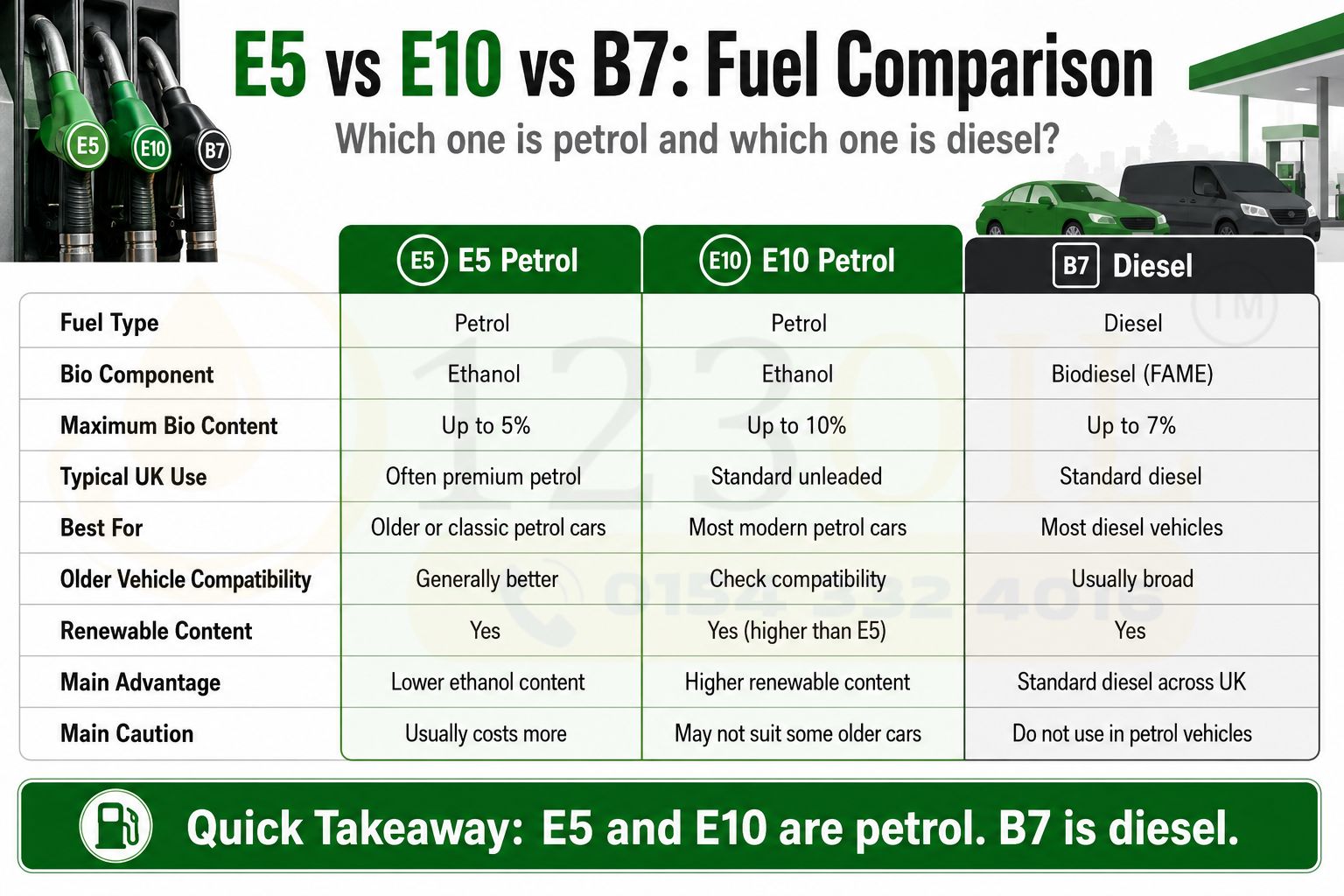
E5 and E10 are petrol fuels, not diesel. The “E” stands for ethanol. E5 petrol contains up to 5% ethanol, while E10 can contain up to 10% ethanol. Diesel uses different fuel labels, such as B7, where the “B” refers to biodiesel content. Most modern petrol vehicles can use E10, while some older or classic vehicles may require E5.
Seeing E5 and E10 labels at a filling station can be confusing, especially if you are used to thinking about fuel simply as petrol or diesel. The letters and numbers look technical, but the system is actually quite straightforward once you know what they represent.
The distinction matters because ethanol content can affect vehicle compatibility, fuel economy, storage and the way older fuel-system components behave. For most modern petrol cars in the UK, E10 is perfectly suitable. However, some older vehicles, classic cars and specialist engines may still require E5.
This guide explains the difference between E5 and E10, how they compare with diesel, which vehicles can use them, their benefits and disadvantages, storage considerations and how to avoid filling your vehicle with the wrong fuel.
Understanding the E5 and E10 Labels
Fuel labels are designed to tell drivers what proportion of renewable biofuel may be present.
With petrol:
- E5 means up to 5% ethanol.
- E10 means up to 10% ethanol.
- The remaining proportion is mainly petrol derived from conventional refining components and other permitted blend stocks.
The “E” therefore has nothing to do with engine type, emissions class or octane rating.
It simply refers to ethanol.
This is important because some people assume E10 is a type of diesel simply because it is displayed alongside diesel pumps at filling stations.
It is not.
Diesel has its own labelling system.
What Is Ethanol in Petrol?
Ethanol is an alcohol-based fuel that can be produced from renewable biological materials.
Depending on the production system, ethanol may be made from materials such as:
- Wheat
- Maize
- Sugar crops
- Agricultural feedstocks
- Certain waste-derived materials
When ethanol is blended into petrol, it reduces the amount of purely fossil-derived petrol required in each litre.
The idea is to introduce a renewable component into everyday road fuel without forcing the entire vehicle fleet to switch immediately to an entirely different energy source.
Ethanol also has useful combustion characteristics, including a relatively high-octane rating.
However, it has different chemical and physical properties from conventional petrol, which is why vehicle compatibility and storage conditions matter.
E5 Petrol Explained
E5 petrol can contain up to 5% ethanol.
In Britain, E5 is commonly associated with premium-grade unleaded petrol because standard 95-octane petrol has largely moved to E10.
However, not every premium fuel should automatically be assumed to be E5. Drivers should always check the pump label.
E5 remains particularly useful for:
- Older petrol vehicles
- Some classic cars
- Certain motorcycles
- Specialist engines
- Vehicles not approved for E10
- Equipment requiring lower ethanol content
Because it contains less ethanol, E5 may also be preferred in some situations involving longer-term storage.
E10 Petrol Explained
E10 contains up to 10% ethanol.
It became the standard 95-octane petrol grade across much of the UK as part of efforts to reduce transport-related greenhouse gas emissions.
For most modern petrol cars, E10 is now the normal everyday fuel.
The majority of vehicles manufactured in recent years are designed to use it without difficulty.
Its main advantage is that a larger renewable component replaces some fossil petrol.
However, because ethanol has a lower energy content per litre than petrol, E10 can sometimes produce slightly lower fuel economy compared with a lower-ethanol blend.
The difference is usually modest rather than dramatic.
E5 vs E10 Petrol Comparison
Feature | E5 Petrol | E10 Petrol |
Fuel type | Petrol | Petrol |
Maximum ethanol content | 5% | 10% |
Renewable content | Lower | Higher |
Common UK availability | Often premium grade | Standard 95 RON petrol |
Modern vehicle compatibility | Very high | Very high |
Older vehicle compatibility | Generally better | Must be checked |
Classic-car suitability | Often preferred | May be unsuitable |
Energy content | Slightly higher | Slightly lower |
Storage sensitivity | Lower than E10 | Greater moisture sensitivity |
Typical price | Often higher | Usually, lower |
Main benefit | Broad compatibility | Higher renewable content |
Main drawback | More expensive in many cases | Not suitable for every older vehicle |
E5 and E10 vs Diesel
Petrol and diesel are fundamentally different fuels.
The E5 and E10 labels apply to petrol.
Diesel normally uses labels beginning with “B”.
For example:
B7 diesel can contain up to 7% biodiesel, generally FAME.
A basic comparison looks like this:
Fuel | Main Engine Type | Renewable Component |
E5 | Petrol engine | Up to 5% ethanol |
E10 | Petrol engine | Up to 10% ethanol |
B7 | Diesel engine | Up to 7% biodiesel |
HVO | Compatible diesel engines | Renewable paraffinic diesel |
This labelling distinction can make the pump much easier to understand.
E = ethanol petrol blend
B = biodiesel blend
Main Benefits of E10 Petrol
Higher Renewable Content
The most obvious difference between E10 and E5 is the amount of ethanol that can be included.
E10 can contain twice the maximum ethanol percentage of E5.
This means less purely fossil-derived petrol is required in each litre.
Suitable for Most Modern Petrol Cars
Most relatively modern petrol vehicles are designed to run on E10.
For ordinary drivers with compatible cars, no mechanical conversion is normally needed.
Widely Available
E10 has become the standard petrol option at filling stations throughout the UK.
This makes it easy to obtain for drivers travelling around the country.
Supports Transport Decarbonisation
Replacing part of fossil petrol with renewable ethanol can help reduce lifecycle greenhouse gas emissions, depending on how the ethanol was produced.
It is not a zero-carbon fuel, but it can reduce dependence on purely fossil petrol.
Disadvantages of E10 Petrol
E10 also has some limitations.
Not Compatible with Every Vehicle
Some older cars were manufactured before higher ethanol blends became commonplace.
Certain fuel-system materials may not be fully compatible.
Slightly Lower Energy Content
Ethanol contains less energy per litre than conventional petrol.
As a result, fuel economy with E10 can be slightly lower than with E5.
For most drivers, the difference is relatively small.
Greater Moisture Attraction
Ethanol is hygroscopic, meaning it can absorb moisture from the surrounding environment.
This becomes more relevant when fuel is stored for long periods rather than regularly consumed.
Storage Can Be More Sensitive
Fuel containing higher amounts of ethanol generally requires more careful management during long-term storage.
This is especially relevant for classic cars, garden machinery, boats and seasonal equipment.
Benefits of E5 Petrol
E5 still serves an important purpose despite E10 becoming the mainstream choice.
Better Compatibility with Older Cars
Vehicles manufactured before E10 compatibility became widespread may operate more safely on E5.
Lower Ethanol Content
A smaller ethanol percentage can reduce concerns relating to moisture absorption and compatibility with certain older seals, hoses and fuel-system materials.
Useful for Classic Vehicles
Classic-car owners frequently prefer fuels with lower ethanol content were permitted by the vehicle’s requirements.
Potentially Slightly Better Fuel Economy
Because E5 generally contains less ethanol, it may have a marginally higher energy content per litre.
However, the difference will depend on the actual blend and driving conditions.
Disadvantages of E5 Petrol
Usually More Expensive
In the UK, E5 is often sold as a premium petrol grade.
This means the pump price can be noticeably higher than standard E10.
Lower Renewable Content
Compared with E10, E5 contains less renewable ethanol.
Less Common as Standard Petrol
E10 has become the mainstream 95 RON petrol option, so E5 may not be available from every pump or every station.
Which Vehicles Can Use E10?
Most modern petrol-powered cars can use E10 without problems.
Vehicles manufactured from roughly the 2010s onwards are generally very likely to be compatible, although drivers should not rely on age alone.
Compatibility can depend on:
- Manufacturer
- Model
- Engine
- Production year
- Fuel-system design
The safest approach is to check the owner’s handbook or manufacturer guidance.
If you are uncertain about a particular older vehicle, use an official compatibility checker or contact the manufacturer.
Cars That May Need E5
Some vehicles deserve extra attention before switching to E10.
These can include:
- Classic cars
- Older petrol vehicles
- Certain performance cars
- Some motorcycles
- Specialist vehicles
- Older fuel-injected models
- Vehicles with sensitive seals or hoses
This does not mean every old petrol car will immediately fail on E10.
Compatibility is specific to the vehicle.
The sensible approach is to check rather than guess.
Why Older Cars Can Have Problems with E10
Higher ethanol concentrations can affect some older fuel-system materials.
Possible concerns may include:
- Rubber seals
- Fuel hoses
- Certain plastics
- Gaskets
- Metal components
- Carburettor parts
Ethanol’s ability to attract moisture can also contribute to corrosion in poorly maintained fuel systems.
Modern vehicles use materials specifically designed to tolerate ethanol blends.
Some older vehicles were engineered when higher ethanol concentrations were not expected.
Does E10 Reduce Fuel Economy?
Potentially, slightly.
Ethanol contains less energy per litre than petrol.
Increasing the ethanol content therefore slightly reduces the overall energy density of the finished fuel.
In real-world driving, the difference between E5 and E10 is usually relatively small and can easily be overshadowed by:
- Traffic conditions
- Driving speed
- Tyre pressure
- Vehicle load
- Weather
- Air-conditioning use
- Engine condition
- Driving style
For most everyday motorists, driving behaviour will have a much greater impact on fuel consumption than the change from E5 to E10.
Octane Rating and Ethanol Content Are Different Things
This is another area where confusion happens.
E5 and E10 describe ethanol percentage.
They do not directly describe octane rating.
For example, a petrol station may offer:
95 RON E10
and:
97, 98 or 99 RON E5 premium petrol
The RON figure describes the fuel’s resistance to knocking.
The E figure describes ethanol content.
A higher number after the E does not mean higher octane.
E5, E10 and Premium Petrol
Premium petrol is normally marketed according to its higher-octane rating and additive package.
It may contain:
- Detergent additives
- Friction modifiers
- Deposit-control additives
- Higher-octane blend components
Premium fuel can be E5, but the exact labelling should always be checked.
Drivers should not buy premium petrol simply because they assume E5 is automatically “better”.
If the vehicle is fully compatible with E10 and designed for ordinary 95 RON fuel, standard E10 is normally appropriate.
Premium fuel is more relevant where the manufacturer recommends or requires higher-octane petrol.
E10 Petrol and Engine Performance
For an E10-compatible car, the fuel should not normally cause noticeable performance problems.
The engine-management system is designed to operate with the fuel specification permitted in the market.
Performance issues after refuelling are more likely to be caused by other factors such as:
- Poor-quality fuel
- Ignition problems
- Injector faults
- Sensor issues
- Fuel contamination
- Maintenance problems
E10 should not automatically be blamed simply because it contains ethanol.
E5 and E10 Fuel Storage
Storage is where ethanol content deserves additional consideration.
Vehicles used every day generally consume their petrol long before storage becomes a serious issue.
The situation is different for:
- Classic cars
- Lawn equipment
- Seasonal machinery
- Backup equipment
- Boats
- Motorcycles stored over winter
Keep Containers Sealed
Minimise contact with humid air wherever possible.
Use Approved Fuel Containers
Ordinary household containers are not suitable for petrol storage.
Avoid Excessive Storage Time
Petrol can degrade during prolonged storage.
Protect Fuel from Heat
Store approved containers in appropriate conditions and follow all relevant safety requirements.
Consider Lower-Ethanol Fuel for Suitable Older Equipment
Where manufacturer guidance allows or recommends it, E5 may be preferable for certain older engines and storage situations.
What Happens If You Put E10 in an E5-Only Car?
A single accidental fill does not necessarily mean catastrophic engine failure.
However, continued use of E10 in a vehicle that is not approved for it may increase the risk of fuel-system compatibility problems.
If you accidentally fill an incompatible vehicle with E10:
- Avoid unnecessary driving.
- Check manufacturer guidance.
- Top up with suitable E5 if advised.
- Contact a garage if uncertain.
- Monitor for fuel-system problems.
Do not panic and start dismantling the car in the petrol station car park. That would be a fairly impressive overreaction.
What Happens If You Put E5 in an E10-Compatible Car?
Generally, nothing problematic.
A petrol vehicle compatible with E10 can normally also use E5.
The main difference may simply be price and ethanol content.
Some drivers intentionally use premium E5 because their car requires a higher-octane rating.
What Happens If You Put Petrol in a Diesel Car?
This is much more serious.
E5 and E10 are both petrol.
Neither should be put into a diesel vehicle.
Petrol does not provide the same lubricating properties as diesel, and it can potentially damage diesel fuel pumps and injection components.
If petrol has been added to a diesel vehicle:
Do not start the engine.
If possible, avoid even switching on the ignition because some vehicles may activate fuel pumps.
Arrange professional fuel drainage.
What Happens If Diesel Goes into a Petrol Car?
Diesel contamination of a petrol vehicle also creates problems.
The engine may:
- Misfire
- Produce smoke
- Run poorly
- Fail to start
- Stall
Again, avoiding engine operation after misfuelling can significantly reduce the amount of contaminated fuel circulated through the system.
E5 and E10 for Commercial Fleets
Fleet operators should maintain clear fuel policies, particularly when operating a mixed fleet containing both petrol and diesel vehicles.
Driver training and accurate fuel cards can reduce misfuelling incidents.
Companies using Nationwide Fuel Delivery Services should specify fuel type, quantity and required grade accurately when arranging bulk or site deliveries, especially where several fuels are stored at the same location.
Clear tank labelling is equally important.
E5 and E10 Are Not Red Diesel
Red diesel is completely different.
Red diesel is a gas oil containing a fiscal marker and dye, intended for legally permitted off-road or specialist uses.
It is diesel fuel, not petrol.
E5 and E10 should therefore never be confused with red diesel.
Businesses searching for Emergency Red Diesel Suppliers should ensure the fuel is required for an eligible application and that the correct diesel storage equipment is being used.
E5, E10 and B7 Comparison
Feature | E5 | E10 | B7 |
Fuel type | Petrol | Petrol | Diesel |
Bio component | Ethanol | Ethanol | FAME biodiesel |
Maximum bio content | 5% | 10% | 7% |
Typical engine | Petrol | Petrol | Diesel |
UK availability | Common premium grade | Standard petrol | Standard diesel |
Older vehicle compatibility | Generally better | Must be checked | Usually, broad |
Renewable component | Yes | Yes | Yes |
Misfuelling risk | Never use in diesel | Never use in diesel | Never use in petrol |
This simple table is probably the quickest way to remember the differences.
Choosing Between E5 and E10
The decision should begin with vehicle compatibility.
Choose E10 When:
- Your vehicle is approved for E10.
- You use standard 95 RON petrol.
- You want the mainstream UK petrol grade.
- The car is used regularly.
- The manufacturer does not require premium petrol.
Consider E5 When:
- Your vehicle is not E10-compatible.
- You own an older or classic vehicle.
- The manufacturer requires higher-octane premium petrol.
- You operate specialist equipment requiring lower ethanol content.
- Storage characteristics are particularly important.
Do not choose purely according to the number on the pump.
The correct fuel is the one that meets the vehicle manufacturer’s specification.
Common Myths About E5 and E10
“E10 Is Diesel”
No. E10 is petrol containing up to 10% ethanol.
“E5 Means Five-Octane Petrol”
No. The number refers to ethanol percentage, not octane rating.
“E10 Damages Every Older Car”
Not every older vehicle is incompatible.
Compatibility needs to be checked by make, model and engine.
“Premium Petrol Is Always E5”
Often, but not necessarily.
Always read the pump label.
“E10 Gives Terrible Fuel Economy”
The difference is usually small.
Driving style and vehicle condition have a much larger effect.
Fuel Buying Tips for Businesses
Businesses storing or purchasing petrol should take a systematic approach.
Consider:
- Required fuel grade
- Ethanol content
- Engine compatibility
- Storage duration
- Tank condition
- Fuel turnover
- Delivery quantity
- Safety procedures
- Supplier reliability
Companies managing multiple fuels should use clearly labelled tanks and dedicated dispensing equipment.
A supplier such as 123 Oil can support commercial fuel requirements where businesses need planned deliveries for vehicles, machinery or operational sites.
Pros and Cons of E5 and E10
E5 Advantages
- Better compatibility with some older vehicles
- Lower ethanol content
- Often available in higher-octane grades
- Useful for certain classic vehicles
- Potentially slightly higher energy content
E5 Disadvantages
- Usually more expensive
- Lower renewable content
- Less widely available as standard-grade petrol
E10 Advantages
- Higher renewable ethanol proportion
- Widely available
- Suitable for most modern petrol vehicles
- Usually less expensive than premium E5
- Standard UK petrol grade
E10 Disadvantages
- Unsuitable for some older vehicles
- Slightly lower energy density
- Greater moisture sensitivity
- Requires more consideration during long-term storage
Final Thoughts
So, is E5 or E10 petrol or diesel?
Both are petrol.
The E stands for ethanol, while the number represents the maximum proportion of ethanol that may be blended into the fuel.
E5 contains up to 5% ethanol.
E10 contains up to 10%.
Diesel uses a completely different labelling system, with B7 being the most familiar standard diesel designation in the UK.
For most modern petrol cars, E10 is the everyday choice. It is widely available, suitable for the majority of vehicles and contains a larger renewable component than E5.
E5 remains important for certain older cars, classic vehicles, specialist engines and drivers requiring premium high-octane fuel.
The easiest way to avoid problems is simple: check the vehicle handbook, read the pump label and never assume that all fuels with similar-looking codes belong to the same category.
Most importantly, remember:
E5 and E10 = petrol.
B7 = diesel.
That little distinction can save you from a very expensive afternoon at the fuel station.
Frequently Asked Questions
E10 is unleaded petrol containing up to 10% ethanol. It is not diesel and should never be put into a diesel vehicle.
Neither is automatically better. E10 has more renewable ethanol and is suitable for most modern petrol vehicles, while E5 is useful for some older cars and vehicles requiring premium petrol.
Yes, an E10-compatible petrol car can normally also use E5, provided the octane rating meets the manufacturer's requirements.
Check the owner's manual, fuel filler flap or manufacturer guidance. Older and classic vehicles should be checked carefully before switching to E10.
The E stands for ethanol. E5 can contain up to 5% ethanol, while E10 can contain up to 10%.
E10 is generally sold as standard 95 RON petrol and is often cheaper than premium E5. Actual prices vary by filling station, location and market conditions.
B7 is diesel. The B refers to biodiesel content, while E5 and E10 are petrol grades containing ethanol.