


Diesel is often more expensive than petrol because it costs more to refine, has higher demand from commercial industries, is affected by stricter fuel-quality requirements and is influenced by global supply and demand conditions. Diesel is heavily used by trucks, transport fleets, agriculture, construction equipment, generators and industrial operations, which can increase demand and affect pricing.
Fuel prices are something most drivers notice every time they visit a filling station. While petrol and diesel prices often move in the same direction, diesel frequently costs more than petrol, leaving many people wondering why this happens.
The question “why is diesel more expensive than gas?” is common among motorists, businesses, fleet operators and industries that rely heavily on diesel-powered vehicles and equipment.
The reason is not simply that diesel is a “better” fuel. Diesel pricing is influenced by several factors, including refining costs, demand, taxation, production processes, global oil markets, seasonal demand and the industries that depend on diesel.
Although diesel engines are generally more fuel-efficient than petrol engines, the fuel itself often carries a higher price per litre. Understanding these factors helps explain why diesel can cost more and why the price difference changes over time.
Diesel vs Gas: Understanding the Difference
Before looking at prices, it is important to understand the difference between diesel and petrol.
Diesel and petrol are both produced from crude oil, but they are different fuel types designed for different engines.
Petrol (Gasoline)
Petrol is used mainly in:
- Cars
- Motorcycles
- Small engines
- Some light commercial vehicles
Petrol engines use spark plugs to ignite the fuel-air mixture inside the combustion chamber.
Diesel
Diesel is mainly used in:
- HGVs
- Vans
- Buses
- Agricultural machinery
- Construction equipment
- Generators
- Industrial machinery
Diesel engines work through compression ignition, where air is compressed at high pressure and temperature before diesel fuel is injected.
Diesel engines are generally more efficient and provide higher torque, making them ideal for heavy loads and long-distance operation.
However, these differences also influence how diesel fuel is produced, distributed and priced.
The Main Reasons Diesel Costs More Than Petrol
There is no single reason diesel is more expensive.
Instead, several factors combine to create the price difference.
1. Diesel Requires More Complex Refining
One of the biggest reasons diesels often costs more is the refining process.
Crude oil contains many different hydrocarbons, and refineries must separate and process these components to create usable fuels.
Diesel requires specific refining processes to achieve the correct:
- Sulphur content
- Cetane rating
- Density
- Lubricity
- Cold-weather performance
- Emissions compliance
Modern diesel must meet strict quality standards because today’s diesel engines use advanced fuel systems and emissions technology.
Processes such as hydrodesulphurisation are used to remove sulphur and produce cleaner fuel.
These additional refining requirements can increase production costs compared with petrol.
2. Diesel Demand Is Extremely High
Diesel is not only used by private motorists.
A large proportion of diesel demand comes from commercial sectors.
Major diesel users include:
- Freight companies
- Delivery fleets
- Public transport
- Construction companies
- Farmers
- Manufacturers
- Warehousing businesses
- Emergency services
Heavy industries rely on diesel because it provides high energy density and strong performance under load.
For example, a delivery company operating hundreds of vans or lorries requires large quantities of diesel every day.
This constant commercial demand can place upward pressure on prices.
Businesses requiring reliable fuel supplies often rely on providers offering Nationwide Oil Delivery Services to maintain vehicle fleets, machinery and operational sites.
3. Diesel Has Higher Tax and Duty Considerations
Fuel taxation plays an important role in the final price drivers see at the pump.
The amount paid for diesel includes several elements:
- Wholesale fuel cost
- Fuel duty
- VAT
- Distribution costs
- Retail margins
Government fuel duty policies can influence diesel pricing significantly.
Because diesel is widely used by commercial operators, changes in fuel taxation can have a noticeable impact on transport and logistics costs.
4. Diesel Has Strong Industrial Demand
Diesel is not just a transport fuel.
Many industries depend on diesel-powered equipment.
Examples include:
- Construction machinery
- Backup generators
- Agricultural equipment
- Mining equipment
- Manufacturing machinery
- Heavy transport
Unlike petrol, which is mainly associated with passenger vehicles, diesel supports many essential commercial activities.
This broader industrial demand means diesel prices can react strongly when economic activity increases.
5. Global Oil Market Conditions Affect Diesel More
Diesel and petrol prices both depend on crude oil prices, but they can respond differently to market conditions.
Factors affecting diesel prices include:
- Global crude oil prices
- Refinery capacity
- International shipping costs
- Currency exchange rates
- Geopolitical events
- Seasonal demand
For example, during periods of increased freight activity or reduced refinery output, diesel prices may rise faster than petrol.
6. Winter Demand Can Increase Diesel Prices
Seasonal demand is another important factor.
During colder months, diesel demand often rises because similar middle-distillate fuels are also used for heating and industrial purposes.
Diesel belongs to a group of fuels known as middle distillates, which includes products such as heating oil and gas oil.
When demand increases for these products at the same time, prices can rise.
Industries that rely on Heating Oil for Industries may also experience market changes linked to wider middle-distillate supply conditions.
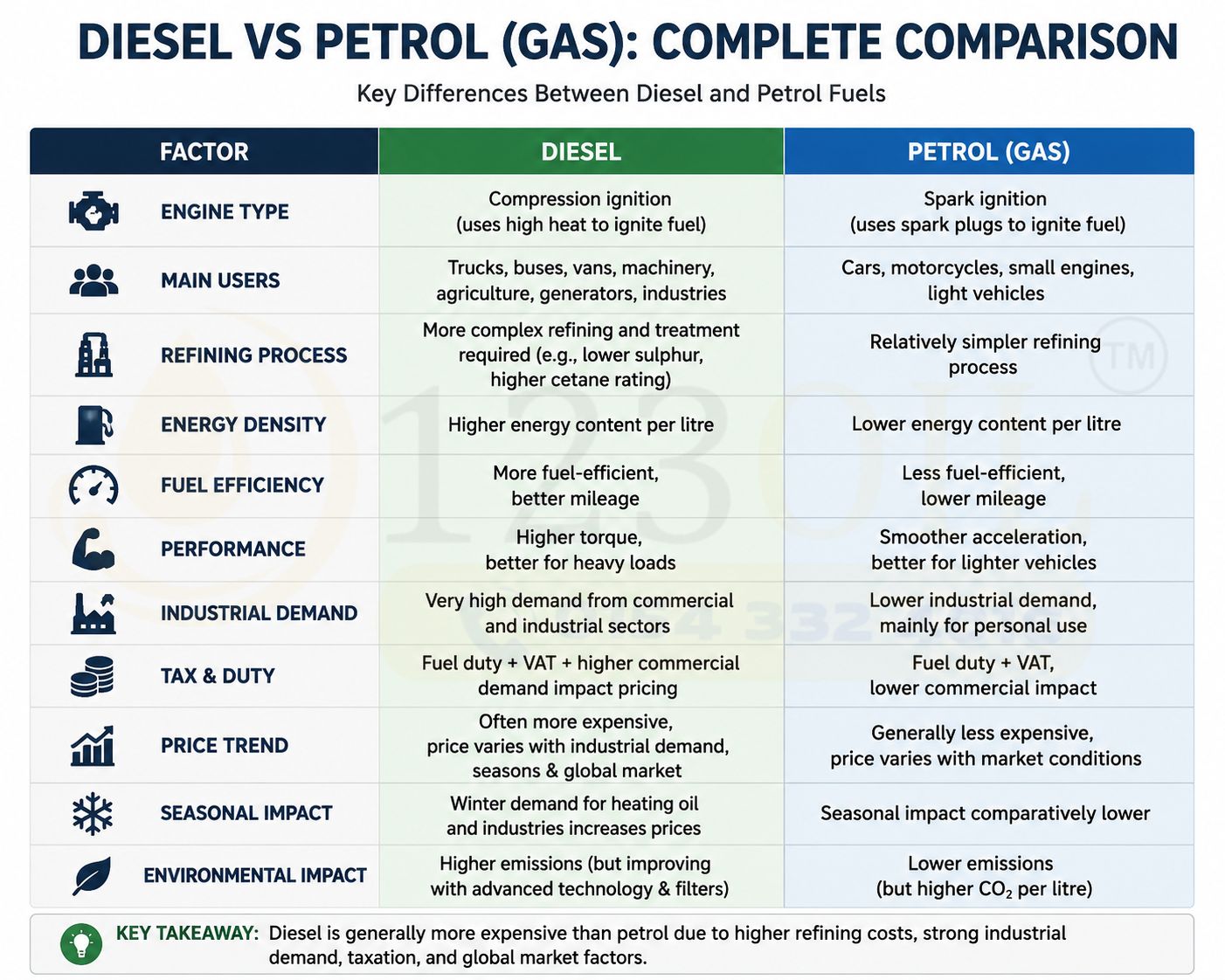
Diesel vs Petrol Price Comparison
Factor | Diesel | Petrol |
Engine type | Compression ignition | Spark ignition |
Main users | Commercial vehicles, trucks, machinery | Cars and motorcycles |
Fuel efficiency | Generally higher | Generally lower |
Refining complexity | Higher | Lower |
Industrial demand | Very high | Lower |
Energy density | Higher | Lower |
Typical fuel economy | Better | Lower |
Price volatility | Can be higher | Usually, different market pattern |
Heavy transport usage | Extensive | Limited |
Why Do Businesses Pay More for Diesel?
For businesses, diesel costs can have a much larger impact than for individual drivers.
Companies operating:
- Transport fleets
- Delivery vehicles
- Excavators
- Generators
- Agricultural equipment
may consume thousands of litres every month.
Even a small increase in price per litre can significantly affect operating expenses.
For this reason, commercial fuel buyers often focus on:
- Bulk purchasing
- Fuel efficiency
- Supplier reliability
- Storage management
- Delivery planning
Some businesses arrange scheduled deliveries rather than purchasing fuel only when tanks are nearly empty.
Why Diesel Is Still Popular Despite Higher Prices
Although diesel often costs more per litre, it remains extremely popular because of its efficiency.
Better Fuel Economy
Diesel engines typically use less fuel than equivalent petrol engines.
This means the total cost per mile can sometimes remain competitive despite the higher fuel price.
More Torque
Diesel engines produce strong pulling power at lower engine speeds.
This makes them ideal for:
- Trucks
- Vans
- Towing
- Heavy equipment
Long Engine Life
Many diesel engines are built for durability and heavy workloads.
This is why industries continue to rely on diesel technology.
Suitable for Long Distances
Commercial operators covering thousands of miles benefit from diesel’s efficiency and range.
Does Diesel Always Cost More Than Petrol?
No.
Although diesel is frequently more expensive, the difference changes constantly.
There are periods when:
- Diesel prices fall below petrol
- The price gap becomes very small
- Diesel rises significantly above petrol
The difference depends on:
- Refinery output
- Seasonal demand
- International markets
- Government policy
- Regional supply conditions
Fuel prices are not fixed and can change quickly.
Diesel Prices and Heating Oil Markets
Diesel and heating oil markets are closely connected because both belong to the middle-distillate fuel category.
This means factors affecting one market can influence the other.
For example:
- Cold winters increase heating demand
- Industrial activity increases fuel consumption
- Global supply shortages affect availability
Companies requiring Heating Oil Delivery Services must therefore monitor fuel markets carefully, especially during periods of high demand.
Diesel vs Red Diesel
Red diesel is another type of diesel fuel, but it is different from standard road diesel.
The difference is mainly related to:
- Tax treatment
- Approved uses
- Fuel marking requirements
Red diesel is commonly associated with eligible off-road applications such as certain machinery and equipment.
Businesses that require specialist fuel supplies often work with Red Diesel Suppliers to ensure they receive the correct fuel for their approved applications.
Using the wrong fuel type can lead to penalties and operational issues.
Why Diesel Is Important for Industries
Many industries simply cannot operate efficiently without diesel.
Examples include:
Construction
Heavy machinery such as excavators, cranes and loaders often relies on diesel because of its power output.
Agriculture
Tractors, harvesters and agricultural machinery require reliable fuel with high energy density.
Transport
HGVs and logistics companies depend heavily on diesel for long-distance operations.
Manufacturing
Factories often use diesel generators for backup power and equipment operation.
Emergency Services
Reliable diesel-powered backup systems are essential in many critical facilities.
How Businesses Can Reduce Diesel Costs
Although businesses cannot control global fuel markets, they can reduce overall fuel expenses.
Improve Vehicle Efficiency
Regular maintenance helps reduce unnecessary fuel consumption.
Important checks include:
- Tyre pressure
- Engine servicing
- Injector condition
- Oil changes
- Filter replacement
Monitor Fuel Usage
Fuel monitoring systems can identify:
- Excessive idling
- Poor driving habits
- Unnecessary consumption
- Fuel losses
Buy Strategically
Bulk fuel purchasing may provide better pricing for businesses with suitable storage capacity.
Plan Deliveries
Avoiding emergency purchases can help reduce additional costs.
However, unexpected situations happen, and companies may occasionally require Emergency Oil Delivery when fuel levels become critically low.
Is Diesel More Expensive Because It Is Better?
Not exactly.
Diesel is not simply more expensive because it is a superior fuel.
The price difference exists because diesel has:
- Different production requirements
- Different market demand
- Different users
- Different supply pressures
Diesel does offer advantages for certain applications, especially where efficiency, torque and durability are important.
However, petrol remains the better choice for many smaller vehicles and lighter applications.
The “better” fuel depends entirely on the purpose.
Future of Diesel Prices
The future of diesel pricing will depend on several changing factors.
These include:
- Renewable fuel adoption
- Electric vehicle growth
- Government emissions policies
- Global oil production
- Industrial demand
- Alternative fuels
Renewable diesel alternatives such as HVO are becoming increasingly popular among businesses looking to reduce carbon emissions while continuing to use diesel-compatible equipment.
However, diesel remains essential for many sectors where electric alternatives are currently difficult to implement.
Common Misconceptions About Diesel Prices
“Diesel Is More Expensive Because It Uses More Oil”
Not necessarily. Pricing depends on refining, demand and market conditions.
“Diesel Always Costs More Than Petrol”
No. The price difference changes regularly.
“Diesel Engines Are Always Cheaper”
Not always. Diesel vehicles may cost more to purchase and maintain, although fuel efficiency can offset this.
“Diesel Is Only Used in Cars”
Diesel is heavily used in transport, construction, agriculture and industry.
Final Thoughts
So, why is diesel more expensive than gas?
The answer comes down to a combination of factors rather than one simple reason.
Diesel costs more because it often requires more complex refining, has strong demand from commercial industries, is affected by seasonal middle-distillate demand and operates within a highly regulated fuel market.
Despite the higher price per litre, diesel remains one of the most important fuels in the UK because of its efficiency, reliability and ability to power heavy-duty applications.
For everyday motorists, the fuel price difference may be noticeable at the pump. For businesses, diesel costs can influence entire operating budgets.
Understanding what drives diesel pricing helps drivers and companies make better decisions about fuel purchasing, storage and long-term planning.
Frequently Asked Questions
Diesel is often more expensive because it requires more complex refining, has strong demand from commercial industries and is affected by global middle-distillate fuel markets.
Yes, diesel engines are generally more fuel-efficient than petrol engines because diesel fuel contains more energy and diesel engines operate differently.
No. Fuel prices change constantly based on supply, demand, taxes, refinery output and global oil markets.
Trucks use diesel because it provides higher torque, better fuel efficiency and the ability to handle heavy loads over long distances.
Yes. Heating oil and diesel are both middle-distillate fuels, so demand changes in one market can influence the other.
Diesel powers many industrial applications, including construction equipment, generators, agricultural machinery and heavy transport.
Businesses purchasing large quantities may sometimes receive better commercial pricing, depending on supplier rates, delivery size and market conditions.