


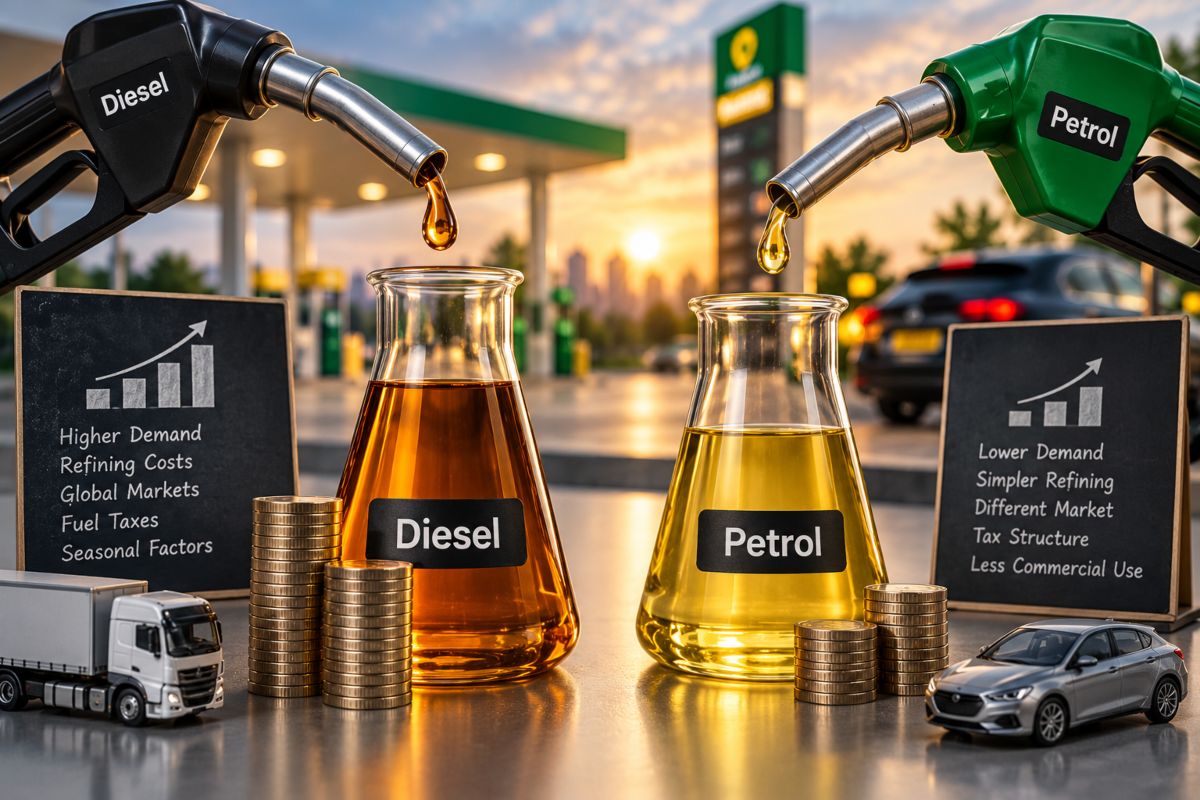
Diesel can be more expensive than petrol because diesel has strong demand from transport, construction, agriculture and industry, while its refining and supply requirements can make it more expensive to produce and distribute. Seasonal demand, crude oil prices, refinery capacity, fuel taxes and global supply conditions can also push diesel prices higher.
Diesel is not always more expensive than petrol, and the price difference changes over time. Although diesel may cost more per litre, diesel engines generally provide better fuel economy and higher low-speed torque, which can make them economical for high-mileage and heavy-duty use.
If you have visited a UK filling station recently, you may have noticed that diesel can cost more per litre than petrol. For drivers who remember a time when diesel was often cheaper, this can seem confusing. After all, diesel engines are generally known for their fuel efficiency, so why does the fuel itself sometimes cost more?
The answer is not down to one single factor. Diesel prices are influenced by crude oil costs, refinery processes, commercial demand, seasonal fuel requirements, taxation, supply and demand, distribution costs and international energy markets. These factors can interact in complicated ways, causing diesel to become more expensive than petrol even when both fuels are produced from crude oil.
There is also an important distinction between the price of fuel and the overall cost of running a vehicle. A diesel car may use less fuel per mile than a comparable petrol car, meaning a higher price per litre does not necessarily make diesel more expensive to operate.
This guide looks at exactly why diesel can cost more than petrol, how the two fuels are produced, what influences their prices, whether diesel is still economical and how businesses and motorists can manage rising fuel costs.
Petrol and Diesel Come from the Same Basic Source
Both petrol and diesel are produced from crude oil, but they are not the same product.
Crude oil is a complex mixture of hydrocarbons. During refining, it is separated into different fractions, which can then be processed into fuels and other petroleum products.
Petrol is made from lighter hydrocarbon fractions, while diesel comes from heavier middle-distillate fractions.
The refining process is carefully controlled to produce fuels with specific characteristics. These include ignition properties, energy content, volatility, sulphur levels, density and performance requirements.
This is one reason it is too simplistic to say that petrol and diesel should cost roughly the same simply because both originate from crude oil.
Diesel Requires Specific Refining Processes
The cost of producing diesel is affected by the way crude oil has to be processed.
Modern road diesel must meet strict fuel-quality requirements. Refineries may use processes such as hydrodesulphurisation to remove sulphur and improve fuel quality.
The finished fuel must also meet requirements relating to characteristics such as:
- Cetane quality
- Sulphur content
- Density
- Lubricity
- Cold-weather performance
- Stability
- Distillation characteristics
These requirements add complexity to the production process.
Refinery economics can therefore have a significant impact on the wholesale price of diesel.
Diesel Has Enormous Commercial Demand
One of the biggest reasons diesel prices can rise is the sheer number of industries that depend on it.
Petrol is heavily associated with passenger cars, but diesel has a much wider commercial role.
Diesel is commonly used in:
- HGVs
- Delivery vans
- Buses
- Coaches
- Agricultural machinery
- Construction equipment
- Generators
- Industrial machinery
- Commercial fleets
- Some marine applications
A large logistics company can consume thousands of litres of diesel every week.
A construction company may need fuel for excavators, dumpers, generators and other machinery.
A farm can use substantial quantities of diesel during planting and harvesting periods.
When economic activity increases, diesel demand can therefore rise significantly.
Heavy Transport Has a Major Influence on Diesel Demand
Road freight is particularly important.
Heavy goods vehicles travel long distances and consume large quantities of diesel. Unlike a private car, which might use several hundred litres of fuel each month, a large commercial vehicle can consume substantial quantities during regular operations.
This creates a huge underlying demand for diesel.
When the transport sector is busy, fuel consumption increases. If refinery output or global supply cannot keep pace, wholesale diesel prices can rise.
This is one reason diesel markets can react differently from petrol markets.
Diesel Is Part of the Middle-Distillate Market
Diesel does not exist in isolation within the fuel market.
It belongs broadly to the middle-distillate group, which includes other petroleum products with similar refining characteristics.
These markets can include products associated with:
- Road diesel
- Heating fuels
- Gas oil
- Aviation fuel
- Industrial fuels
Demand for these products can influence refinery economics.
For example, cold weather can increase demand for heating fuels. At the same time, transport operators continue to require diesel.
When several sources of demand increase simultaneously, pressure can build within the middle-distillate market.
Seasonal Demand Can Push Diesel Prices Higher
Fuel demand changes throughout the year.
Winter can be particularly important because energy consumption increases across several sectors.
Heating requirements rise, while commercial transport continues operating.
This can place additional pressure on middle-distillate supplies.
Diesel prices can therefore respond to seasonal demand in ways that are not always mirrored by petrol prices.
Seasonal effects are not the only factor, but they can contribute to a noticeable difference between the two fuels.
Refinery Capacity Matters
The amount of fuel available depends partly on refinery capacity.
Refineries require maintenance, and unexpected shutdowns can also occur.
When a major refinery is temporarily offline, fuel production may fall.
If diesel supply becomes tighter while demand remains strong, wholesale prices can increase.
This does not necessarily mean there is a complete fuel shortage. Even a relatively modest reduction in available supply can affect wholesale market pricing.
Global Oil Prices Affect Both Fuels
Crude oil remains one of the biggest influences on fuel prices.
When crude oil prices rise, the cost of producing petroleum-based fuels can also increase.
However, petrol and diesel do not always respond identically.
Their prices are influenced by separate supply and demand conditions within the wider refined-products market.
This means crude oil can fall while diesel remains relatively expensive, or crude oil can rise while the price difference between petrol and diesel changes.
Global Supply and Demand
The global fuel market is enormous.
Diesel is used across transport, manufacturing, construction, agriculture and energy generation in countries around the world.
Changes in demand from major economies can influence global prices.
Likewise, production changes in major oil-producing regions can affect the availability and price of crude oil and refined fuels.
This is why UK diesel prices can be influenced by events taking place thousands of miles away.
Geopolitical Events Can Affect Diesel Prices
Fuel markets are sensitive to international events.
Supply disruptions, shipping problems, sanctions, conflicts and changes in international trade can all affect the energy market.
Even when a particular event does not directly affect UK fuel supplies, markets may react to the possibility of future disruption.
This can increase wholesale prices before the physical supply situation changes significantly.
The Difference Between Wholesale and Retail Diesel Prices
The price you see at a filling station is not simply the wholesale cost of diesel.
The final retail price contains several components.
These can include:
- Wholesale fuel cost
- Refining costs
- Transport and distribution
- Fuel duty
- VAT
- Forecourt operating costs
- Retail margin
A change in the wholesale price may therefore take time to appear at the pump.
Likewise, a fall in crude oil prices does not necessarily mean motorists immediately see an equivalent fall in diesel prices.
Fuel Duty Also Affects the Final Price
UK fuel duty is another important part of the retail price.
It is charged on road fuels and contributes significantly to the amount motorists pay at the pump.
VAT is also applied to the relevant fuel price.
This means the final amount paid by a customer is considerably more complicated than the basic cost of producing the diesel.
Government decisions concerning fuel duty can therefore affect the price motorists pay.
Why Can Diesel Be More Expensive Even When It Is More Efficient?
This is one of the most confusing parts of the comparison.
Diesel engines are generally more efficient than comparable petrol engines.
They can often travel further using the same volume of fuel.
However, fuel efficiency and fuel price are two separate things.
Imagine a diesel car that achieves 55 miles per gallon and a petrol car that achieves 40 miles per gallon.
If diesel costs more per litre, the diesel vehicle may still use less money per mile because it consumes less fuel.
Therefore, a higher price per litre does not automatically mean a higher running cost per mile.
This is particularly important for high-mileage drivers.
Diesel Engines Have Higher Energy Efficiency
Diesel engines generally convert a greater proportion of the fuel’s energy into useful mechanical work.
One reason is their high compression ratio.
Diesel engines compress air to a high pressure and temperature before injecting the fuel.
This compression-ignition process contributes to their efficiency.
Diesel fuel also contains a high amount of energy per litre.
The combination helps diesel vehicles achieve strong fuel economy.
Diesel Provides Strong Low-Speed Torque
Another advantage of diesel engines is torque.
Diesel engines generally produce substantial torque at lower engine speeds.
This is particularly useful when moving heavy loads.
It explains why diesel remains popular for:
- HGVs
- Vans
- Towing
- Tractors
- Construction equipment
- Commercial vehicles
For these applications, the ability to produce strong pulling power efficiently is often more important than simply having the cheapest fuel per litre.
Is Diesel Better Than Petrol?
Whether is diesel better than petrol depends entirely on how the vehicle is used.
Diesel can be an excellent choice for someone who:
- Drives long distances
- Covers high annual mileage
- Tows regularly
- Carries heavy loads
- Operates commercial vehicles
- Spends substantial time on motorways
Petrol may be more suitable for someone who:
- Drives short distances
- Mainly drives in urban areas
- Has relatively low annual mileage
- Wants a smooth and responsive engine
- Does not regularly carry heavy loads
There is no universal winner.
Petrol Can Be Better for Short Journeys
Modern diesel vehicles often use sophisticated emissions-control systems.
These can include:
- Diesel particulate filters
- EGR systems
- Selective catalytic reduction
- NOx sensors
- AdBlue systems
Repeated short journeys can sometimes prevent diesel emissions systems from operating under ideal conditions.
For example, a diesel particulate filter may require regeneration to burn accumulated soot.
If the vehicle mainly performs very short trips, regeneration may become difficult.
Petrol vehicles can therefore be more practical for some urban drivers.
Diesel Is Often Better for Long-Distance Driving
Diesel engines can be particularly effective on longer journeys.
Once operating at normal temperature, they can deliver excellent fuel economy.
Motorway driving can therefore make good use of diesel’s strengths.
A driver covering 20,000 or 30,000 miles a year may benefit significantly from diesel’s efficiency.
Someone travelling only a few thousand miles a year may not receive the same financial benefit.
Diesel Price vs Total Cost of Ownership
The purchase price of a vehicle also matters.
Diesel vehicles have historically cost more than equivalent petrol versions in many vehicle ranges.
This can be due to the additional engineering required for:
- High-pressure fuel systems
- Strong engine components
- Turbocharging
- Emissions systems
- Exhaust after-treatment
A diesel vehicle may therefore need to deliver substantial fuel savings before its higher purchase price is recovered.
The calculation is different for every driver.
Maintenance Can Influence the Economics
Diesel engines can be extremely durable, but modern diesel vehicles can also have more complicated systems.
Potentially expensive components include:
- Diesel injectors
- High-pressure fuel pumps
- Turbochargers
- DPFs
- EGR valves
- NOx sensors
- SCR systems
- AdBlue components
Petrol vehicles are not immune to expensive repairs, particularly modern turbocharged and direct-injection engines.
The key point is that fuel economy should not be considered separately from maintenance costs.
Diesel and Petrol Emissions
Emissions are another important part of the comparison.
Diesel engines have historically been associated with higher nitrogen oxide and particulate emissions.
Modern diesel vehicles use sophisticated systems to reduce these pollutants.
Petrol engines generally produce different emissions profiles.
The environmental comparison therefore depends on the age and technology of the vehicle.
A modern diesel vehicle with advanced emissions controls is very different from an older diesel engine.
Likewise, modern petrol engines can be considerably cleaner than older petrol technology.
Diesel Fuel Quality Matters
Fuel quality can also affect operating costs.
Modern diesel engines use highly precise fuel-injection systems.
Contaminated fuel can damage sensitive components.
Potential contaminants include:
- Water
- Dirt
- Sediment
- Microbial contamination
- Poor-quality fuel
For commercial operators buying fuel in bulk, proper tank management becomes particularly important.
Clean storage tanks, suitable filtration and regular inspections can help protect the fuel system.
Bulk Diesel Can Have Different Pricing
Businesses do not always purchase diesel from ordinary retail forecourts.
A company operating a large fleet may order fuel in bulk and have it delivered directly to its premises.
Bulk pricing depends on:
- Order size
- Wholesale market conditions
- Delivery distance
- Supplier
- Fuel specification
- Storage arrangements
- Commercial terms
A bulk customer may therefore pay a different price per litre from a motorist filling a car at a retail station.
Diesel for Construction and Industry
Diesel’s commercial importance goes well beyond road vehicles.
Construction sites use diesel-powered:
- Excavators
- Dumpers
- Telehandlers
- Generators
- Compressors
- Loaders
Industrial operations may also rely on diesel generators and equipment.
This broad demand makes diesel an important industrial fuel.
Companies such as 123 Oil can support businesses that require reliable fuel supply and delivery for commercial operations.
Agriculture Also Depends Heavily on Diesel
Agricultural machinery has traditionally relied on diesel because of its high torque and efficiency.
Tractors, combines and other machinery can work for long periods under heavy loads.
During particularly busy seasons, fuel demand can rise substantially.
A farm may consume hundreds or thousands of litres during intensive periods of work.
This means changes in diesel prices can have a direct impact on agricultural operating costs.
Diesel and Transport Costs
Fuel is one of the major operating expenses for transport businesses.
A haulage company does not simply pay for the diesel itself.
Fuel costs affect:
- Delivery prices
- Freight rates
- Operating margins
- Logistics planning
- Fleet efficiency
- Customer charges
If diesel prices increase substantially, transport companies may eventually need to adjust their pricing.
This can have a wider effect because transported goods ultimately form part of the supply chain for many products.
Why Diesel Prices Can Rise Faster Than Petrol
There are periods when diesel prices rise more quickly than petrol.
This can happen when:
- Global diesel demand increases.
- Refinery production is reduced.
- Middle-distillate supplies become tighter.
- Freight and commercial transport demand increases.
- Seasonal heating demand rises.
- Crude oil prices increase.
- International supply disruptions occur.
Several of these factors can happen at the same time.
When they do, the diesel-petrol price gap can become much larger.
Why the Price Difference Can Reverse
The opposite can also happen.
There are periods when diesel becomes cheaper relative to petrol.
Fuel markets are constantly adjusting.
Changes in refinery output, crude oil prices, seasonal demand and international fuel consumption can all alter the relationship between the two products.
Therefore, it is incorrect to say that diesel will always be more expensive than petrol.
It is better to understand the underlying factors that cause the price difference.
How Drivers Can Reduce the Impact of High Diesel Prices
Drivers cannot control the wholesale fuel market, but they can reduce consumption.
Maintain Correct Tyre Pressures
Under-inflated tyres increase rolling resistance and can reduce fuel economy.
Avoid Excessive Idling
Leaving the engine running while stationary wastes fuel.
Drive Smoothly
Hard acceleration and unnecessary high-speed driving increase fuel consumption.
Keep the Vehicle Maintained
Blocked filters, poor injectors and mechanical faults can reduce efficiency.
Reduce Unnecessary Weight
Carrying heavy items that are not required can increase fuel consumption.
Plan Longer Journeys
Combining several short trips into one longer journey can sometimes reduce overall fuel use.
How Businesses Can Control Diesel Costs
Commercial operators have additional opportunities to reduce fuel expenditure.
They can monitor:
- Fuel consumption per vehicle
- Driver behaviour
- Idle time
- Route efficiency
- Vehicle load
- Maintenance costs
- Supplier pricing
- Bulk purchasing
Fleet management technology can also identify vehicles that are consuming significantly more fuel than expected.
Small improvements across a large fleet can create substantial annual savings.
Petrol vs Diesel: Cost Comparison
Factor | Petrol | Diesel |
Price per litre | Can be lower | Can be higher |
Fuel economy | Generally lower | Generally higher |
Low-speed torque | Moderate | Strong |
Long-distance efficiency | Good | Excellent |
Heavy-load performance | Good | Excellent |
Short journeys | Generally suitable | Can be less suitable |
Commercial use | Moderate | Very high |
Engine complexity | Varies | Often higher |
Emissions systems | Advanced | Often more complex |
High-mileage suitability | Good | Excellent |
Fuel demand | High | Very high |
This table shows why simply comparing the price displayed on the pump does not tell the complete story.
The Future of Diesel Pricing
The diesel market is changing.
Several developments could influence future demand, including:
- Electric vehicles
- Hybrid vehicles
- HVO
- Renewable diesel
- Alternative fuels
- Changes to emissions regulations
- Energy policy
- Changes in global oil consumption
Passenger-car diesel demand may continue to evolve as alternative powertrains become more common.
However, diesel is likely to remain important for sectors where electrification is more difficult.
Heavy transport, agriculture, construction and certain industrial applications have demanding energy requirements that cannot always be replaced easily.
Will Diesel Always Be More Expensive Than Petrol?
No.
There is no permanent rule stating that diesel must cost more.
The price relationship can change according to market conditions.
Diesel can be more expensive when middle-distillate supplies are tight or commercial and industrial demand is particularly strong.
Petrol can become relatively more expensive when its own supply and demand conditions change.
The difference you see at the pump is therefore a snapshot of a much larger global fuel market.
Final Thoughts
So, why is diesel more expensive than petrol?
The answer comes down to a combination of refining requirements, strong commercial demand, global supply and demand, seasonal factors, crude oil prices, refinery capacity, taxation and international energy markets.
Diesel is used far beyond private cars. HGVs, vans, agricultural machinery, construction equipment, generators and industrial operations all depend heavily on it. This creates substantial demand for diesel throughout the year.
At the same time, diesel belongs to the middle-distillate market, where changes in heating, transport and industrial demand can place additional pressure on available supplies.
However, a higher diesel price per litre does not automatically mean that diesel vehicles are more expensive to operate.
Diesel engines generally deliver better fuel economy and stronger low-speed torque, which can make them highly economical for drivers who cover long distances or operate under heavy loads.
For a low-mileage urban driver, petrol may make more sense. For a high-mileage motorway driver or commercial operator, diesel may still provide excellent value despite its higher price per litre.
Ultimately, the best way to compare petrol and diesel is to look beyond the pump price. Fuel economy, annual mileage, maintenance, vehicle price, driving conditions and intended use all matter when calculating the real cost of ownership.
Frequently Asked Questions
Diesel can cost more because of strong commercial demand, refining requirements, middle-distillate supply conditions, seasonal demand, crude oil prices, taxes and refinery capacity. The price difference changes over time and diesel are not always more expensive.
Not necessarily. Diesel can cost more per litre but usually provides better fuel economy, so a diesel vehicle may cost less per mile. The result depends on fuel prices, vehicle efficiency, mileage and maintenance.
Fuel price and fuel consumption are separate factors. A diesel engine may use less fuel to travel the same distance, which can offset a higher price per litre.
Diesel is generally well suited to long-distance driving because it offers strong fuel economy, high torque and efficient operation at sustained speeds. Petrol can also be economical, particularly with modern efficient or hybrid technology.
Diesel engines produce strong low-speed torque and can deliver good fuel economy while carrying heavy loads. These characteristics make diesel particularly useful for HGVs, vans, buses, construction machinery and agricultural equipment.
Yes. Diesel is not permanently more expensive. Changes in refinery production, crude oil prices, seasonal demand, global supply and fuel consumption can cause the price difference between diesel and petrol to narrow or reverse.
Refining costs are one factor, but they are not the only reason. Supply, demand, refinery capacity, taxes, distribution costs and global market conditions also play important roles in determining the final diesel price.