


Euro 6 is the newer and cleaner emissions standard compared with Euro 5. The biggest improvement is the reduction of nitrogen oxide emissions from diesel vehicles. Euro 6 vehicles commonly use advanced systems such as Selective Catalytic Reduction (SCR), AdBlue technology and improved exhaust filters to meet stricter emissions limits.
Euro 5 vehicles can still be reliable and efficient, but Euro 6 models generally produce fewer harmful emissions and are more suitable for areas with low-emission restrictions.
Vehicle emissions have become an important consideration for drivers, businesses and fleet operators across the UK. As governments introduce stricter air-quality regulations, cars and commercial vehicles must meet specific emissions standards before they can be approved for use.
Two of the most commonly discussed standards are Euro 5 and Euro 6. These classifications determine how much pollution a vehicle is allowed to produce, particularly emissions such as nitrogen oxides (NOx), particulate matter (PM), hydrocarbons and carbon monoxide. Euro standards were introduced to gradually reduce harmful vehicle emissions and improve air quality.
Many drivers ask questions such as “what is the difference between Euro 5 and Euro 6?”, “what does Euro 6 mean?” and whether upgrading from a Euro 5 vehicle to a Euro 6 model is worthwhile.
This detailed guide explains the differences between Euro 5 and Euro 6, how they affect diesel and petrol vehicles, technology improvements, costs, benefits, disadvantages and what drivers should know before buying a vehicle.
What Are Euro Emission Standards?
Euro emission standards are regulations that set limits on the number of pollutants vehicles can release through their exhaust systems.
They apply to:
- Cars
- Vans
- Commercial vehicles
- Trucks
- Buses
The standards have become progressively stricter over time:
- Euro 1
- Euro 2
- Euro 3
- Euro 4
- Euro 5
- Euro 6
- Euro 7 (future standard)
Each new version introduces tighter limits, encouraging manufacturers to develop cleaner engine technology.
Euro 5 was introduced before Euro 6, meaning Euro 6 vehicles must meet stricter requirements.
What Does Euro 5 Mean?
Euro 5 is an emissions standard introduced for vehicles to reduce harmful exhaust pollutants compared with earlier Euro standards.
For diesel vehicles, Euro 5 focused on reducing:
- Nitrogen oxides (NOx)
- Particulate matter (PM)
- Carbon monoxide (CO)
- Hydrocarbons (HC)
Many Euro 5 diesel vehicles introduced technologies such as:
- Diesel particulate filters (DPF)
- Improved fuel injection systems
- Better engine management software
These improvements helped reduce soot and other harmful emissions compared with older diesel engines.
However, as air-quality concerns increased, especially in cities, stricter limits were introduced.
This led to the development of Euro 6.
What Does Euro 6 Mean?
Many drivers search for “what does Euro 6 mean on a car?”
A Euro 6 vehicle is one that meets a stricter set of emissions requirements compared with Euro 5.
Euro 6 means the vehicle has been designed to produce lower levels of harmful exhaust emissions, particularly nitrogen oxides from diesel engines.
Euro 6 diesel vehicles often include advanced systems such as:
- Selective Catalytic Reduction (SCR)
- AdBlue injection
- Improved diesel particulate filters
- More advanced engine control systems
These technologies work together to reduce pollutants before they leave the exhaust system.
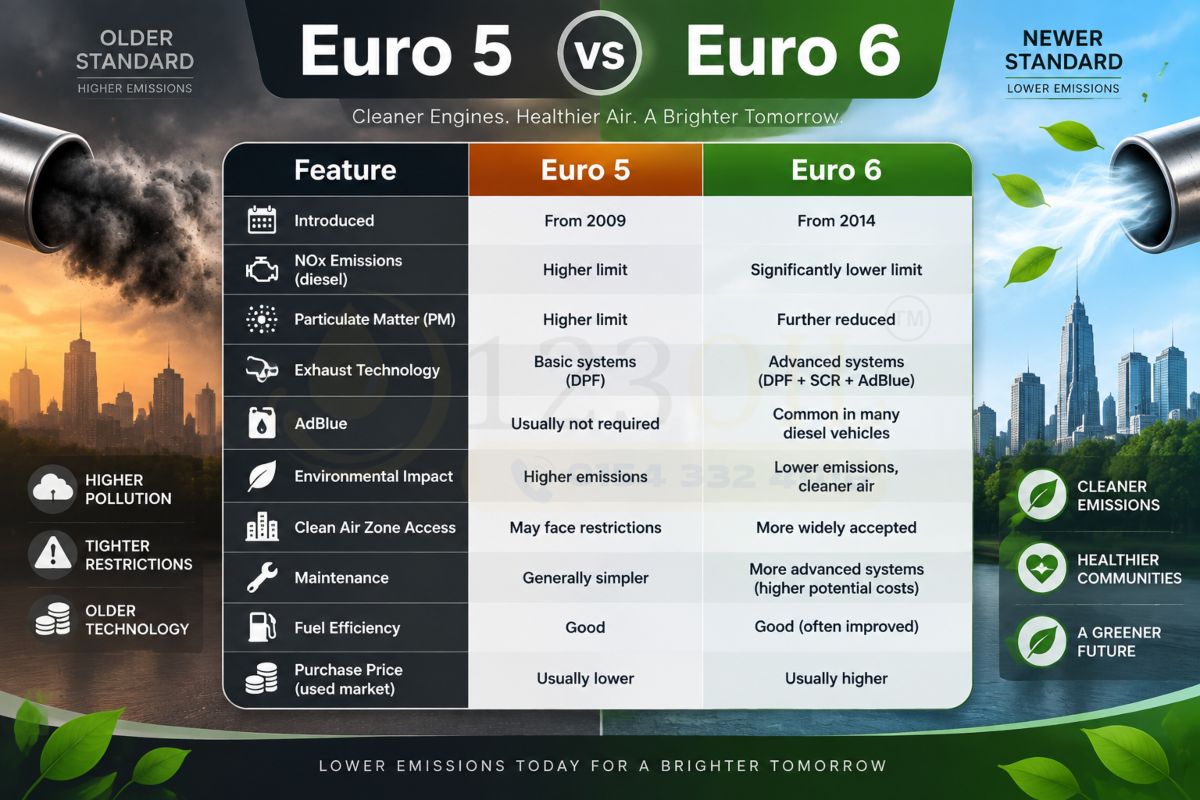
Euro 5 vs Euro 6 Emissions Comparison
The biggest difference between Euro 5 and Euro 6 is the reduction of harmful emissions.
Emission Type | Euro 5 | Euro 6 |
Nitrogen Oxides (NOx) | Higher permitted limits | Much lower permitted limits |
Particulate Matter | Controlled | Further reduced |
Carbon Monoxide | Regulated | Stricter limits |
Hydrocarbons | Regulated | Stricter limits |
Exhaust technology | Basic emissions systems | Advanced after-treatment systems |
AdBlue requirement | Usually not required | Common in many diesel vehicles |
Suitable for clean air zones | Limited | More suitable |
Euro 6 introduced significantly lower NOx limits for diesel cars compared with Euro 5.
Euro 5 vs Euro 6 Diesel Vehicles
The difference between Euro 5 and Euro 6 is most noticeable in diesel vehicles.
Diesel engines naturally produce higher levels of nitrogen oxides compared with petrol engines, so manufacturers needed additional technology to meet stricter regulations.
Euro 5 Diesel Technology
Euro 5 diesel vehicles commonly use:
- Diesel particulate filters
- Improved combustion control
- Better fuel injection systems
These systems reduce soot and particulate emissions.
Euro 6 Diesel Technology
Euro 6 diesel vehicles often add:
- SCR systems
- AdBlue injection
- Advanced NOx sensors
- Improved exhaust treatment
AdBlue is a liquid solution injected into the exhaust system, where it helps convert harmful nitrogen oxides into nitrogen and water vapour.
Euro 5 vs Euro 6 Petrol Vehicles
The difference between Euro 5 and Euro 6 is usually less dramatic for petrol vehicles.
Petrol engines generally produce lower NOx emissions than diesel engines, but Euro 6 still introduced improvements.
Modern Euro 6 petrol vehicles may include:
- Improved catalytic converters
- Better engine management
- Direct injection improvements
- Particulate filters on some engines
The biggest impact of Euro 6 was focused on reducing diesel emissions.
Why Was Euro 6 Introduced?
Euro 6 was introduced because previous emissions standards were not considered strict enough to address urban air pollution concerns.
One of the main targets was nitrogen oxide pollution.
NOx emissions can contribute to poor air quality, particularly in busy urban areas with high traffic levels.
Euro 6 aimed to significantly reduce these emissions through improved vehicle technology.
Main Technologies Used in Euro 6 Vehicles
Euro 6 vehicles use several advanced systems.
Selective Catalytic Reduction (SCR)
SCR technology reduces NOx emissions by using a chemical reaction inside the exhaust system.
AdBlue System
AdBlue is used in many Euro 6 diesel vehicles.
The system injects AdBlue into the exhaust, helping convert NOx into less harmful substances.
Improved Diesel Particulate Filters
DPFs capture soot particles from diesel exhaust.
Euro 6 systems are designed to improve particulate control further.
Advanced Engine Management
Modern engines use sensors and computer systems to adjust fuel injection and combustion more accurately.
Euro 5 vs Euro 6 Performance
Many people assume that a cleaner emissions standard means lower performance.
However, this is not necessarily true.
Euro 6 vehicles can offer:
- Similar power output
- Better fuel efficiency
- Improved emissions control
- More advanced technology
Manufacturers have developed engines that maintain performance while reducing pollution.
However, additional emissions equipment can sometimes add complexity.
Euro 6 Vehicle Maintenance
One consideration with Euro 6 vehicles is maintenance.
Advanced emissions systems require additional components.
Potential maintenance areas include:
- AdBlue systems
- NOx sensors
- SCR components
- DPF systems
- EGR valves
These systems are designed to last, but repairs can sometimes be expensive if problems occur.
Regular servicing and correct maintenance are important for keeping Euro 6 vehicles operating efficiently.
Euro 5 Vehicle Advantages
Although Euro 6 is newer, Euro 5 vehicles still have some advantages.
Lower Purchase Price
Used Euro 5 vehicles are often cheaper compared with newer Euro 6 models.
Simpler Technology
Some Euro 5 vehicles have fewer emissions components, which can mean fewer complex systems to maintain.
Reliable Engines
Many Euro 5 engines are proven designs with good reliability records.
Lower Initial Cost
For buyers with limited budgets, a Euro 5 vehicle may provide good value.
Euro 5 Vehicle Disadvantages
However, Euro 5 vehicles may have limitations.
These include:
- Higher emissions compared with Euro 6
- Possible restrictions in clean air zones
- Lower resale appeal in some markets
- Older vehicle technology
Drivers who regularly enter emissions-controlled areas should consider these factors.
Euro 6 Vehicle Advantages
Euro 6 vehicles offer several benefits.
Lower Emissions
The biggest advantage is reduced pollution.
Better Access to Clean Air Zones
Many UKS clean air zones require vehicles to meet specific emissions standards. Euro 6 diesel vehicles are commonly accepted where Euro 5 vehicles may face restrictions.
Newer Technology
Euro 6 vehicles often include:
- Better fuel systems
- Improved efficiency
- Modern safety features
- Updated technology
Better Future Usability
As environmental regulations become stricter, newer emissions standards may provide better long-term usability.
Euro 6 Vehicle Disadvantages
Euro 6 vehicles are not perfect.
Potential disadvantages include:
Higher Purchase Cost
Newer vehicles usually cost more.
More Complex Systems
More emissions technology means more components.
Potential Repair Costs
Systems such as AdBlue and SCR can require specialist repairs.
Short Journey Issues
Diesel Euro 6 vehicles can still experience issues if mainly used for repeated short trips.
Euro 5 vs Euro 6 for Clean Air Zones
Clean Air Zones are areas where vehicles may face restrictions depending on their emissions.
Many UK cities use emissions standards to reduce pollution.
Euro 6 diesel vehicles are generally more likely to meet these requirements compared with Euro 5 diesel vehicles.
Before buying a vehicle, drivers should check the requirements of the areas they regularly visit.
Euro 5 vs Euro 6 Fuel Economy
Fuel economy depends on the individual vehicle rather than only the emissions standard.
A Euro 6 vehicle may achieve similar or better fuel economy because it often uses newer engine technology.
Factors affecting fuel consumption include:
- Engine size
- Vehicle weight
- Driving style
- Maintenance
- Road conditions
- Vehicle design
A well-maintained Euro 5 vehicle can still be economical.
Euro 5 vs Euro 6 Commercial Vehicles
For businesses operating vans and trucks, the difference can be particularly important.
Commercial operators need to consider:
- Emission zone access
- Fuel economy
- Reliability
- Maintenance costs
- Vehicle lifespan
- Resale value
A Euro 6 commercial vehicle may provide better access to restricted areas and better long-term usability.
Businesses that rely on fuel supply for commercial operations may also work with suppliers such as 123 Oil to manage their fuel requirements efficiently.
Euro 5 vs Euro 6: Comparison Table
Factor | Euro 5 | Euro 6 |
Emissions standard | Older | Newer |
Pollution levels | Higher | Lower |
Diesel NOx emissions | Higher | Significantly reduced |
Exhaust technology | Less advanced | More advanced |
AdBlue | Usually not required | Common in diesel models |
Clean Air Zone compatibility | More limited | Better |
Purchase price | Usually, lower | Usually, higher |
Maintenance complexity | Lower | Higher |
Technology | Older | Newer |
Long-term suitability | Moderate | Stronger |
Is Euro 6 Better Than Euro 5?
In terms of emissions and future regulations, Euro 6 has clear advantages.
Euro 6 vehicles produce fewer harmful emissions and are more suitable for modern low-emission requirements.
However, whether Euro 6 is the better choice depends on individual circumstances.
Someone buying a used vehicle on a limited budget may find Euro 5 more affordable.
Someone who regularly drives into cities with emissions restrictions may benefit from choosing Euro 6.
Should You Buy a Euro 5 or Euro 6 Vehicle?
The right choice depends on how you use your vehicle.
Choose Euro 5 If:
- You want a lower purchase price.
- You rarely drive in clean air zones.
- You want simpler technology.
- You find a well-maintained example.
Choose Euro 6 If:
- You regularly drive in urban areas.
- You want lower emissions.
- You need better future compatibility.
- You operate a commercial vehicle.
- You want newer technology.
How to Check Your Vehicle’s Euro Standard
You can check your vehicle’s Euro emissions category through:
- Vehicle registration documents
- Manufacturer information
- Government vehicle-check services
- Vehicle specification databases
The Euro category is usually linked to the vehicle’s registration details.
Final Thoughts
The difference between Euro 5 and Euro 6 comes down mainly to emissions technology.
Euro 5 vehicles meet earlier emissions requirements, while Euro 6 vehicles use more advanced systems to reduce harmful pollutants, especially nitrogen oxides from diesel engines.
Euro 5 vehicles can still be reliable, affordable and efficient, making them a practical choice for many drivers.
However, Euro 6 vehicles provide advantages in terms of cleaner operation, lower emissions and improved compatibility with modern clean air regulations.
For motorists, the best choice depends on budget, driving habits and where the vehicle will be used.
For city drivers and commercial operators who frequently enter restricted areas, Euro 6 may offer greater long-term flexibility.
For buyers looking for affordability and a reliable used vehicle, a well-maintained Euro 5 model can still be a sensible option.
Ultimately, the condition of the vehicle, maintenance history and intended use are just as important as the emissions standard itself.
Frequently Asked Questions
The main difference is that Euro 6 has stricter emissions limits than Euro 5, particularly for diesel NOx emissions. Euro 6 vehicles use more advanced exhaust technology to reduce harmful pollutants.
Euro 6 means the vehicle meets a stricter European emissions standard designed to reduce pollutants such as nitrogen oxides and particulate matter.
Yes, Euro 6 is generally better for emissions performance because it produces fewer harmful pollutants. However, Euro 5 vehicles can still be reliable and economical.
It depends on the specific clean air zone rules. Some areas may charge Euro 5 diesel vehicles, while Euro 6 diesel vehicles are more commonly accepted.
Many Euro 6 diesel vehicles use AdBlue technology, but not every Euro 6 vehicle has the same system. It depends on the manufacturer and engine design.
A Euro 5 vehicle can still be a good purchase if it is well maintained and suitable for your driving needs. However, buyers should consider future emissions restrictions.
Not necessarily. Fuel economy depends on the engine and vehicle design. Many Euro 6 vehicles are designed to maintain or improve efficiency while reducing emissions.