


A septic tank is an underground container that collects and partially treats domestic wastewater. Solid waste settles at the bottom as sludge, while lighter materials form a surface layer and liquid effluent leaves the tank through an outlet to a drainage field. Bacteria naturally break down part of the waste inside the tank, while the drainage field provides further treatment as the effluent passes through the soil.
A septic tank is an underground system used to collect and partially treat wastewater from properties that are not connected to a public sewer. It is commonly found in rural homes, cottages, farms and other properties where a mains drainage connection is unavailable or impractical.
Although septic tanks have been used for many years, there is often confusion about what actually happens inside the tank, where the wastewater goes and how the system differs from a cesspool or modern sewage treatment plant.
A properly designed septic system provides an effective way of managing domestic wastewater. However, it needs suitable installation, regular maintenance and careful use. If the system becomes overloaded, damaged or poorly maintained, it can cause unpleasant smells, drainage problems and environmental pollution.
Understanding how a septic tank works is therefore important for anyone who owns or is considering buying a property with private drainage. In England, septic tank operators must also follow the relevant environmental rules governing sewage discharges.
What is a Septic Tank Used For?
A septic tank is designed to manage wastewater from properties that do not have access to a public foul sewer.
Wastewater entering the system can come from:
- Toilets
- Sinks
- Showers
- Baths
- Washing machines
- Dishwashers
- Other normal domestic activities
The system provides a place where wastewater can settle and undergo natural biological treatment before the liquid component moves into a drainage field.
This makes septic tanks particularly useful for properties in rural areas were connecting to a mains sewer may not be possible.
A septic tank is not simply an underground storage container. Unlike a cesspool, it is designed to separate solids from liquid and provide partial treatment before the liquid moves onwards through the drainage system.
How Does a Septic Tank Work?
The process inside a septic tank is relatively straightforward, although several biological and physical processes happen at the same time.
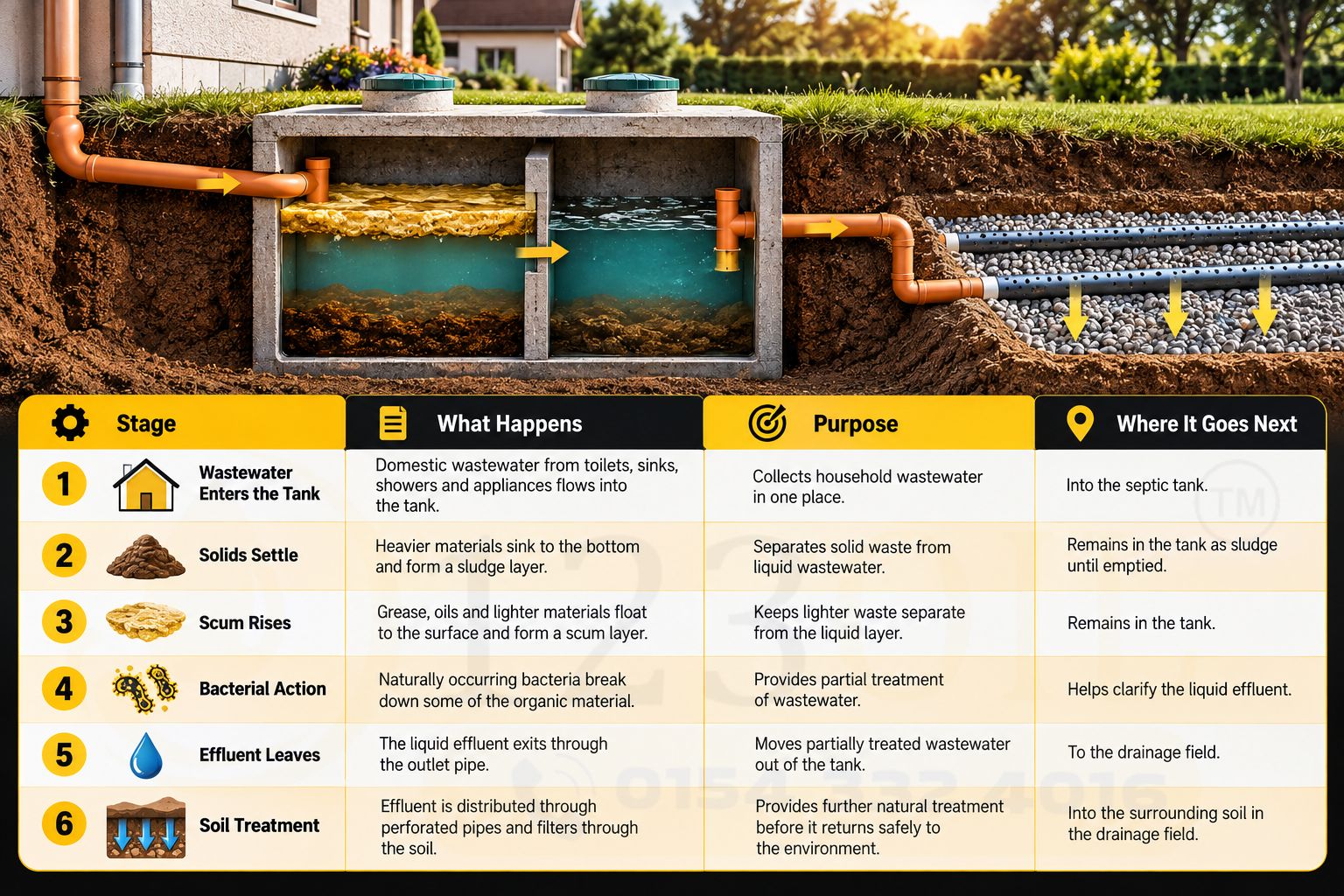
Wastewater enters the underground tank through an inlet pipe. Once inside, the flow slows down enough for different materials to separate according to their density.
The heavier solids settle towards the bottom and form a layer of sludge. Lighter materials, including grease and oils, can rise to the surface and form a scum layer.
Between these two layers is the liquid effluent.
Naturally occurring bacteria help break down some of the organic material in the tank. The partially treated liquid then leaves through the outlet and is normally directed towards a suitable drainage field, where further treatment takes place as it passes through the soil.
Read Full blog on → How Does a Septic Tank Work?
The Main Stages of Septic Tank Treatment
Stage | What Happens | Purpose |
Wastewater enters | Domestic wastewater flows into the tank | Collects household wastewater |
Solids settle | Heavy materials sink to the bottom | Creates a sludge layer |
Scum rises | Grease and lighter materials float | Separates lighter waste |
Bacterial action | Naturally occurring bacteria break down organic matter | Provides partial treatment |
Effluent leaves | Liquid exits through the outlet | Moves wastewater towards the drainage field |
Soil treatment | Effluent filters through the drainage field | Provides further natural treatment |
This process means the tank must have sufficient capacity and be maintained properly to continue operating effectively.
What Happens Inside a Septic Tank?
There are generally three important layers inside a working septic tank.
Sludge Layer
The heavy solid material sinks to the bottom and gradually forms sludge.
This layer naturally builds up over time. If it becomes excessive, it reduces the amount of effective tank capacity available for wastewater.
Regular emptying is therefore an important part of septic tank maintenance. The exact frequency depends on the system, usage and manufacturer’s instructions. Where an environmental permit applies in England, the tank must be emptied at least once a year.
Liquid Effluent Layer
The middle section contains the liquid component of the wastewater.
This is the part that leaves the tank through the outlet and moves towards the drainage field.
It is important to understand that the liquid leaving a septic tank is not the same as fully treated sewage. A septic tank provides primary treatment, while additional treatment takes place through the drainage field and soil.
Scum Layer
Grease, oils and other lighter materials can float to the surface.
This forms a scum layer that remains within the tank. If unsuitable substances are regularly introduced into the system, they can interfere with its operation and contribute to blockages or other problems.
What is a Drainage Field?
A drainage field is an important part of many septic tank systems.
It consists of perforated pipes installed in trenches within suitable ground. The treated effluent from the septic tank is distributed through these pipes and gradually passes into the surrounding soil.
The soil provides further natural treatment as the wastewater moves through it.
This is why a septic tank should not be viewed as an isolated piece of equipment. The tank, pipework and drainage field work together as one wastewater treatment system.
A damaged or unsuitable drainage field can cause problems even when the septic tank itself appears to be functioning correctly.
Septic Tank vs Sewage Treatment Plant vs Cesspool
These systems are sometimes confused because they can all be used where properties do not have a conventional mains sewer connection.
However, they work differently.
Feature | Septic Tank | Sewage Treatment Plant | Cesspool |
Stores wastewater | Yes | Yes | Yes |
Settles solids | Yes | Yes | Yes |
Biological treatment | Natural bacterial action | More active treatment | No treatment |
Mechanical components | Usually no | Usually yes | No |
Drainage field | Normally required | May be required depending on discharge | No |
Discharge | To suitable drainage field | Can achieve higher treatment levels | None |
Emptying required | Yes | Yes | Yes, regularly |
Main purpose | Primary treatment | More advanced wastewater treatment | Wastewater storage |
A cesspool is fundamentally different because it is a sealed holding tank that stores sewage rather than treating it and releasing effluent. It must be watertight and emptied regularly.
Benefits of Having a Septic Tank
A septic tank can offer several practical advantages for suitable properties.
Suitable for Rural Properties
Homes located away from public sewer networks can use private wastewater treatment systems instead of relying on a mains connection.
Long-Term Solution
A properly designed and maintained septic system can provide wastewater management for many years.
Natural Treatment Process
Septic tanks use settlement and naturally occurring bacterial activity as part of the treatment process.
No Direct Mains Sewer Connection Required
For suitable properties, a septic system provides an independent method of managing domestic wastewater.
Can Be Suitable for Different Property Types
Depending on design and capacity, septic systems may be used for homes, holiday properties and other premises producing domestic sewage.
Factors That Affect Septic Tank Performance
A septic tank does not operate independently of the property using it. Several factors can affect its performance.
Number of People Using the Property
More occupants generally mean more wastewater entering the system.
A system designed for a small household may struggle if the property is regularly occupied by many more people than originally intended.
Water Usage
Large volumes of water entering the tank in a short period can affect the settlement process.
Reducing unnecessary water usage can help the system operate more effectively.
Tank Capacity
The tank needs to be appropriately sized for the amount of wastewater it is expected to handle.
Government guidance in England states that treatment systems must have enough capacity for the maximum amount of sewage they need to treat.
What Goes Down the Drains
The contents of wastewater can also affect the system.
Excessive amounts of grease, oils, chemicals and inappropriate waste can interfere with normal operation.
Septic Tank Maintenance
Regular maintenance is essential for keeping a septic system working properly.
Maintenance requirements vary according to the system, manufacturer and applicable regulations, but important tasks include checking the tank, monitoring the drainage field and arranging professional emptying when required.
Signs that a system may need attention include:
- Unpleasant sewage smells
- Slow drainage
- Standing water around the drainage field
- Sewage backing up
- Wet or unusually green areas around the drainage field
- Gurgling pipes
- Visible leaks
Government guidance for England states that systems should be regularly maintained according to the manufacturer’s instructions and repaired or replaced if they are not in good working order.
What Should Not Go into a Septic Tank?
Being careful about what enters the drainage system can help protect the tank and drainage field.
Avoid putting unsuitable materials down toilets or sinks, including:
- Wet wipes
- Sanitary products
- Nappies
- Large quantities of cooking oil
- Paint
- Solvents
- Strong chemicals
- Non-biodegradable objects
Toilets should generally only be used for human waste and toilet paper.
Similarly, excessive grease and oils should not be poured down kitchen sinks because they can accumulate within pipework and wastewater systems.
Common Signs of a Septic Tank Problem
Recognising warning signs early can prevent a relatively small issue from becoming a major repair.
Bad Odours
Persistent sewage smells around the tank or drainage field may indicate a problem.
Slow Drains
If sinks, toilets and other fixtures drain slowly, the issue could involve pipework, the tank or drainage field.
Standing Water
Pools of wastewater around the drainage field can indicate that the system is not absorbing effluent correctly.
Sewage Backups
Wastewater returning into the property is a serious warning sign that requires prompt attention.
Unusually Wet Drainage Field
An area that remains consistently wet can indicate drainage problems.
These symptoms should not simply be masked with household products. The system should be inspected by a suitably competent professional.
Septic Tank Rules in the UK
Rules governing septic tanks differ between England, Wales, Scotland and Northern Ireland, so property owners should check the requirements applicable to their location.
In England, septic tanks and small sewage treatment plants can operate under the Environment Agency’s general binding rules when the relevant conditions are met. These rules cover matters such as the type of discharge, treatment system, pollution prevention and maintenance.
One particularly important point is that septic tank effluent must not be discharged directly into a watercourse under the general binding rules for discharge to ground. A suitable drainage field is normally required for ground discharge.
If a system does not meet the applicable requirements, the property owner may need to modify the system, connect to a public foul sewer where reasonably possible or apply for the relevant environmental permit.
Because regulations can change and differ across the UK, owners should check current guidance rather than relying solely on older information.
Septic Tank Installation Considerations
Installing a septic tank is not simply a case of digging a hole and placing a tank underground.
The system needs to be appropriately designed for:
- Property occupancy
- Wastewater volume
- Ground conditions
- Drainage requirements
- Tank capacity
- Environmental considerations
The drainage field is particularly important because the ground needs to be suitable for receiving and treating the effluent.
In England, current guidance refers to relevant standards including BS EN 12566 for septic tanks and small sewage treatment plants and BS 6297:2007 for drainage fields.
Professional assessment is therefore important before installing or significantly changing a private sewage system.
Septic Tank Maintenance vs Neglect
Proper Maintenance | Neglected System |
Regular inspections | Problems remain unnoticed |
Appropriate emptying | Sludge continues accumulating |
Good drainage | Standing water may develop |
Controlled wastewater | System may become overloaded |
Suitable waste disposal | Blockages become more likely |
Prompt repairs | Small faults can become major problems |
The difference is important because septic system problems can become expensive when they are ignored.
How Long Does a Septic Tank Last?
The lifespan of a septic tank depends on several factors rather than a single guaranteed number.
Important factors include:
- Tank construction
- Installation quality
- Ground conditions
- Maintenance
- Wastewater volume
- System age
- Drainage field condition
A well-maintained tank may continue functioning for many years, but the drainage field, pipes and other components can eventually require repair or replacement.
Regular professional inspections make it easier to identify deterioration before the entire system fails.
Read Full blog on → How Long Does a Septic Tank Last?
Final Thoughts
A septic tank is essentially the first stage of a private wastewater treatment system. It collects domestic sewage, separates solids from liquids and uses natural biological processes to partially break down organic waste. The resulting effluent then needs appropriate further treatment, normally through a drainage field.
For property owners, the important thing is to look at the entire system rather than just the tank underground. A tank can appear perfectly sound while a blocked, saturated or damaged drainage field creates serious problems elsewhere on the property.
Good maintenance also makes a substantial difference. Regular inspections, appropriate emptying, sensible water usage and keeping unsuitable materials out of the drainage system can all help protect the system and extend its useful life.
If you are buying a property with private drainage, it is worth finding out exactly what type of system is installed, where it discharges and what maintenance records are available. In England, owners also need to understand the applicable environmental rules and ensure their discharge does not cause pollution.
Ultimately, a septic tank can be a practical solution for properties without access to mains drainage, but it is not a set-and-forget system. Treating it as part of the property’s essential infrastructure, rather than simply an underground tank, is the best way to keep wastewater management reliable and avoid unpleasant surprises.
Frequently Asked Questions
A septic tank is used to collect and partially treat domestic wastewater from properties that are not connected to a public sewer. Solids settle inside the tank while liquid effluent moves towards a suitable drainage field.
Wastewater enters the tank, where solids settle as sludge, lighter materials form a scum layer and bacteria break down some organic matter. The liquid effluent then leaves the tank for further treatment through the drainage field.
A septic tank partially treats wastewater and releases liquid effluent, normally through a drainage field. A cesspool is a sealed storage tank that does not discharge wastewater and must be emptied regularly.
There is no single frequency that applies to every system. It depends on the tank size, usage and manufacturer's guidance. Where an environmental permit applies in England, the tank must be emptied at least once a year.
Under the general binding rules for discharge to ground in England, septic tank effluent must not be discharged directly into a watercourse. The applicable rules depend on where and when the discharge began.
Common warning signs include sewage smells, slow drainage, standing water, sewage backups and unusually wet areas around the drainage field. These problems should be investigated rather than ignored.
Yes, provided the system is correctly sized for the expected wastewater volume. If occupancy or wastewater production increases, the system may need to be reassessed to ensure it has sufficient capacity.