

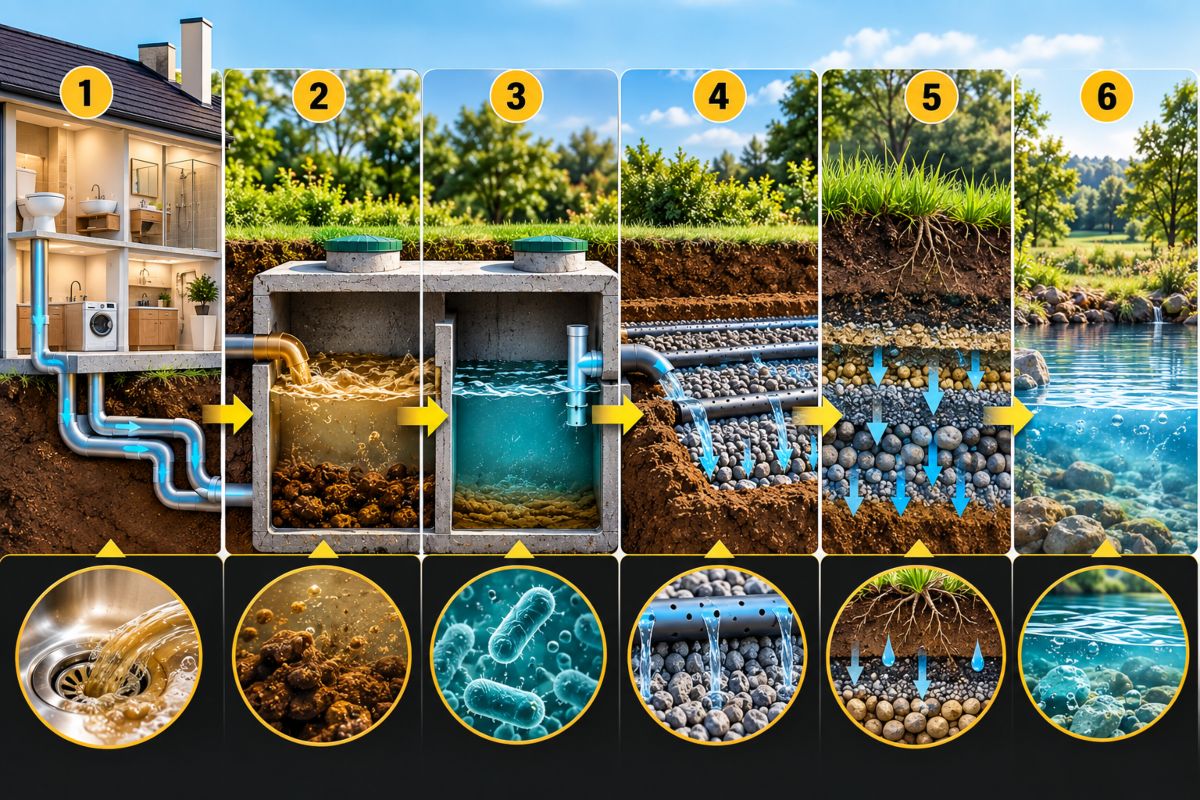
A septic tank works by collecting wastewater, allowing solids to settle and lighter materials to float, while naturally occurring bacteria break down some of the organic waste. The partially treated liquid, known as effluent, then leaves the tank and normally passes into a drainage field for further treatment.
If a property is not connected to a mains sewer, it needs another way to deal with wastewater. One of the most common solutions is a septic tank, an underground system designed to collect household wastewater, separate solids from liquids and provide an initial stage of treatment.
But what actually happens after you flush a toilet or empty a sink? Where does the wastewater go? How are solids separated? What happens to the liquid that leaves the tank? And why does a septic tank need a drainage field?
Understanding how a septic tank works is important for homeowners, landlords and anyone buying a rural property with private drainage. A septic tank is not simply a buried container that stores sewage. It is part of a wider wastewater system involving settlement, natural bacterial activity, pipework and usually a drainage field.
When the system is correctly designed, installed and maintained, it can provide reliable wastewater management for properties without access to a public sewer. However, poor maintenance, excessive wastewater or unsuitable materials entering the system can eventually cause blockages, smells, drainage problems and other issues.
This guide explains the complete septic tank process in simple terms, from the moment wastewater leaves your property to what happens after it leaves the tank.
What is a Septic Tank?
A septic tank is an underground container used to receive and partially treat wastewater from a property that is not connected to a mains sewer.
Wastewater from toilets, sinks, baths, showers and household appliances travels through drainage pipes and enters the tank.
Inside the tank, the wastewater is given enough time to settle. Heavier solid materials sink towards the bottom, lighter materials rise to the surface, and the liquid remains between these two layers.
Bacteria naturally present in the wastewater help break down some of the organic material. The resulting liquid then flows out of the tank through an outlet pipe.
The tank is therefore only one part of the system. The drainage field or another approved discharge arrangement is responsible for further treatment of the effluent.
Read Full blog on → What is a Septic Tank?
The Basic Septic Tank Process
The complete process can be broken down into several stages.
Stage | What Happens | Main Purpose |
Wastewater enters | Household wastewater flows into the tank | Collects wastewater |
Solids settle | Heavy solids sink to the bottom | Forms the sludge layer |
Scum rises | Grease and lighter materials float | Forms the scum layer |
Bacteria work | Microorganisms break down organic matter | Provides partial treatment |
Effluent exits | Liquid leaves through the outlet | Transfers wastewater onwards |
Further treatment | Effluent passes through the drainage field | Provides additional treatment |
Each stage is important. If one part of the system becomes damaged or overloaded, the performance of the entire septic system can be affected.
Step 1: Wastewater Enters the Septic Tank
Everything begins when wastewater leaves the property.
When someone flushes a toilet, takes a shower, washes dishes or uses a washing machine, the wastewater travels through the property’s drainage pipework.
This wastewater can contain:
- Human waste
- Toilet paper
- Food particles
- Soap
- Grease
- Organic matter
- Cleaning products
- Water
The wastewater eventually reaches the septic tank through the inlet pipe.
The inlet is designed to control the flow and reduce excessive disturbance inside the tank. Once the wastewater enters, the tank provides a relatively calm environment where different materials can separate naturally.
Step 2: Wastewater Separates into Layers
One of the most important things that happens inside a septic tank is separation.
Different materials behave differently depending on their density.
Heavy materials sink towards the bottom, while lighter materials float towards the surface.
This creates three main areas inside the tank:
The Sludge Layer
Heavy solid waste settles at the bottom.
Over time, this material accumulates and forms a layer known as sludge.
The sludge contains:
- Solid organic material
- Human waste
- Toilet paper
- Other heavier particles
The sludge does not disappear completely through bacterial activity. As it accumulates, the available capacity inside the tank gradually decreases.
This is why septic tanks need to be inspected and emptied periodically.
The Liquid Layer
Between the sludge and scum is the liquid wastewater.
This is the layer that eventually moves towards the outlet pipe.
Although the liquid has undergone initial treatment inside the tank, it should not be considered completely purified wastewater.
It still requires appropriate further treatment before being safely discharged into the environment.
The Scum Layer
Lighter materials rise to the surface.
These can include:
- Grease
- Oils
- Fat
- Floating organic material
Together, these materials form the scum layer.
Keeping excessive grease and oils out of household drains can help prevent unnecessary problems within the septic system.
Step 3: Bacteria Break Down Organic Material
A septic tank relies partly on natural biological activity.
Wastewater contains microorganisms that can break down some organic material in an environment with limited oxygen.
This biological process reduces some of the organic matter within the wastewater.
However, it is important not to misunderstand what this means.
A septic tank does not completely clean wastewater. It provides an initial treatment stage, while the drainage field and surrounding soil normally provide additional treatment.
This distinction is particularly important when considering how septic systems differ from more advanced sewage treatment plants.
Step 4: The Effluent Moves Towards the Outlet
As new wastewater enters the tank, the liquid level gradually rises.
The liquid effluent in the middle section moves towards the outlet.
The outlet is positioned so that it allows liquid to leave while helping prevent large amounts of sludge and scum from escaping.
This is one reason why excessive sludge accumulation can cause problems.
If the sludge level becomes too high, solid material can begin moving towards the outlet instead of remaining safely at the bottom.
That can potentially lead to blockages and problems within the drainage field.
Step 5: Effluent Leaves the Tank
The partially treated wastewater leaving the tank is known as effluent.
This is where many people misunderstand the septic tank process.
The effluent is not simply clean water.
It has undergone primary treatment, but it still contains dissolved and suspended substances that require further treatment.
For a conventional septic system, the effluent normally moves through pipework towards a drainage field.
Step 6: The Drainage Field Provides Further Treatment
The drainage field is an essential part of many septic systems.
It typically consists of a network of perforated pipes installed within suitable ground.
The effluent is distributed through these pipes and gradually enters the surrounding soil.
The soil then provides additional physical, chemical and biological treatment.
This is why the condition and suitability of the drainage field are extremely important.
A perfectly maintained septic tank can still experience problems if the drainage field is damaged, blocked or unsuitable for the amount of wastewater being produced.
How Does a Drainage Field Work?
The drainage field spreads effluent across a larger area rather than allowing it to collect in one location.
As the liquid moves through the surrounding soil, the soil helps filter and treat the wastewater.
The process depends on several factors, including:
- Soil characteristics
- Ground conditions
- Drainage field design
- Wastewater volume
- System condition
The drainage field therefore works as an extension of the treatment process that began inside the septic tank.
What Happens to the Solids?
Solid waste does not leave the septic tank in the same way as liquid effluent.
The heavier material remains at the bottom and gradually forms sludge.
Although bacteria break down some organic material, sludge continues to accumulate.
Eventually, the tank needs to be emptied.
The frequency depends on factors such as:
- Tank capacity
- Number of occupants
- Wastewater volume
- System design
- Manufacturer guidance
- Local requirements
Regular emptying helps prevent excessive sludge from reducing the effective capacity of the tank.
What Happens to the Scum?
The lighter material floating at the top forms the scum layer.
This layer remains inside the tank and needs to be accounted for during inspection and maintenance.
Large quantities of cooking oils and grease should not be poured down household drains because they can contribute to problems within drainage systems.
Simple habits such as disposing of cooking oil correctly can help reduce the amount of grease entering the septic system.
Why Septic Tanks Need Regular Maintenance
A septic tank is not a completely maintenance-free system.
Regular inspection and appropriate emptying help ensure that:
- Sludge does not become excessive
- Scum does not interfere with operation
- Inlet and outlet pipes remain functional
- Problems are identified early
- The drainage field is protected
Ignoring maintenance can eventually result in more serious problems.
For example, excessive sludge can reduce the space available for wastewater and increase the risk of solids reaching the outlet.
What Can Cause a Septic Tank to Stop Working Properly?
Several factors can affect septic tank performance.
Problem | Possible Effect | Prevention |
Excessive sludge | Reduces available tank capacity | Regular emptying |
Too much grease | Can contribute to blockages | Dispose of cooking oil correctly |
Excessive water use | Can overload the system | Use water efficiently |
Damaged pipework | Can cause leaks or poor flow | Regular inspection |
Blocked drainage field | Prevents proper effluent absorption | Monitor drainage performance |
Incorrect installation | Can affect the entire system | Professional design and installation |
Unsuitable waste | Can disrupt treatment | Avoid flushing inappropriate materials |
What Should Not Go into a Septic Tank?
The contents of a septic tank are strongly influenced by what goes down the property’s drains.
To help protect the system, avoid flushing or pouring unsuitable materials into it.
These can include:
- Wet wipes
- Nappies
- Sanitary products
- Paint
- Solvents
- Large quantities of cooking oil
- Non-biodegradable materials
- Excessive household chemicals
Toilets should generally only receive human waste and toilet paper.
Sinks should also be protected from excessive grease and oils.
How Water Usage Affects a Septic Tank
A septic system needs to cope with the amount of wastewater produced by the property.
Using very large quantities of water within a short period can affect the settlement process.
For example, problems may occur if several water-intensive appliances are used simultaneously while multiple showers and baths are also operating.
Practical water-saving measures include:
- Repairing leaking taps
- Fixing running toilets
- Using efficient appliances
- Spreading laundry throughout the week
- Avoiding unnecessary water usage
Reducing excessive water flow can help the system manage wastewater more effectively.
How Household Size Affects Septic Tank Performance
The number of people using a property has a direct relationship with wastewater production.
A septic tank designed for a small household may not be suitable for a significantly larger number of occupants.
More people generally mean:
- More toilet use
- More showers
- More laundry
- More washing-up
- More wastewater
This is particularly important when buying or extending a property with an existing private drainage system.
Septic Tank vs Sewage Treatment Plant
Although the terms are sometimes used interchangeably, septic tanks and sewage treatment plants are not the same.
Feature | Septic Tank | Sewage Treatment Plant |
Main function | Primary wastewater treatment | More advanced wastewater treatment |
Settlement | Yes | Yes |
Biological treatment | Natural bacterial action | More active biological treatment |
Mechanical equipment | Generally limited | Usually includes mechanical components |
Effluent treatment | Requires further treatment | Designed for a higher level of treatment |
Maintenance | Required | Required |
Energy use | Usually, low | Usually requires electricity |
A septic tank relies heavily on settlement and natural processes, while a sewage treatment plant uses additional treatment stages to achieve a higher level of treatment.
The appropriate system depends on the property, site conditions, discharge requirements and applicable regulations.
Septic Tank vs Cesspool
A cesspool, also known as a cesspit, works differently.
A septic tank partially treats wastewater and allows liquid effluent to leave the tank through an appropriate discharge system.
A cesspool is essentially a sealed storage tank.
Feature | Septic Tank | Cesspool |
Wastewater storage | Yes | Yes |
Partial treatment | Yes | No |
Liquid discharge | Yes, through an appropriate system | No |
Drainage field | Normally associated with the system | Not used |
Emptying | Required periodically | Required regularly |
Understanding the difference is important when buying a property because maintenance requirements and running costs can be very different.
Signs That a Septic Tank May Have a Problem
Early warning signs should never be ignored.
Common indicators include:
Slow Drains
If several drains throughout the property become slow at the same time, the issue may involve the wider drainage system.
Unpleasant Odours
Persistent sewage smells around the tank or drainage field can indicate a problem.
Sewage Backups
Wastewater backing up into toilets, sinks or other fixtures requires prompt attention.
Standing Water
Persistent wet patches around the drainage field may indicate that effluent is not being absorbed correctly.
Unusually Lush Grass
A particularly wet or unusually green area around the drainage field can sometimes indicate wastewater-related problems.
How to Keep a Septic Tank Working Properly
Good habits can help protect the entire system.
Use Water Sensibly
Avoid overwhelming the system with excessive water.
Protect the Drainage Field
Do not drive heavy vehicles over the drainage field unless the system has specifically been designed to withstand such loading.
Avoid Flushing Unsuitable Materials
Only appropriate materials should enter the wastewater system.
Arrange Regular Maintenance
Follow the tank manufacturer’s maintenance recommendations and applicable regulations.
Investigate Problems Early
Small drainage problems can become significantly more expensive when ignored.
A septic tank deals with wastewater, while fuel suppliers deal with products used for heating, vehicles and commercial operations. Businesses operating rural properties may have several different infrastructure requirements, and providers such as 123 Oil may handle fuel requirements separately from private drainage arrangements.
Keeping these systems separate is important because fuel, oils and other unsuitable substances should never be introduced into a septic system.
The Complete Septic Tank Process at a Glance
Process | What Happens | Result |
Wastewater collection | Household wastewater enters the tank | Wastewater is contained |
Settlement | Heavy solids sink | Sludge forms |
Flotation | Lighter materials rise | Scum forms |
Biological action | Bacteria break down organic material | Partial treatment occurs |
Separation | Liquid remains between the layers | Effluent becomes available for discharge |
Outlet flow | Liquid leaves the tank | Effluent moves to the next stage |
Drainage field | Effluent passes through pipes and soil | Further natural treatment occurs |
Final Thoughts
Understanding how a septic tank works becomes much easier when you view the system as a series of connected stages rather than simply an underground container.
Wastewater first enters the tank, where gravity separates heavy solids from lighter materials. Sludge settles at the bottom, scum forms at the top and liquid remains between the two layers. Naturally occurring bacteria then break down some of the organic material before the liquid effluent moves towards the outlet.
But the process does not finish when the effluent leaves the tank. For a conventional septic system, the drainage field and surrounding soil play an important role in providing further treatment.
That is why proper maintenance, sensible water usage and suitable drainage arrangements are so important. A problem with the tank, pipework or drainage field can affect the performance of the whole system.
For homeowners, understanding these stages also makes it easier to recognise warning signs. Slow drains, unpleasant smells, standing water and sewage backups should not be treated as normal parts of owning a septic system.
A well-managed septic system can provide a practical wastewater solution for properties away from mains drainage. The key is to treat the tank, pipework and drainage field as one complete system and give each part the attention it needs.
Frequently Asked Questions
A septic tank collects wastewater, separates solids and liquids, and uses natural bacterial activity for partial treatment. Heavy solids settle at the bottom, lighter materials float and liquid effluent leaves through the outlet towards further treatment.
Heavy solids settle at the bottom and form sludge. Some organic material is broken down naturally, but sludge continues to accumulate and must be removed periodically.
The liquid effluent normally leaves the tank through an outlet pipe and moves towards a drainage field, where it receives further treatment through the soil.
The required frequency depends on the tank size, household usage, system design and manufacturer guidance. Regular inspection helps determine when emptying is required.
No. A septic tank provides primary treatment, but the liquid leaving the tank still requires appropriate further treatment before final discharge.
Avoid flushing wet wipes, sanitary products, nappies, chemicals, paint, solvents and other unsuitable materials. Large quantities of grease and cooking oil should also be kept out of the system.
Common warning signs include slow drainage, sewage smells, standing water, sewage backups and unusually wet areas around the drainage field.