


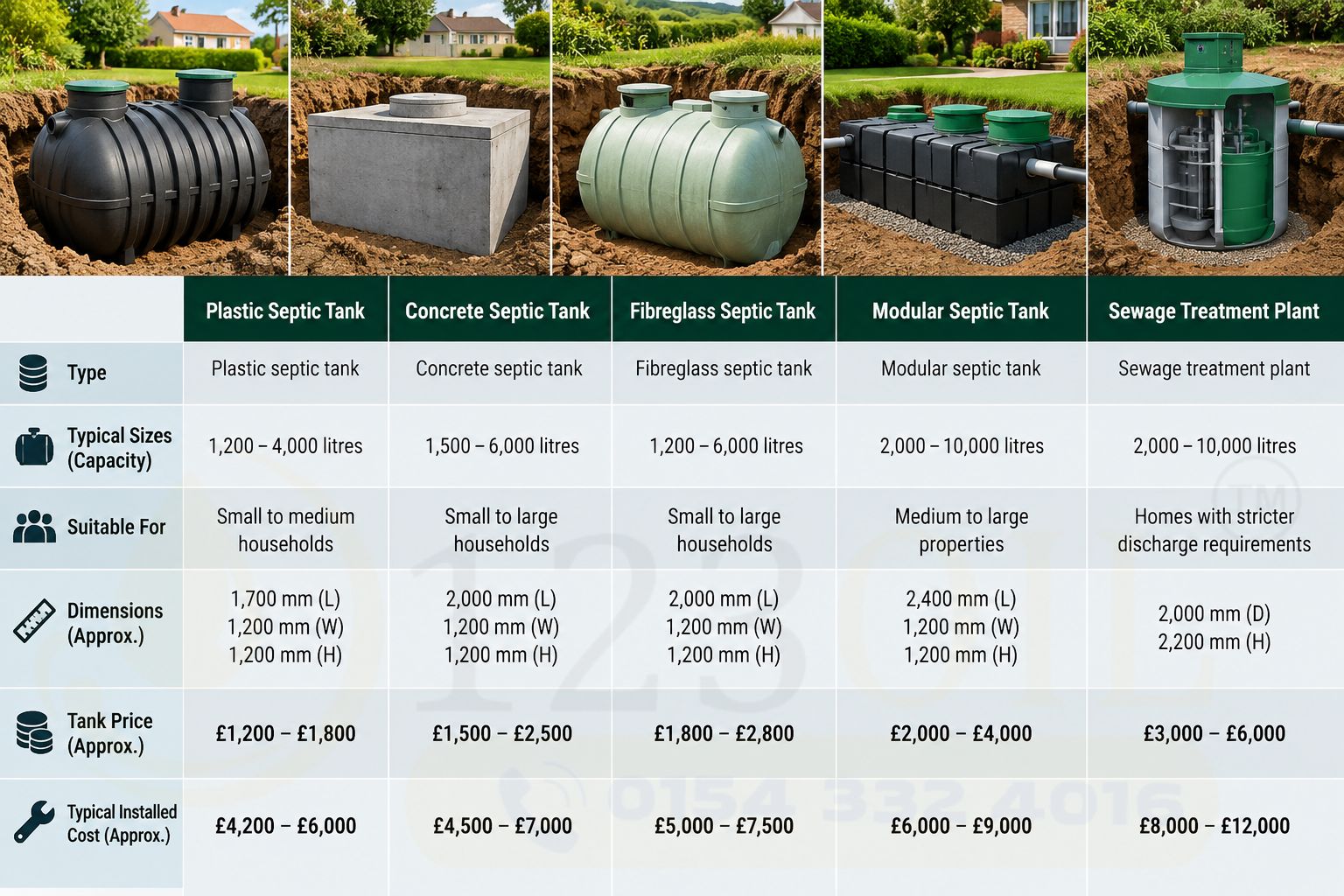
A new septic tank in the UK typically costs around £1,200 to £1,800 for the tank alone, while a complete installation commonly costs about £4,200 to £6,000 including standard excavation and fitting. Costs can exceed £10,000 on complex sites, especially where a new drainage field, difficult groundwork or major compliance upgrades are required.
For homes that are not connected to mains drainage, a septic tank can be one of the most important pieces of infrastructure on the property. It quietly manages wastewater every day, yet most homeowners only start thinking about its cost when an old tank fails, a new property is being built, or an existing drainage system needs upgrading.
So, how much is a new septic tank?
The short answer is that the price varies considerably.
A small domestic tank may cost around £1,200 to buy, but the final bill is rarely just the price of the tank. Excavation, groundwork, drainage field construction, labour, pipework, access, testing and regulatory compliance can push the total much higher. Current UK cost estimates put a typical complete septic tank installation at around £4,200 to £6,000 under normal conditions.
That figure can rise quickly when the site is difficult, machinery cannot easily access the property or the ground is unsuitable for a straightforward drainage field.
Understanding exactly what you are paying for makes it much easier to compare quotes and avoid an unpleasant surprise halfway through the project.
Typical Septic Tank Costs in the UK
A useful way to understand septic tank pricing is to separate the tank purchase price from the complete installation cost.
Current 2026 estimates suggest:
Septic Tank Cost | Typical Price |
Small tank only | Around £1,200 |
Large tank only | Around £1,800 |
Small complete installation | Around £4,200 |
Medium complete installation | Around £5,000 |
Large complete installation | Around £6,000 |
Replacement system | Around £4,000 |
New drainage field | Around £3,000 to £7,000 |
Complex installations | £10,000+ possible |
These are ballpark figures rather than guaranteed prices. Ground conditions, access and the existing drainage arrangement can make a substantial difference.
What Is Included in the Cost of a New Septic Tank?
A septic tank installation is not simply a matter of buying the vessel and lowering it into the ground.
A complete project may involve:
- Site inspection
- Tank sizing
- Ground investigation
- Excavation
- Tank purchase
- Delivery
- Installation
- Inlet and outlet pipework
- Backfilling
- Drainage field construction
- Inspection chambers
- Ventilation
- Testing
- Landscaping repairs
- Building Regulations approval
- Environmental compliance work
This explains why a tank costing £1,500 can eventually become a £5,000 or £6,000 project.
The tank itself is often only one slice of the financial pie.
Tank Size and Its Effect on Price
Tank size is one of the most obvious cost factors.
A septic system must have enough capacity for the property and the expected number of occupants.
A small household usually requires less storage capacity than:
- A large family home
- Multi-generational property
- Guest accommodation
- Rural business premises
- Property with several bathrooms
Installing a tank that is too small can cause poor settlement, frequent emptying and system failure.
Buying the largest tank available is not automatically sensible either.
A properly designed system should match the property’s wastewater demand.
Current estimates place small tanks at roughly £1,200, while larger tanks may cost approximately £1,800 before installation.
Excavation Can Become a Major Cost
Digging the hole sounds straightforward until the excavator meets rock, heavy clay or a garden that cannot accommodate machinery.
Standard excavation is often included within typical installation estimates.
However, costs can rise if the contractor encounters:
- Rock
- Dense clay
- High groundwater
- Existing foundations
- Buried utilities
- Restricted access
- Steep slopes
- Trees and roots
- Retaining walls
- Existing drainage pipes
The deeper or more complicated the excavation becomes, the more labour, machinery and time are required.
This is one reason two properties requiring the same tank can receive very different quotations.
Drainage Field Costs
A septic tank does not normally work alone.
The tank primarily separates solids from liquid wastewater.
The remaining liquid effluent then needs further treatment, generally through a properly designed drainage field.
Installing a new drainage field can typically cost around £3,000 to £7,000, depending on its size, soil conditions and the extent of the groundwork.
A drainage field may be needed when:
- There is no existing field
- The old drainage field has failed
- Existing pipework is clogged
- The system is being upgraded
- The existing arrangement does not comply
- The property is undergoing major redevelopment
This additional work can transform what looks like a £4,000 replacement into a project costing considerably more.
Advantages of Installing a New Septic Tank
Replacing an ageing system can provide several long-term benefits.
Better Reliability
A modern tank reduces the risk of leaks, structural failure and unexpected sewage problems.
Improved Compliance
New systems can be designed around current environmental and Building Regulations requirements.
Lower Risk of Ground Pollution
A correctly installed septic tank and drainage field help wastewater receive suitable treatment before entering the ground.
Easier Maintenance
Modern installations can include properly positioned access covers that make inspections and emptying easier.
Better Property Saleability
An obviously failing drainage system can frighten potential buyers faster than a mysterious damp patch and a nervous estate agent.
A compliant system with maintenance records can provide greater confidence.
Longer Service Life
A well-maintained septic system can potentially last for decades. Current estimates suggest systems can remain serviceable for up to around 40 years depending on materials, usage and ground conditions.
Disadvantages and Costs to Consider
Septic systems also come with responsibilities.
High Initial Installation Cost
Several thousand pounds can be required before the system becomes operational.
Ongoing Emptying
Solids accumulate inside the tank and need to be removed periodically.
Typical UK domestic emptying costs are currently around £175 to £300, although larger tanks or difficult access can increase the price.
Space Requirements
You need enough suitable land for the tank and drainage field.
Ground Suitability
Not every garden is suitable for a traditional septic drainage field.
Maintenance Responsibility
Unlike mains drainage, responsibility for inspection, emptying and maintenance lies with the owner or operator.
Environmental Rules
Poorly operated systems can cause pollution, which can lead to legal and financial consequences.
New Septic Tank vs Replacement Septic Tank
Replacing an existing tank can sometimes cost less than installing a completely new system.
Current UK estimates suggest a standard replacement may cost around £4,000, particularly when the existing drainage field remains suitable and compliant.
However, replacing only the tank is not always possible.
If the drainage field has failed, the replacement cost may need to include:
- Excavation
- Old tank removal
- New pipework
- New drainage field
- Soil testing
- Landscaping restoration
This can push the total well beyond the basic replacement figure.
Plastic Septic Tanks
Modern plastic tanks are widely used because they are relatively lightweight and resistant to corrosion.
Advantages
Plastic septic tanks can offer:
- Easier transportation
- Faster installation
- Corrosion resistance
- Watertight construction
- Lower handling requirements
Disadvantages
They may require careful installation and correct backfilling to prevent:
- Movement
- Deformation
- Buoyancy
- Damage from ground pressure
Groundwater conditions are particularly important.
A lightweight empty tank can potentially move if it is installed incorrectly in wet ground.
Concrete Septic Tanks
Concrete tanks are heavier and extremely robust.
Advantages
They can provide:
- Strong structural resistance
- Good stability underground
- Long service life
- Reduced buoyancy risk
Disadvantages
Concrete tanks can be more difficult and expensive to transport.
They often require larger machinery for lifting and positioning.
Older concrete tanks may also eventually develop cracks or deterioration.
The right material depends on access, soil conditions and the proposed installation.
Site Access Can Change the Price Dramatically
A tank may be relatively inexpensive, but getting it into the garden can be another story.
Properties with easy access for excavators and delivery vehicles are generally cheaper to work on.
Costs may increase where contractors need to negotiate:
- Narrow gates
- Terraced houses
- Limited parking
- Steep land
- Existing extensions
- Mature landscaping
- Fences
- Overhead cables
- Tight rural lanes
In extreme situations, specialist lifting equipment may be required.
Before accepting a quote, ask whether plant access and delivery are fully included.
Soil Conditions and Percolation Testing
The drainage field depends on the soil’s ability to absorb and treat wastewater.
This means soil conditions must be assessed before deciding where and how to install the system.
Percolation testing helps determine whether the ground drains at a suitable rate.
If water passes through the soil too slowly, effluent can rise towards the surface.
If it passes through too quickly, there may not be enough treatment before the wastewater reaches groundwater.
Unsuitable ground can mean the property needs:
- A redesigned drainage field
- A drainage mound
- A treatment plant
- Alternative discharge arrangements
Each alternative can change the budget considerably.
Planning and Building Regulations
A new septic system is not simply a landscaping project.
In England, new sewage treatment systems require Building Regulations approval and may also require planning permission depending on the circumstances.
Building Regulations require septic tanks and other wastewater systems to be constructed and located so they do not harm health, contaminate water sources and remain accessible for maintenance and emptying.
Therefore, the cheapest installation is not necessarily the cheapest legal installation.
Compliance should be built into the project from the beginning.
Environmental Rules Affect the Final Design
In England, septic tanks are covered by the Environment Agency’s general binding rules.
Where the rules are met, a separate environmental permit may not be required.
Septic tank effluent discharged to the ground must meet applicable rules.
These regulations affect:
- System design
- Discharge location
- Drainage field construction
- Pollution control
- Tank capacity
- Maintenance responsibilities
If the proposed arrangement cannot meet the general binding rules, additional permission or a different system may be required.
This is another reason professional assessment matters before purchasing the tank itself.
Septic Tank vs Sewage Treatment Plant Costs
A septic tank is not the only option for properties without mains drainage.
A sewage treatment plant treats wastewater more extensively than a traditional septic tank.
A treatment plant may be more appropriate where:
- Ground conditions are difficult
- Discharge requirements are stricter
- Space is limited
- A drainage field cannot be installed conventionally
Treatment plants often have a higher initial purchase price and may require electricity and servicing.
However, they can offer greater flexibility.
Comparing only purchase price can therefore be misleading.
The best system is the one that works legally and practically on the site.
Cost of Removing an Old Septic Tank
If you are replacing an existing system, the old tank may need to be:
- Emptied
- Cleaned
- Excavated
- Removed
- Crushed or filled
- Safely decommissioned
The exact approach depends on the material, location and project design.
Removal may add considerably to the budget if the old tank is large, made of reinforced concrete or located somewhere difficult to reach.
Make sure your quotation explains what will happen to the old system.
Running Costs After Installation
The financial commitment does not end once the lawn has been put back.
Ongoing costs can include:
- Tank emptying
- Inspection
- Repairs
- Drain cleaning
- Replacement covers
- Pipe repairs
- Drainage field maintenance
Typical tank emptying currently costs around £175 to £300 for many domestic installations.
Spread across a long service life, these costs can still be manageable, but they should be included when comparing septic systems with other wastewater options.
Factors That Increase Septic Tank Installation Costs
Your final quotation is likely to move upwards when the project involves:
- A very large tank
- Difficult ground
- Deep excavation
- Limited machinery access
- Rock removal
- High groundwater
- Long pipe runs
- A completely new drainage field
- Old tank removal
- Extensive landscaping repairs
- Additional regulatory work
- Specialist lifting equipment
On complicated sites, total costs can exceed £10,000.
That is why online averages should be treated as budgeting guides rather than fixed prices.
Ways to Keep Septic Tank Costs Under Control
A lower price should never come at the expense of safe or compliant installation.
However, sensible planning can prevent unnecessary spending.
Obtain Several Itemised Quotes
Do not compare one lump sum with another.
Ask each contractor to separately identify:
- Tank
- Labour
- Excavation
- Drainage field
- Pipework
- Machinery
- Waste removal
- Testing
- Landscaping
- VAT
This makes quote comparison far easier.
Test the Ground Early
Discovering poor soil after excavation has already begun can create expensive design changes.
Choose the Correct Tank Size
Oversizing wastes money.
Undersizing creates operational problems.
Preserve a Compliant Existing Drainage Field
If an existing field is proven to be functional and suitable, retaining it can potentially reduce replacement costs.
Plan Access Before Work Starts
Removing and later rebuilding walls or fences adds unnecessary expense.
New Septic Tank Cost Example
Consider a rural three-bedroom home replacing an ageing tank.
A straightforward project might include:
- New domestic tank
- Excavation
- Standard pipe connections
- Easy excavator access
- Existing suitable drainage field
The project might fall near the £4,000 to £6,000 range.
Now take the same house but add:
- Failed drainage field
- Heavy clay
- Restricted garden access
- Old concrete tank removal
- Additional pipe runs
The final cost may climb beyond £10,000.
Same house size, completely different underground drama.
When Is a New Septic Tank Worth the Investment?
Replacement normally makes sense when the existing tank has reached the point where repairs are no longer economical or safe.
Common signs include:
- Cracked tank walls
- Recurring leaks
- Collapsed internal structure
- Sewage backing up
- Persistent overflow
- Severe corrosion
- Failed drainage connections
- Non-compliant discharge arrangements
Frequent repair bills can eventually cost more than proper replacement.
A new system also provides an opportunity to correct problems with access, drainage, capacity and environmental compliance.
New Septic Tank Installation Process
A typical installation follows several stages.
Site Assessment
The contractor examines the property, wastewater demand, access and ground conditions.
Ground Testing
Where a drainage field is required, soil and percolation conditions are assessed.
System Design
The tank capacity, location and drainage field are planned.
Approvals
Building Regulations and any required environmental or planning matters are addressed.
Excavation
The tank pit, pipe trenches and drainage field are excavated.
Installation
The tank is positioned, levelled and connected.
Drainage Field Construction
Distribution pipes are installed in prepared trenches.
Backfilling
The system is carefully surrounded and covered using appropriate material.
Testing
Connections and drainage performance are checked.
Landscaping
The ground is reinstated.
Professional installation matters because mistakes hidden underground can be expensive to correct.
Septic Tank Maintenance After Installation
Protecting the new system helps maximise its service life.
Good habits include:
- Emptying the tank at appropriate intervals
- Avoiding excessive water use
- Keeping vehicles away from the drainage field
- Avoiding flushing wipes and sanitary products
- Not pouring oils or aggressive chemicals down drains
- Watching for wet patches
- Inspecting covers
- Repairing leaks promptly
For properties using heating oil alongside off-grid wastewater systems, 123 Oil may also be relevant when considering broader rural property services and responsible domestic liquid management.
Common Mistakes When Budgeting for a Septic Tank
Looking Only at the Tank Price
A £1,500 tank does not equal a £1,500 installation.
Forgetting the Drainage Field
This can add thousands of pounds.
Ignoring Ground Conditions
Unexpected rock or groundwater can transform the excavation cost.
Choosing the Cheapest Quote Automatically
An unusually cheap quote may exclude important elements.
Forgetting Long-Term Maintenance
Emptying and servicing continue throughout the life of the system.
Buying Before a Site Assessment
Never purchase a tank just because it looks the right size online.
The installation must suit the property and legal requirements.
Final Thoughts
So, how much is a new septic tank?
For UK homeowners, the tank itself may typically cost around £1,200 to £1,800, while complete standard installations usually fall around £4,200 to £6,000. More complicated work, especially projects requiring drainage fields, difficult excavation or extensive compliance work, can exceed £10,000.
Rather than focusing only on the cheapest tank, budget for the complete wastewater system.
Tank size, soil, access, drainage field design, installation quality and legal compliance all affect the true cost.
A properly planned septic system represents a significant upfront investment, but when correctly installed and maintained, it can provide reliable wastewater treatment for many years.
Frequently Asked Questions
A septic tank alone typically costs around £1,200 to £1,800, depending on size. A complete standard installation generally costs approximately £4,200 to £6,000.
A standard septic tank replacement may cost around £4,000 where the existing drainage field can still be used. A new drainage field or difficult groundwork can substantially increase the cost.
The cost includes much more than the tank. Excavation, labour, pipework, drainage field construction, delivery, ground testing and compliance work can all contribute to the final price.
A new drainage field typically costs around £3,000 to £7,000, depending on its size, ground conditions and the amount of excavation required.
Typical domestic septic tank emptying currently costs around £175 to £300, although location, tank size, access and waste volume can affect the final charge.
Yes. Complex projects can exceed £10,000, especially where there is difficult excavation, poor access, a new drainage field, extensive groundwork or regulatory upgrades.
A well-maintained septic system can potentially last for decades, with some systems lasting around 40 years, depending on construction material, usage and ground conditions.