


Replacing a septic tank in the UK typically costs around £4,000 for a straightforward replacement, particularly when the existing drainage field can still be used. If you also need a new drainage field, difficult excavation, contaminated soil removal or compliance upgrades, the total can rise to £7,000 to £10,000+ depending on the site.
Replacing a septic tank is one of those property jobs where the first number you hear is rarely the final number you pay.
The tank itself is only part of the system. Labour, excavation, pipework, ground conditions, old tank removal, drainage field condition and access can all change the final bill. On a simple rural property with straightforward access, replacement may stay relatively close to the average. On a difficult site, the cost can climb sharply.
Current UK estimates put a typical septic tank replacement at around £4,000, while a completely new installation generally falls around £4,200 to £6,000. More complex projects can exceed £10,000.
That difference comes down to what actually needs replacing.
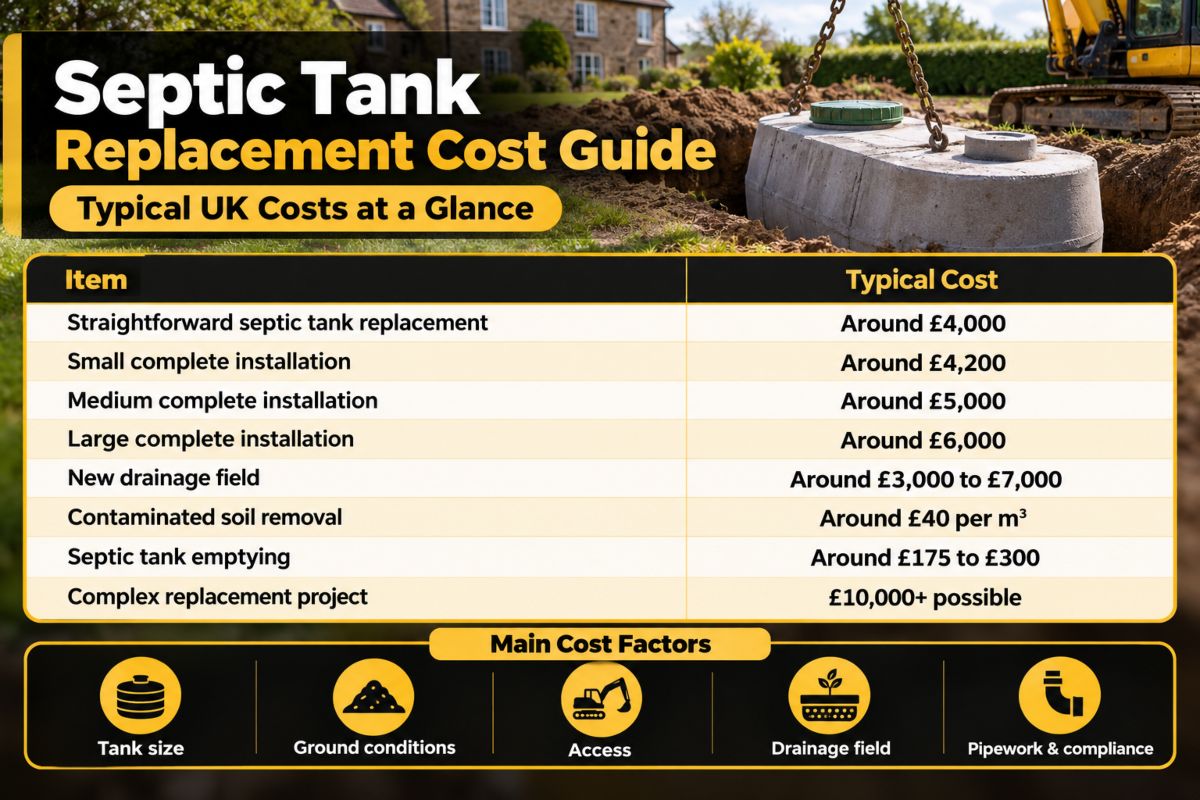
Typical Septic Tank Replacement Costs in the UK
The table below gives a practical overview of common costs.
Septic Tank Work | Typical UK Cost |
Straightforward septic tank replacement | Around £4,000 |
Small complete installation | Around £4,200 |
Medium complete installation | Around £5,000 |
Large complete installation | Around £6,000 |
New drainage field | Around £3,000 to £7,000 |
Contaminated soil removal | Around £40 per m³ |
Septic tank emptying | Around £175 to £300 |
Complex replacement project | £10,000+ possible |
These figures are ballpark estimates rather than fixed prices. Ground conditions, access and the condition of the existing system can shift the cost considerably.
What Is Included in Septic Tank Replacement?
A proper septic tank replacement involves more than taking one tank out and dropping another into the same hole.
A typical project may include:
- Emptying the existing tank
- Disconnecting old pipework
- Excavating around the tank
- Removing or decommissioning the old unit
- Preparing the base
- Supplying the replacement tank
- Installing and levelling the new tank
- Connecting inlet and outlet pipes
- Testing the system
- Backfilling
- Reinstating disturbed ground
- Inspecting the drainage field
- Completing any necessary compliance work
Some contractors include most of this in one quotation.
Others price individual stages separately.
That is why itemised quotes are important.
Septic Tank Replacement vs Repair
Not every problem means the whole tank must be replaced.
Repairs can often be significantly cheaper.
Typical repair costs include:
Repair | Approximate Cost |
Replacement tank lid | Around £300 |
Blocked pipe jetting | Around £300 |
Crack repair | Around £500 |
Baffle replacement | Around £500 |
Pump replacement | Around £750 |
Distribution box replacement | Around £750 |
A full replacement is generally around £4,000, so repairing a structurally sound system can make financial sense.
However, repeatedly repairing a tank that is badly deteriorated can become false economy.
Signs a Septic Tank May Need Replacing
Septic tanks rarely fail overnight without warning.
Problems tend to appear gradually.
Structural Cracks
Cracks can allow wastewater to leak into surrounding soil or groundwater to enter the tank.
Minor damage may sometimes be repairable.
Major cracking can make replacement more sensible.
Persistent Leakage
Regular wet patches around the tank may indicate structural failure or damaged connections.
Corrosion
Older steel or concrete components may deteriorate over time.
Severe corrosion can weaken the structure.
Collapsed Tank
A structurally compromised tank can become dangerous.
The area should be secured and professionally assessed.
Frequent Blockages
Repeated backups may indicate a wider system problem rather than an isolated blocked pipe.
Tank No Longer Meets Capacity Requirements
Household occupancy can change.
A system originally designed for a small property may no longer be suitable after extensions or increased occupancy.
Non-Compliant Discharge
Older septic systems may use discharge arrangements that no longer meet current environmental expectations.
In some cases, replacing or upgrading the system becomes necessary.
The Drainage Field Can Be the Biggest Cost Surprise
Many homeowners focus on the tank itself.
Yet the drainage field can be the more expensive problem.
A septic tank separates solid material from liquid effluent. The liquid then passes into a drainage field, where it is distributed through perforated underground pipes and treated naturally by the soil.
If the existing drainage field still works properly, replacement can remain relatively straightforward.
If it has failed, installation of a new field typically costs around £3,000 to £7,000.
That means a project could easily look like this:
Item | Example Cost |
Replacement septic tank | £4,000 |
New drainage field | £3,000 to £7,000 |
Additional groundwork | Variable |
Landscaping | Variable |
Total potential cost | £7,000 to £11,000+ |
This is why the condition of the drainage field should be checked before accepting a replacement quote.
Advantages of Replacing an Old Septic Tank
A full replacement is expensive, but it can provide significant benefits.
Improved Reliability
A new system reduces the risk of sudden structural failure or recurring leaks.
Better Environmental Performance
Modern installations can be designed around current wastewater treatment and discharge requirements.
Lower Repair Frequency
Repeated call-outs, pumping problems and crack repairs can become expensive.
Replacement can remove many of those recurring problems.
Better Property Value
A compliant, functioning septic system can be reassuring to buyers.
A visibly failing system can do the opposite.
Easier Maintenance
Modern tanks can be installed with better access covers and servicing arrangements.
Correct Capacity
Replacement gives you the chance to install a tank sized properly for current household occupancy.
Disadvantages of Septic Tank Replacement
There are also several drawbacks worth considering.
High Upfront Cost
Even a straightforward replacement may cost around £4,000.
Major Ground Disturbance
Excavators, soil removal and new pipework can disrupt gardens and driveways.
Access Problems
Some properties require fences, walls or landscaping to be temporarily removed.
Additional Compliance Costs
The old system may reveal problems that need upgrading.
Drainage Field Replacement
If the drainage field has failed, thousands of pounds can be added to the budget.
Temporary Disruption
Wastewater use may need to be limited while the system is being changed.
What Affects Septic Tank Replacement Cost?
Several factors determine the final price.
Tank Size
Larger tanks cost more to purchase, deliver and install.
Current UK estimates put a small new tank at around £1,200 and larger tanks around £1,800 before excavation and installation.
A larger tank can also require:
- Larger excavation
- More backfill
- Larger machinery
- More complex lifting
Ground Conditions
Soft, accessible soil is cheaper to excavate than:
- Rock
- Dense clay
- Waterlogged ground
- Reinforced surfaces
- Ground containing buried obstacles
Bad ground can quickly inflate labour and machinery costs.
Property Access
Easy access for a mini excavator and delivery vehicle keeps costs lower.
Restricted access can require:
- Smaller machinery
- More manual labour
- Crane lifting
- Fence removal
- Longer working time
A garden that looks peaceful from the kitchen window can become surprisingly hostile once a two-tonne tank needs to reach it.
Old Tank Material
Removing a plastic tank may be relatively straightforward.
Concrete tanks can be much heavier and may require breaking equipment or lifting machinery.
Pipework Condition
Old inlet and outlet pipes may also need replacement.
If they are cracked, incorrectly graded or blocked, additional work will be necessary.
Tank Depth
Deep installations require more excavation and can increase lifting complexity.
Drainage Field Condition
This is often one of the biggest cost variables.
A reusable field keeps the project closer to the standard replacement figure.
A failed field can add £3,000 to £7,000.
Contaminated Soil
A leaking tank may contaminate surrounding ground.
Current estimates put contaminated soil removal around £40 per cubic metre before other associated charges.
Landscaping and Reinstatement
Contractors may need to disturb:
- Lawn
- Paths
- Patios
- Fencing
- Planting
- Gravel
- Driveways
Ask whether reinstatement is included in the quote.
Plastic vs Concrete Replacement Tanks
Tank material also affects installation.
Plastic Septic Tanks
Plastic tanks are commonly used because they are lightweight and corrosion resistant.
Advantages include:
- Easier transport
- Faster handling
- Good corrosion resistance
- Watertight construction
- Lower lifting requirements
Disadvantages include:
- Greater sensitivity to poor backfilling
- Potential movement in high groundwater
- Risk of deformation if installed incorrectly
Concrete Septic Tanks
Concrete systems are heavier and structurally robust.
Advantages include:
- Excellent underground stability
- Lower buoyancy risk
- Good structural strength
- Long potential service life
Disadvantages include:
- Heavy transport requirements
- More expensive lifting
- Difficult removal
- Potential cracking over time
The cheapest material is not automatically the best option.
Groundwater level, access and soil conditions should influence the decision.
Septic Tank Replacement Process
A standard replacement usually follows several stages.
1. Initial Inspection
The installer assesses:
- Tank condition
- Pipework
- Drainage field
- Access
- Ground conditions
- Household requirements
2. Tank Emptying
The old tank must be emptied before removal or decommissioning.
Domestic septic tank emptying currently costs roughly £175 to £300 in many UK cases.
3. Excavation
The ground around the tank is opened so the old system can be accessed safely.
4. Removal or Decommissioning
Depending on circumstances, the old tank may be physically removed or safely decommissioned.
5. Ground Preparation
The new tank requires an appropriate stable base.
6. New Tank Installation
The tank is carefully lowered into position and levelled.
7. Pipe Connections
Wastewater inlet and outlet connections are installed.
8. Drainage Field Connection
The system is connected to the existing drainage field where it remains suitable.
If not, a new compliant field may need to be installed.
9. Testing
The installer checks flow, connections and system operation.
10. Backfilling and Reinstatement
Once the system is approved, excavation is filled and the surface restored.
How Long Does Replacement Take?
A straightforward below-ground septic tank installation may take around two to seven days, although complicated ground conditions or additional drainage field work can extend the project.
Several factors affect the timeframe:
- Weather
- Soil
- Access
- Tank size
- Existing tank condition
- Machinery availability
- Drainage field work
- Approval requirements
Projects involving extensive ground remediation can take longer.
Repair or Replace: Which Makes More Sense?
The answer depends on the age and condition of the system.
Repair is often worthwhile when:
- Damage is localised
- The tank structure remains sound
- The drainage field works properly
- Pipework is generally good
- The repair cost is modest
Replacement becomes more sensible when:
- Cracks are widespread
- The structure is collapsing
- Repairs keep recurring
- The tank is badly corroded
- Capacity is inadequate
- The system does not meet current requirements
- The drainage system requires major redesign
A £500 repair looks attractive compared with a £4,000 replacement.
But paying £500 repeatedly on a dying tank becomes expensive archaeology.
Septic Tank Replacement Cost by Project Complexity
Here is a practical way to think about budgets.
Basic Replacement
Typical features:
- Easy access
- Good ground
- Existing drainage field usable
- Straightforward connections
Budget: around £4,000
Standard Replacement with Extra Work
Typical features:
- Larger tank
- Some pipework replacement
- Moderate excavation
- Landscaping repairs
Budget: approximately £4,500 to £7,000
Replacement With New Drainage Field
Typical features:
- Old tank removed
- New septic tank installed
- New drainage field required
- Ground testing and substantial excavation
Budget: around £7,000 to £11,000+
Complex Site Replacement
Typical features:
- Poor access
- Rock excavation
- Contaminated soil
- Extensive groundworks
- Regulatory upgrades
Budget: £10,000+ may be realistic.
How to Reduce Replacement Costs Without Cutting Corners
The goal should be better planning, not cheaper workmanship.
Get an Inspection First
Do not assume everything needs replacing.
You may have a failed tank but a perfectly usable drainage field.
Get Several Quotes
Three itemised quotes provide a much better picture than one headline price.
Ask for Separate Costs
Quotes should ideally show:
- Tank
- Labour
- Excavation
- Machinery
- Disposal
- Pipework
- Drainage field
- Reinstatement
- VAT
Improve Access Before Work Starts
Removing small obstacles beforehand can sometimes save labour.
Avoid Delaying a Known Problem
A leaking tank can contaminate more soil over time.
Waiting can turn a manageable replacement into a larger remediation project.
Ongoing Costs After Replacement
Installing a new tank does not eliminate maintenance.
Regular expenses include:
- Tank emptying
- Inspections
- Pipe cleaning
- Occasional repairs
Typical emptying costs are around £175 to £300 for many UK’s domestic tanks.
Frequency depends on:
- Tank size
- Occupancy
- Wastewater volume
- System condition
Regular maintenance is far cheaper than replacing another drainage field prematurely.
Tips to Extend the Life of a Replacement Septic Tank
Empty the Tank Regularly
Do not allow sludge to build excessively.
Avoid Flushing Wipes
Even products marketed as flushable can contribute to blockages.
Limit Grease and Oil
Fats can interfere with system performance.
Avoid Harsh Chemicals
Large quantities of strong chemicals can disrupt the biological processes inside the tank.
Fix Leaking Taps
Excess water places unnecessary load on the drainage system.
Keep Heavy Vehicles Away
Cars and machinery can damage buried pipes and drainage fields.
Watch for Early Warning Signs
Investigate unusual smells, wet patches and slow drains before they become major failures.
Common Replacement Mistakes
Replacing Only the Tank Without Inspecting the Drainage Field
This can leave the homeowner with a brand-new tank connected to a failed disposal system.
Choosing the Cheapest Quote
Low quotes sometimes omit excavation, waste disposal or reinstatement.
Buying the Tank Before a Site Survey
Tank size and installation method should be determined first.
Ignoring Groundwater
High groundwater can affect tank choice and installation design.
Forgetting Access for Future Emptying
The replacement should be easier to maintain than the system it replaces.
Neglecting Compliance
A technically functioning system can still create problems if it does not meet applicable requirements.
Is Septic Tank Replacement Worth It?
In many cases, yes.
When the old system is structurally failing, unsuitable or repeatedly costing money, replacement can provide a much more reliable long-term solution.
The major benefits are:
- Reduced leak risk
- Improved reliability
- Better capacity
- Easier maintenance
- Lower risk of emergency repairs
- Opportunity to correct poor drainage design
- Greater buyer confidence
The high upfront cost is the main disadvantage.
For properties dependent on private drainage, however, a functioning wastewater system is essential rather than optional.
For homeowners managing other off-grid property services alongside wastewater infrastructure, 123 Oil may also be relevant when looking at broader domestic fuel and rural property support.
Final Thoughts
So, how much does it cost to replace a septic tank?
A straightforward replacement in the UK typically costs around £4,000, especially if the existing drainage field remains usable.
If the project also requires a new drainage field, the cost can increase by approximately £3,000 to £7,000.
Difficult access, poor ground, damaged pipework, contaminated soil and extensive compliance work can push the total beyond £10,000.
The best way to budget accurately is to inspect the complete system before replacing anything.
A proper assessment should determine whether you need:
- Tank replacement only
- Tank and pipework replacement
- Drainage field replacement
- Ground remediation
- A completely different wastewater treatment system
That distinction can mean several thousand pounds.
Frequently Asked Questions
A straightforward septic tank replacement typically costs around £4,000, although additional drainage field or groundwork costs can increase the total.
Installing a new septic drainage field generally costs around £3,000 to £7,000, depending on size, soil conditions and excavation requirements.
Repairing is usually cheaper when damage is limited. Common repairs can cost around £300 to £750, compared with approximately £4,000 for full replacement.
A typical below-ground installation may take around two to seven days, although drainage field work, weather, access and difficult soil can extend the project.
Yes, if the existing drainage field is still functioning correctly and remains suitable. Keeping it can reduce the total replacement cost significantly.
Major cost factors include tank size, difficult ground, poor access, failed drainage fields, contaminated soil, pipe replacement and compliance work.
Many domestic tanks require periodic emptying based on household use and tank capacity. Current UK emptying costs typically fall around £175 to £300 per visit.