

To clean a septic tank, hire a professional waste carrier to pump out accumulated sludge, scum and wastewater. The process includes removing waste, inspecting pipes and checking for blockages or damage. In the UK, septic tanks should generally be desludged annually or as recommended by the manufacturer.
Understanding Septic Tank Cleaning and Why It Matters
A septic tank is an important part of a property’s private wastewater system, particularly in rural areas of the UK where homes are not connected to the public sewer network. It collects sewage from toilets, bathrooms, kitchens and other household drainage points, allowing solids to separate from liquid wastewater.
Although septic tanks are designed to manage sewage naturally, they cannot operate indefinitely without maintenance. Sludge gradually accumulates at the bottom, while fats, grease and other floating materials form a layer of scum at the top. If these materials are not removed, they reduce the tank’s effective capacity and increase the likelihood of drainage problems.
Regular septic tank cleaning helps prevent sewage backups, unpleasant odours, blocked pipes and damage to the drainage field. It also reduces the risk of untreated wastewater contaminating nearby soil, groundwater and watercourses.
For UK homeowners, maintaining a septic tank is more than a practical consideration. Environmental regulations require private sewage systems to operate without causing pollution, and different requirements apply across England, Scotland, Wales and Northern Ireland.
Understanding the correct cleaning procedure, maintenance schedule and legal responsibilities can prevent expensive repairs and help keep the entire wastewater system operating effectively.
How Does a Septic Tank Work?
Before learning how to clean a septic tank, it helps to understand what happens inside it.
A conventional septic tank provides primary treatment by separating wastewater into three main layers.
1. Sludge Layer
Heavier solids settle at the bottom of the tank, forming sludge. Naturally occurring bacteria break down some organic material, but they cannot eliminate all accumulated solids.
Over time, the sludge layer becomes thicker and must be professionally removed.
2. Liquid Wastewater Layer
Between the sludge and scum is a layer of partially treated wastewater.
As new sewage enters the tank, liquid flows through the outlet towards a suitable drainage field, where further treatment occurs within the soil.
3. Scum Layer
Oils, fats, grease and other floating materials form a layer of scum on the surface.
The tank’s internal baffles or outlet arrangements help prevent excessive floating material and solids from entering the drainage field.
When the sludge and scum layers become too thick, solid waste can escape into the outlet pipe. This may block the drainage field and lead to costly repairs.
Important: A septic tank is not the same as a cesspit or package sewage treatment plant. A cesspit stores sewage without a normal treatment discharge, while a package treatment plant provides a higher level of wastewater treatment.
How to Clean a Septic Tank: Step-by-Step Process
The following explains how a professional cleans a septic tank. Homeowners can prepare the area and monitor the system, but sewage removal and internal servicing should be carried out by competent specialists.
Step 1: Locate the Septic Tank
The first step is identifying the location of the septic tank and its access points.
Septic tanks are normally installed underground, often within a garden, driveway area or other accessible part of a property.
If you do not know where your tank is located, check the property’s drainage plans, installation documents or previous maintenance records.
A drainage specialist can also locate the system using suitable survey equipment.
Do not dig blindly or attempt to uncover buried pipework without identifying underground utilities.
Step 2: Prepare the Area for Cleaning
A professional septic tank cleaning service usually requires access for a vacuum tanker.
Before the appointment:
- Remove movable obstacles from the access route.
- Clear vegetation around the tank lid without disturbing its structure.
- Keep children and pets away from the working area.
- Inform the contractor about narrow gates, steep driveways or restricted access.
- Identify any buried pipes, fragile surfaces or underground obstacles.
- Check whether the tanker can park close enough for its suction hose.
Good preparation reduces unnecessary delays and may help avoid additional access charges.
Homeowners should not open heavy, damaged or unsecured tank covers themselves.
Step 3: Arrange a Professional Tank Inspection
Before removing waste, the contractor should assess the system and identify potential safety or operational problems.
Depending on the installation, the inspection may include checking the tank’s access arrangements, visible liquid level, condition of accessible components and signs of leakage.
The specialist may also examine whether the system has been experiencing unusually slow drainage or repeated blockages.
A tank with a high liquid level may have an obstructed outlet or drainage field problem. An unexpectedly low level could indicate leakage.
These conditions should be investigated rather than assuming that pumping alone will solve the issue.
Step 4: Pump Out the Sludge and Wastewater
Professional septic tank emptying involves removing accumulated waste using a specialist vacuum tanker.
The contractor opens the tank using suitable safety procedures and inserts a suction hose through the designated access point.
Vacuum equipment removes the contents required for effective desludging, including settled sludge and floating scum.
The material is transferred into the tanker for transportation to an authorised treatment or disposal facility.
A standard emptying service generally removes the pumpable contents of the tank. Where more thorough cleaning is required, the contractor may use specialist techniques to remove stubborn deposits.
Never enter a septic tank, lean into its opening or attempt to climb inside to remove sludge. Dangerous gases, oxygen deficiency and harmful microorganisms can cause serious injury or death.
Step 5: Inspect the Tank’s Internal Components
Once the waste has been removed, accessible internal components can be examined more effectively.
The contractor may assess:
- Inlet and outlet pipes for blockages or damage.
- Baffles and tees for deterioration or displacement.
- Concrete, fibreglass or plastic tank walls for visible damage.
- Pipe connections and seals for leaks.
- Outlet filters, where fitted, for accumulated debris.
- Signs of root intrusion or structural movement.
Any specialist cleaning of filters or internal components should follow the manufacturer’s instructions.
Not every maintenance visit includes a full structural inspection, so homeowners should confirm what their chosen service covers.
Step 6: Remove Remaining Deposits if Necessary
In some circumstances, a standard pump-out may not remove compacted deposits or material trapped around accessible components.
A professional may recommend additional cleaning using appropriate equipment.
However, aggressive pressure washing is not automatically necessary and can damage older tanks, seals or internal fittings.
Any additional cleaning should be based on the condition of the tank and performed without pushing waste into the drainage field.
Chemical drain cleaners, acids and other harsh substances should never be poured into the tank as a substitute for proper sludge removal.
Step 7: Check the Drainage Field
After cleaning, the contractor should consider whether the drainage field is functioning correctly, particularly if the system previously experienced poor drainage.
A drainage field allows septic tank effluent to disperse through suitable soil for further treatment.
Potential warning signs include standing water, sewage odours, unusually wet ground and persistent drainage problems.
A blocked or saturated drainage field cannot normally be repaired simply by emptying the septic tank.
Further investigation may involve checking the outlet, distribution arrangements and ground conditions.
Step 8: Secure the Tank and Record the Service
Once the necessary work is complete, the contractor should securely replace the access covers and leave the area safe.
Depending on the tank’s design and the manufacturer’s instructions, the contractor may carry out additional commissioning or operating checks.
The septic tank will normally return towards its operating liquid level as wastewater enters from the property.
Finally, retain a record of the work, including the date, contractor, waste collection details, inspection findings and recommended next service.
These records help establish a reliable maintenance history and may be useful when selling the property.
How Often Should You Clean a Septic Tank in the UK?
For a conventional domestic septic tank in England, Environment Agency guidance says that sludge must be removed before it exceeds the system’s maximum capacity. It recommends desludging at least once a year or according to the manufacturer’s instructions.
The appropriate schedule also depends on household occupancy, tank capacity, wastewater production and the condition of the system.
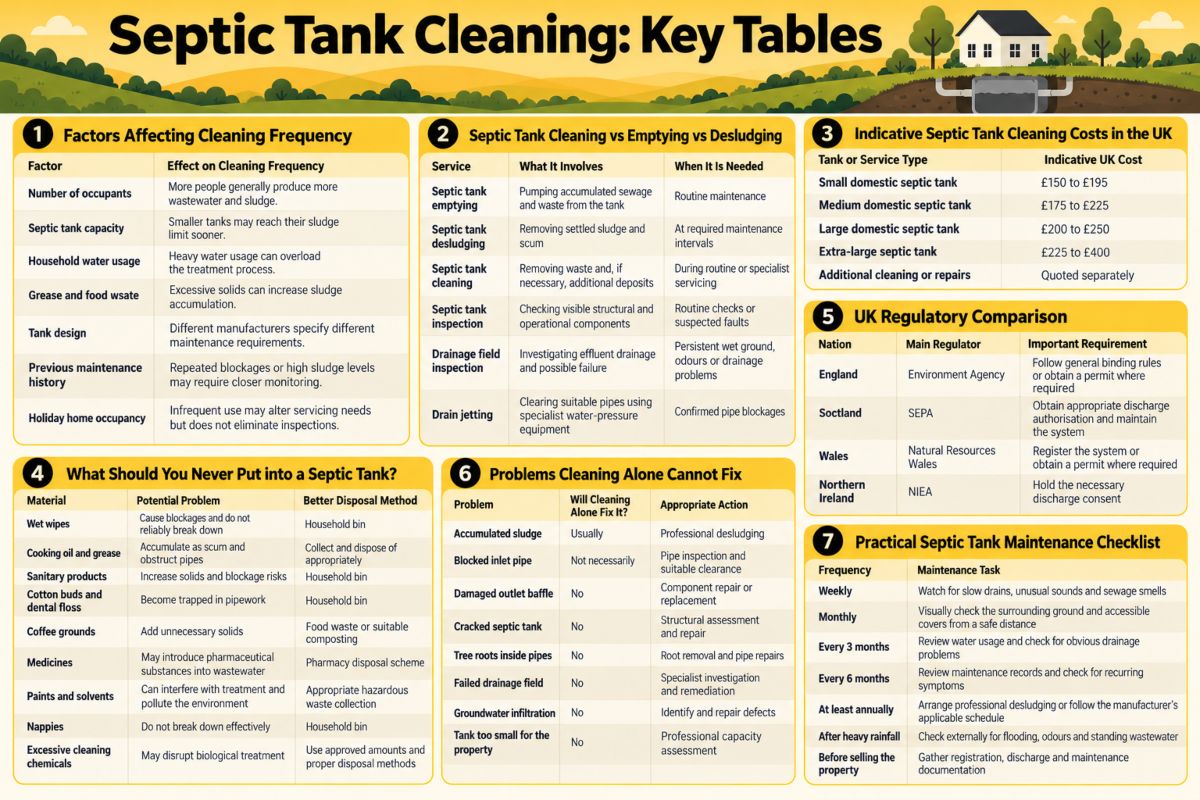
Factor | Effect on Cleaning Frequency |
Number of occupants | More people generally produce more wastewater and sludge. |
Septic tank capacity | Smaller tanks may reach their sludge limit sooner. |
Household water usage | Heavy water usage can overload the treatment process. |
Grease and food waste | Excessive solids can increase sludge accumulation. |
Tank design | Different manufacturers specify different maintenance requirements. |
Previous maintenance history | Repeated blockages or high sludge levels may require closer monitoring. |
Holiday home occupancy | Infrequent use may alter the servicing needs, but does not eliminate inspections. |
A yearly emptying schedule is a useful starting point, but it should not replace the manufacturer’s instructions or professional assessment.
Avoid waiting until sewage backs up into the house before arranging maintenance.
Signs Your Septic Tank Needs Cleaning
A septic tank can develop problems before sewage overflows. Recognising the early warning signs can prevent substantial damage.
1. Slow-Draining Sinks and Toilets
If several household fixtures begin draining slowly, the problem may involve the septic system rather than an individual pipe.
Excess sludge, a blocked inlet or outlet, or a saturated drainage field can restrict wastewater movement.
However, slow drainage alone does not prove that the tank needs emptying.
2. Unpleasant Sewage Smells
Persistent sewage odours around the tank, inspection chambers or drainage field may indicate a blocked pipe, leakage or failure of the treatment system.
A properly operating system should not produce persistent strong odours around the property.
3. Standing Water Around the Drainage Field
Waterlogged ground near the drainage field can be a warning sign, particularly during otherwise dry weather.
Possible causes include a blocked outlet, failed drainage field or unsuitable ground conditions.
Heavy rainfall can also cause temporary saturation, so professional investigation is important.
4. Sewage Backing Up into the Property
Sewage backing up through toilets, baths or floor drains requires urgent attention.
Stop using water where practical, keep people away from contaminated areas and arrange professional assistance.
Do not attempt to force the blockage through using chemical drain cleaners.
5. Unusually Green Grass
A patch of unusually lush grass above the drainage field, particularly when accompanied by damp ground or sewage smells, may indicate escaping wastewater.
Grass colour alone is not a reliable diagnosis, but the combination of symptoms warrants investigation.
6. Unexplained Changes in Tank Levels
An abnormally high liquid level may suggest an outlet blockage or drainage field failure.
An unusually low level may indicate leakage through the tank or associated pipework.
Septic Tank Cleaning vs Emptying vs Desludging
Although these terms are frequently used interchangeably, they can describe slightly different services.
Service | What It Involves | When It Is Needed |
Septic tank emptying | Pumping accumulated sewage and waste from the tank | Routine maintenance |
Septic tank desludging | Removing settled sludge and scum | At required maintenance intervals |
Septic tank cleaning | Removing waste and, if necessary, additional deposits | During routine or specialist servicing |
Septic tank inspection | Checking visible structural and operational components | Routine checks or suspected faults |
Drainage field inspection | Investigating effluent drainage and possible failure | Persistent wet ground, odours or drainage problems |
Drain jetting | Clearing suitable pipes using specialist water-pressure equipment | Confirmed pipe blockages |
A useful distinction is that emptying removes accumulated waste, while a full maintenance visit may also include inspections and additional cleaning.
Ask the contractor exactly which services are included in the quoted price.
How Much Does Septic Tank Cleaning Cost in the UK?
In 2026, professional septic tank emptying commonly costs approximately £175 to £300 for a standard domestic installation, although larger tanks, difficult access and additional work may increase the price. Current UK cost guides report an average of approximately £225.
These figures are indicative rather than fixed national prices.
Tank or Service Type | Indicative UK Cost |
Small domestic septic tank | £150 to £195 |
Medium domestic septic tank | £175 to £225 |
Large domestic septic tank | £200 to £250 |
Extra-large septic tank | £225 to £400 |
Additional cleaning or repairs | Quoted separately |
Factors Affecting Septic Tank Cleaning Costs
- Tank capacity: Larger tanks may contain more material requiring collection and disposal.
- Accessibility: A difficult location may require longer hoses, specialist equipment or extra labour.
- Property location: Travel distances and local disposal arrangements can affect contractor prices.
- Waste volume: Some contractors price services according to the amount of waste removed.
- Emergency attendance: Urgent visits outside normal working hours may attract additional charges.
- Condition of the system: Blockages, damaged components or compacted deposits may require additional services.
When requesting a quotation, confirm whether VAT, waste disposal, hose extensions, inspection and additional cleaning are included.
Regular scheduled maintenance can be more economical than emergency sewage removal.
Can You Clean a Septic Tank Yourself?
Homeowners can carry out basic external maintenance, but they should not attempt to empty a septic tank themselves.
Professional sewage removal requires suitable pumping equipment, safe working procedures and lawful waste transportation and disposal.
Septic tanks can contain hazardous gases, including hydrogen sulphide and methane. Oxygen-deficient atmospheres can also develop.
These dangers may not be obvious from outside the tank.
Never enter a septic tank, lower your head into an inspection opening or attempt a confined-space rescue.
Safe Maintenance Tasks for Homeowners
You can help maintain your septic system by:
- Keeping access covers unobstructed and reporting damaged lids.
- Watching for unusual smells or wet ground.
- Monitoring drainage performance inside the house.
- Reducing unnecessary water consumption.
- Keeping records of professional maintenance.
- Avoiding unsuitable chemicals and non-biodegradable materials.
- Arranging inspections when warning signs appear.
These activities support the system without exposing you to the hazards of handling sewage.
Best Products for Cleaning a Septic Tank
One common misconception is that septic tanks require regular chemical cleaning to remove waste.
In reality, conventional septic tanks rely on naturally occurring microorganisms to help break down organic material.
Introducing inappropriate cleaning products can interfere with the biological process.
Septic-Safe Household Cleaners
Use ordinary household cleaning products in accordance with their labels, preferably choosing products suitable for septic systems.
Moderate, correctly diluted household cleaning generally presents less risk than excessive use of concentrated disinfectants.
However, the term septic-safe should not be treated as a guarantee that every product is harmless in unlimited quantities.
Biological Septic Tank Additives
Some products contain enzymes or bacteria intended to support organic waste decomposition.
However, a correctly operating septic tank already contains naturally occurring bacteria.
There is no reason to assume that routine additives are necessary, and they cannot replace professional desludging.
If a product claims to eliminate the need for emptying, treat that claim cautiously.
Products That Should Never Be Used as Septic Tank Cleaners
Avoid pouring the following directly into the system:
- Concentrated acids or caustic chemicals.
- Paints, varnishes and solvents.
- Petrol, diesel or other fuels.
- Pesticides and hazardous chemicals.
- Large quantities of antibacterial disinfectants.
- Chemical drain unblockers intended to dissolve severe obstructions.
These substances may harm the treatment process, damage components or create pollution risks.
What Should You Never Put into a Septic Tank?
The materials entering a septic tank can influence its performance just as much as the frequency of cleaning.
Material | Potential Problem | Better Disposal Method |
Wet wipes | Cause blockages and do not reliably break down | Household bin |
Cooking oil and grease | Accumulate as scum and obstruct pipes | Collect and dispose of appropriately |
Sanitary products | Increase solids and blockage risks | Household bin |
Cotton buds and dental floss | Become trapped in pipework | Household bin |
Coffee grounds | Add unnecessary solids | Food waste or suitable composting |
Medicines | May introduce pharmaceutical substances into wastewater | Pharmacy disposal scheme |
Paints and solvents | Can interfere with treatment and pollute the environment | Appropriate hazardous waste collection |
Nappies | Do not break down effectively | Household bin |
Excessive cleaning chemicals | May disrupt biological treatment | Use approved amounts and proper disposal methods |
The simplest household rule is to flush only human waste and toilet paper.
Even wet wipes marketed as flushable should be kept out of private sewage systems.
Septic Tank Maintenance Tips to Prevent Blockages
Cleaning removes accumulated waste, but everyday habits determine how efficiently the system operates between visits.
Control Household Water Usage
Excessive water entering a septic tank can reduce the time available for solids to settle.
Spread laundry loads throughout the week instead of operating several washing-machine cycles consecutively.
Repair leaking taps and continuously running toilets.
Consider efficient showerheads and other water-saving fixtures to reduce unnecessary wastewater.
Protect the Drainage Field
A drainage field is a vital part of a conventional septic system.
Avoid driving, parking or placing heavy machinery over buried drainage pipes.
The additional weight can compact the soil or damage underground components.
Do not construct sheds, extensions, patios or other permanent structures over the drainage field without appropriate professional advice.
Keep Tree Roots Away from the System
Large trees and deep-rooted plants can damage underground pipework.
Roots may enter damaged joints and create persistent blockages.
Where appropriate, maintain shallow-rooted grass cover over the drainage field and seek specialist advice before making landscaping changes.
Prevent Rainwater from Entering the Tank
Roof drainage, driveway runoff and land drainage should not be incorrectly connected to the septic tank.
Excess rainwater can overload the system and reduce its treatment efficiency.
Check the drainage arrangements if the system regularly struggles during heavy rainfall.
Maintain a Professional Cleaning Schedule
Book the next desludging appointment before the system reaches its sludge capacity.
If a contractor repeatedly finds unusually high sludge levels, ask whether the tank is correctly sized for the property’s occupancy.
Keep Maintenance Records
Record inspections, emptying dates, repairs and unusual symptoms.
For properties in Wales, Natural Resources Wales specifically requires maintenance records to be kept for five years.
Good documentation also helps specialists identify recurring faults.
UK Septic Tank Cleaning Regulations and Legal Requirements
The regulations governing private sewage systems differ across the four UK nations.
Homeowners should check which environmental regulator applies to their property rather than assuming the rules are identical nationwide.
England: Environment Agency Rules
In England, septic tanks and small sewage treatment plants are subject to the Environment Agency’s general binding rules.
These requirements cover the treatment system, discharge arrangements, maintenance and pollution prevention.
A conventional septic tank must not discharge directly into a river, stream or other surface watercourse.
It must normally discharge to ground through an appropriate drainage field.
For sewage discharged directly to surface water, a suitable package sewage treatment plant is generally required.
The rules also require sludge to be removed before the system exceeds its permitted capacity.
The company transporting the waste must be a registered waste carrier.
An environmental permit may be needed where the general binding rules cannot be met.
Scotland: SEPA Requirements
In Scotland, private sewage discharge systems are regulated by the Scottish Environment Protection Agency (SEPA).
Discharges generally require appropriate environmental authorisation, and operators must comply with the conditions applying to their systems.
SEPA advises owners to desludge at least annually, maintain drainage infrastructure and follow the manufacturer’s instructions.
Where multiple properties share a private treatment system, maintenance responsibility can also be shared.
Regulatory arrangements changed in November 2025, so owners should check the conditions attached to their existing or new authorisation.
Wales: Natural Resources Wales Requirements
In Wales, private sewage systems generally require registration with Natural Resources Wales or an appropriate environmental permit.
Many qualifying domestic systems can receive a free registration.
The correct registration or permitting route depends on factors including discharge location, treatment type and environmental sensitivity.
Regular emptying, appropriate maintenance and record-keeping are important operating responsibilities.
Northern Ireland: NIEA Requirements
In Northern Ireland, private sewage discharges require consent from the Northern Ireland Environment Agency, which operates within the Department of Agriculture, Environment and Rural Affairs.
This requirement applies to existing as well as proposed discharges.
Septic tank owners must ensure their systems operate in accordance with the applicable consent and do not cause water pollution.
Routine maintenance and responsible waste management help protect compliance.
UK Regulatory Comparison
Nation | Main Regulator | Important Requirement |
England | Environment Agency | Follow general binding rules or obtain a permit where required |
Scotland | SEPA | Obtain appropriate discharge authorisation and maintain the system |
Wales | Natural Resources Wales | Register the system or obtain a permit where required |
Northern Ireland | NIEA | Hold the necessary discharge consent |
It is worth checking the registration, authorisation or consent documentation before changing the tank, increasing wastewater discharge or altering where treated effluent flows.
What Happens if You Never Clean Your Septic Tank?
Ignoring septic tank maintenance can gradually reduce the effectiveness of the entire wastewater system.
As sludge accumulates, the tank has less space available for wastewater separation.
Eventually, solids may escape through the outlet and enter the drainage field.
This can lead to several serious consequences.
Blocked drainage pipes: Accumulated solids can obstruct the outlet and underground drainage infrastructure.
Sewage backups: Wastewater may return through household drains and plumbing fixtures.
Drainage field failure: Excess solids may contribute to clogging and reduced soil infiltration.
Unpleasant odours: Poor drainage and escaping wastewater can produce persistent smells.
Environmental pollution: Untreated sewage may contaminate soil, groundwater and nearby watercourses.
Expensive repairs: Severe damage may require excavation, drainage field replacement or installation of a new treatment system.
The cost of routine desludging is generally far lower than the expense of replacing a failed drainage field.
Why Does a Septic Tank Fill Up Quickly After Cleaning?
A septic tank normally contains liquid during operation.
Therefore, a tank returning to its normal operating level after emptying does not necessarily mean that cleaning has failed.
Wastewater from household plumbing gradually refills the tank, and liquid should then flow through its outlet as designed.
The real concern arises when the liquid level rises above normal operating conditions or wastewater cannot leave the system effectively.
Possible causes include:
- A blocked outlet pipe.
- A saturated or failing drainage field.
- Groundwater entering through damaged joints or tank walls.
- Excessive household water consumption.
- Surface water incorrectly entering the foul drainage system.
- A damaged outlet filter or component.
If the septic tank appears to overflow shortly after emptying, arrange a professional investigation rather than paying repeatedly for pumping without identifying the cause.
Septic Tank Problems That Cleaning Cannot Fix
Professional emptying is essential maintenance, but not every drainage problem results from excess sludge.
Problem | Will Cleaning Alone Fix It? | Appropriate Action |
Accumulated sludge | Usually, | Professional desludging |
Blocked inlet pipe | Not necessarily | Pipe inspection and suitable clearance |
Damaged outlet baffle | No | Component repair or replacement |
Cracked septic tank | No | Structural assessment and repair |
Tree roots inside pipes | No | Root removal and pipe repairs |
Failed drainage field | No | Specialist investigation and remediation |
Groundwater infiltration | No | Identify and repair defects |
Tank too small for the property | No | Professional capacity assessment |
Understanding these differences helps homeowners avoid paying for repeated cleaning when the underlying problem requires repair.
Septic Tank Care During Heavy Rainfall and Flooding
Heavy rainfall creates additional challenges for rural properties with private wastewater systems.
When the surrounding soil becomes saturated, a drainage field may struggle to absorb effluent.
Floodwater can also enter damaged tank covers or pipe connections.
If your septic system becomes affected by flooding, reduce non-essential water usage and avoid opening the tank.
Do not attempt to pump out a flooded tank yourself.
Where high groundwater levels are present, emptying an underground tank without appropriate professional assessment can create structural or flotation risks.
A specialist should determine whether pumping is safe and whether the system needs inspection before normal operation resumes.
Never divert untreated sewage into a roadside drain, ditch or nearby watercourse.
Is Septic Tank Cleaning Different for Holiday Homes and Rental Properties?
Properties that are not continuously occupied may require different maintenance arrangements.
A holiday cottage may experience long periods of low wastewater flow followed by heavy usage when fully occupied.
This variation can affect treatment performance and the rate of sludge accumulation.
Owners should establish a cleaning schedule based on actual occupancy and the system’s design rather than assuming occasional use eliminates the need for maintenance.
For rental accommodation, responsibilities should be clarified between the property owner, managing agent and occupants.
The person legally responsible for operating the system must ensure that the applicable discharge requirements are met.
Guest instructions can also help prevent inappropriate materials entering the drains.
A Practical Septic Tank Maintenance Checklist
The following schedule provides a practical way to monitor a domestic system between professional visits.
Frequency | Maintenance Task |
Weekly | Watch for slow drains, unusual sounds and sewage smells |
Monthly | Visually check the surrounding ground and accessible covers from a safe distance |
Every 3 months | Review water usage and check for obvious drainage problems |
Every 6 months | Review maintenance records and check for recurring symptoms |
At least annually | Arrange professional desludging or follow the manufacturer’s applicable schedule |
After heavy rainfall | Check externally for flooding, odours and standing wastewater |
Before selling the property | Gather registration, discharge and maintenance documentation |
This is a suggested household monitoring routine, not a replacement for statutory requirements or manufacturer-specific service instructions.
For homeowners seeking guidance on related tank systems and responsible maintenance, 123 Oil provides an additional resource for understanding property infrastructure and storage requirements.
Common Septic Tank Cleaning Mistakes
Even well-intentioned maintenance can cause problems when the wrong methods are used.
Using Chemicals Instead of Emptying
Chemical products cannot reliably remove the sludge and non-biodegradable material that accumulates over time.
They should never be considered a substitute for professional waste collection.
Delaying Maintenance Until Sewage Overflows
Waiting for an obvious failure increases the possibility of wastewater escaping into the property or drainage field.
Preventative servicing is a more reliable approach.
Assuming Every Drainage Problem Requires Pumping
A blocked pipe or failed drainage field may continue causing problems after the tank has been emptied.
Diagnosis is important before arranging repeated work.
Ignoring the Condition of Access Covers
Damaged, unsecured or incorrectly fitted lids create serious safety hazards.
They should be inspected and repaired by competent personnel.
Hiring an Unregistered Waste Carrier
Improper sewage disposal can create environmental and legal problems.
Always verify that the contractor holds the waste carrier registration or authorisation appropriate to the location.
Neglecting the Drainage Field
A septic tank and its drainage field operate as connected parts of one wastewater system.
Maintaining only the tank while ignoring downstream problems can lead to expensive failures.
Conclusion
Knowing how to clean a septic tank is essential for anyone responsible for a property with private wastewater drainage.
The most effective approach combines professional desludging, regular inspections, appropriate household water usage and responsible waste disposal.
Although septic tanks use natural biological processes to treat sewage, accumulated sludge cannot be ignored. Without maintenance, solid waste can damage the drainage system and increase the likelihood of sewage backups, environmental pollution and expensive repairs.
For UK homeowners, it is equally important to understand the environmental requirements applying to their location. Regular desludging, appropriate discharge arrangements and lawful waste disposal all contribute to a well-maintained system.
By keeping suitable records, recognising early warning signs and following the manufacturer’s maintenance recommendations, property owners can reduce unexpected problems and extend the useful life of their septic systems.
Frequently Asked Questions
The easiest and safest way to clean a septic tank is to hire a professional waste carrier with vacuum tanker equipment. The contractor removes accumulated sludge and scum, inspects accessible components and disposes of the sewage appropriately. Homeowners should focus on prevention and routine maintenance rather than attempting to handle sewage themselves.
You can maintain a septic tank by limiting unsuitable waste, reducing excess water usage and arranging inspections. However, these measures do not remove accumulated sludge. Professional desludging is necessary when the tank reaches its maintenance limit, even if biological treatments or cleaning additives have been used.
Routine domestic septic tank emptying often takes approximately 30 minutes to 90 minutes, depending on capacity, access and waste volume. Additional cleaning, inspections or repairs can increase the time required. Contractors may need longer when the tank is difficult to reach or contains significant compacted deposits.
Small quantities of household bleach used according to product instructions may be compatible with septic systems, but excessive use of concentrated disinfectants can interfere with beneficial bacteria. Never pour large volumes of bleach directly into the tank. Choose appropriate household cleaning products and avoid unnecessary chemical disposal.
Immediately after a full pump-out, a septic tank may contain very little liquid. During normal use, however, the tank fills back to its designed operating level. It is not supposed to remain empty. The contractor should follow the manufacturer's instructions for any refilling or commissioning procedures required by the specific tank.
Naturally occurring bacteria break down some organic material inside a septic tank. However, they do not eliminate all sludge or non-biodegradable waste. Commercial enzyme and bacterial additives are not a proven replacement for routine desludging. The most reliable way to remove accumulated sludge is professional pumping.
Warning signs include slow drainage, sewage backing up, unusual odours, wastewater pooling near the drainage field and abnormally high liquid levels. However, these symptoms can also indicate blocked pipes or drainage field failure. A professional inspection is needed to determine whether the tank requires desludging or another repair.