


A septic tank is used to collect and partially treat household wastewater from toilets, sinks, showers and washing machines in properties without mains sewer connections. It separates solid waste from liquid, allowing partially treated wastewater to flow into a suitable drainage field for further treatment in the soil.
Understanding the Purpose of a Septic Tank
Most homes in the UK are connected to public sewer networks that transport wastewater to centralised treatment facilities. However, many rural properties, countryside cottages, farmhouses and isolated buildings do not have access to these systems.
Without a suitable sewage disposal system, wastewater from everyday household activities would accumulate and create significant health and environmental risks.
A septic tank provides an alternative by treating domestic wastewater directly at the property.
Usually installed underground, a septic tank is a watertight container designed to receive sewage, separate solids from liquids and retain waste materials that require periodic removal.
The liquid leaving the tank is not fully treated. It must undergo further treatment through a properly designed drainage field or another suitable treatment arrangement.
This distinction is important because septic tanks are sometimes described as complete sewage treatment systems. In reality, a conventional septic tank provides only primary treatment, while the surrounding drainage infrastructure plays an essential role in protecting the environment.
For homeowners considering private drainage, understanding what septic tanks are used for, how they operate and where they can legally be installed is essential.
What Are the Main Uses of a Septic Tank?
The primary purpose of a septic tank is to manage domestic sewage where a connection to the public sewer network is unavailable or impractical.
However, septic tanks serve several related functions within a property’s wastewater management system.
1. Collecting Domestic Wastewater
A septic tank collects wastewater produced by everyday household activities.
This includes sewage from toilets and used water from kitchens, bathrooms and laundry facilities.
Rather than transporting wastewater to a public sewage treatment works, the property’s drainage pipes direct it into an underground tank.
Two main categories of wastewater enter the system.
Blackwater refers to wastewater containing human waste, primarily from toilets.
Greywater includes wastewater from showers, baths, bathroom basins, washing machines and other household washing activities.
Kitchen wastewater also enters the system, although fats, oils and food particles must be carefully controlled.
A suitably designed septic system can handle normal domestic wastewater from both categories.
2. Separating Solid and Liquid Waste
Once wastewater enters the septic tank, gravity allows heavier solids to settle.
This creates a sludge layer at the bottom.
Lighter materials, particularly fats, oils and grease, float towards the surface and form a scum layer.
Between these layers is partially clarified wastewater.
This separation reduces the amount of solid material entering the drainage field, helping protect the underground drainage pipes from blockages.
3. Supporting Natural Waste Breakdown
Naturally occurring bacteria inside the septic tank help break down organic material.
Most of this activity occurs in low-oxygen conditions through anaerobic digestion.
The process reduces some biodegradable matter but does not completely remove accumulated solids or harmful microorganisms.
This is why septic tanks require periodic desludging and why wastewater must receive additional treatment after leaving the tank.
4. Providing Primary Wastewater Treatment
A septic tank reduces the concentration of suspended solids in household sewage before the liquid reaches the next treatment stage.
The partially treated liquid, known as effluent, leaves through an outlet designed to retain sludge and floating debris.
The tank’s primary treatment function makes the wastewater more suitable for further treatment within a drainage field.
However, septic tank effluent must not be considered drinking water or water suitable for direct household reuse.
5. Supporting Private Drainage for Off-Mains Properties
Septic tanks allow eligible properties to manage domestic sewage independently of the public sewer network.
They are particularly relevant in locations were connecting to the mains would involve excessive distance, difficult terrain or disproportionate installation costs.
Nevertheless, the availability of a septic tank does not automatically remove the requirement to connect to a public sewer where connection is considered reasonable under applicable regulations.
Where Are Septic Tanks Commonly Used in the UK?
Septic tanks are particularly associated with rural properties, but their application is not limited to traditional countryside houses.
Property Type | Typical Septic Tank Application |
Rural houses | Treating domestic wastewater without mains sewer access |
Farmhouses | Managing household sewage separately from agricultural waste |
Countryside cottages | Providing private wastewater treatment in remote locations |
Holiday homes | Managing wastewater during periods of occupation |
Small rural developments | Serving individual or shared domestic drainage systems |
Remote commercial premises | Treating qualifying domestic-type wastewater from toilets and washing facilities |
Older properties | Continuing to use existing private drainage infrastructure |
A septic tank is not automatically suitable for every property in these categories.
The system must have sufficient capacity, appropriate ground conditions, a compliant discharge arrangement and any required permissions.
Commercial wastewater containing industrial chemicals, manufacturing waste or other non-domestic substances may require a different treatment system and environmental permit.
How Does a Septic Tank Work?
A septic tank works through gravity separation, natural bacterial activity and the controlled movement of wastewater towards a drainage field.
Although designs vary, the basic treatment process is similar across conventional domestic installations.
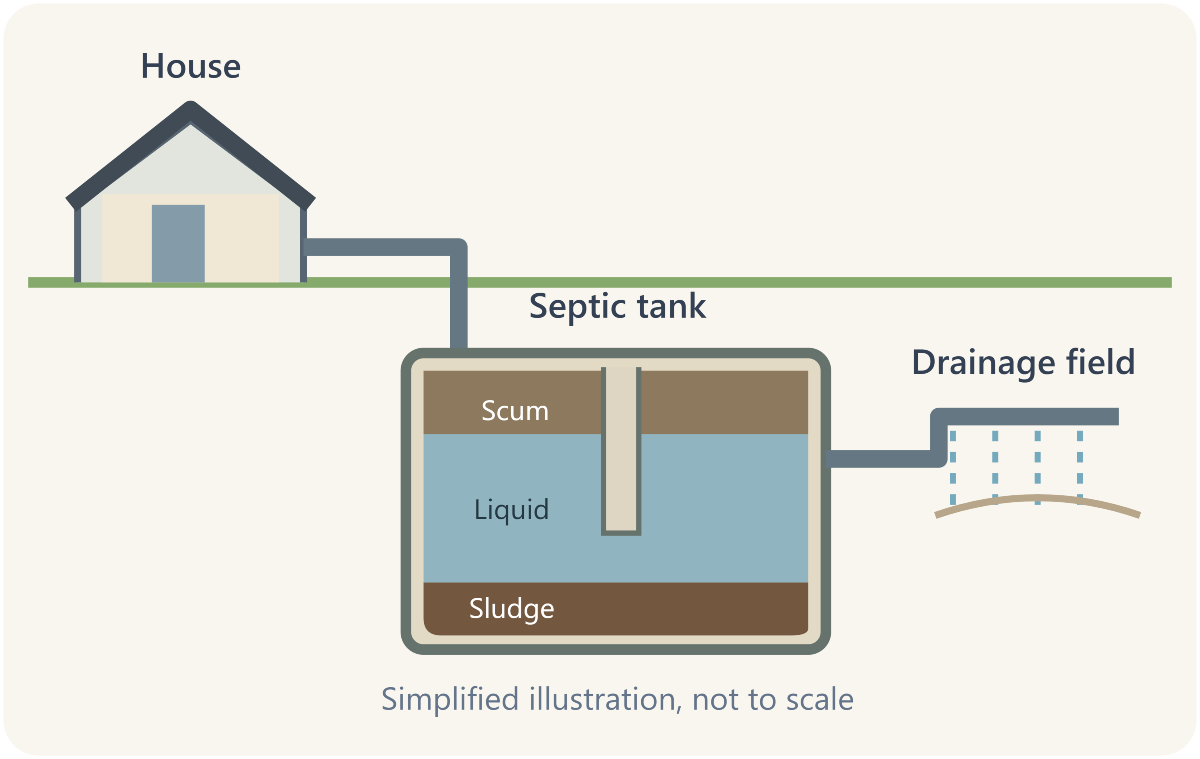
“Wastewater flows from the property into the septic tank, where solids separate before liquid moves to the drainage field for further treatment.”
Step 1: Wastewater Enters the Tank
Wastewater from toilets, sinks, showers, baths and washing machines travels through the property’s foul drainage pipes.
In most installations, gravity carries the wastewater towards the underground tank.
Where the property layout prevents gravity drainage, a properly designed pumping station may be required.
Step 2: Heavier Solids Settle
Inside the tank, the wastewater moves slowly enough for heavier materials to settle.
These solids collect at the bottom as sludge.
The tank must provide sufficient capacity and retention time for effective separation.
An undersized or overloaded tank can allow excessive solids to escape through the outlet.
Step 3: Fats and Grease Form a Surface Layer
Lighter materials float to the surface, forming scum.
Internal baffles or outlet fittings help retain this layer rather than allowing it to enter the drainage field.
Excessive grease can interfere with the process, so cooking oils and fats should never be deliberately poured into household drains.
Step 4: Bacteria Break Down Organic Waste
Microorganisms naturally present in sewage digest some biodegradable material.
This reduces the amount of organic waste, although the process is incomplete.
Non-biodegradable items and residual sludge remain inside the tank until professional removal.
Step 5: Partially Treated Wastewater Leaves
As new wastewater enters the tank, liquid moves through the outlet.
The outlet arrangement helps prevent floating scum and settled sludge from escaping.
Some septic systems also contain outlet filters to capture additional suspended solids.
Step 6: The Drainage Field Provides Further Treatment
The liquid passes into an underground drainage field made of perforated distribution pipes installed in suitable soil.
As wastewater passes through the soil, biological, physical and chemical processes provide further treatment.
The success of this stage depends heavily on soil permeability, groundwater conditions and drainage field design.
A septic tank without a suitable discharge arrangement is not a complete functioning wastewater system.
Main Components of a Septic Tank System
A conventional septic installation contains several components that work together.
Component | Main Function |
Inlet pipe | Carries household wastewater into the tank |
Primary chamber | Allows heavier solids to settle |
Secondary chamber, where fitted | Provides additional separation |
Baffles or tees | Help retain sludge and floating material |
Outlet filter, where fitted | Reduces suspended solids entering the outlet |
Outlet pipe | Carries effluent towards further treatment |
Access covers | Allow professional inspection and desludging |
Ventilation system | Allows gases to escape through suitable ventilation arrangements |
Drainage field | Provides further wastewater treatment and dispersal |
Not every tank has identical internal components.
Some have multiple chambers, while others use alternative arrangements to achieve the necessary separation.
Types of Septic Tanks Used in the UK
Septic tanks are commonly classified by their construction materials and internal design.
Concrete Septic Tanks
Concrete tanks are traditionally used for underground wastewater storage and treatment.
They are relatively heavy and, when properly manufactured and installed, can provide durable structural protection.
However, poor installation, ground movement and long-term deterioration can cause cracks or leakage.
Older concrete tanks may also require careful structural assessment.
Plastic Septic Tanks
Plastic tanks are generally manufactured from polyethylene or similar materials.
Their lighter weight can make transportation and installation easier.
They are also resistant to many forms of corrosion.
However, correct backfilling, anchoring where needed and installation according to ground conditions are essential to prevent movement or structural damage.
Fibreglass Septic Tanks
Fibreglass tanks are lightweight, corrosion-resistant and commonly used in modern private drainage installations.
They can offer long service lives when properly designed and installed.
Poor installation or unsuitable ground conditions may still result in deformation, movement or damage.
Single-Chamber and Multi-Chamber Tanks
Some older septic tanks contain a single primary compartment.
Many modern designs use multiple chambers to improve separation and reduce solids reaching the outlet.
The number of chambers alone does not determine overall treatment performance.
Proper sizing, construction, discharge arrangements and maintenance remain essential.
Benefits of Using a Septic Tank
Septic tanks offer several advantages for suitable off-mains properties.
Independent Wastewater Management
A septic tank allows domestic sewage to be treated locally without relying on a connection to a public foul sewer.
This can be particularly useful for isolated properties.
Low Routine Energy Requirements
Many conventional septic tanks operate through gravity and natural biological processes.
Where the design does not require pumping or other powered equipment, routine electricity consumption can be very low.
Relatively Simple Operation
Compared with some advanced sewage treatment systems, conventional septic tanks contain fewer mechanical components.
Their simple operating principles can reduce the need for electrical servicing.
Long-Term Durability
A correctly designed, installed and maintained septic tank can operate for decades.
However, its actual lifespan depends on construction materials, groundwater conditions, loading and maintenance.
Suitable for Rural Properties
Where public sewer connections are impractical, septic tanks can offer an established method of private sewage treatment.
Their suitability must still be confirmed through site assessment and regulatory checks.
Potentially Lower Running Costs
Gravity-operated tanks can have relatively low day-to-day energy costs.
Nevertheless, owners remain responsible for desludging, inspection, repairs and eventual system replacement.
Disadvantages of Septic Tanks
Septic tanks are not suitable for every property or location.
Disadvantage | Why It Matters |
Regular maintenance | Sludge must be removed before excessive accumulation |
Dependence on suitable soil | Poor drainage can prevent proper effluent treatment |
Land requirements | A compliant drainage field needs adequate space |
Pollution risks | Defective systems can contaminate groundwater and surrounding land |
Installation expense | Excavation, tank installation and drainage fields can be costly |
Limited treatment capability | Conventional tanks provide primary treatment only |
Legal restrictions | Discharge arrangements must comply with applicable environmental rules |
Sensitivity to misuse | Grease, chemicals and unsuitable waste can damage performance |
A septic tank may be cheaper to operate than some powered treatment systems, but it should never be selected purely on its initial purchase price.
The drainage field and local environmental conditions are equally important.
Septic Tank vs Cesspit vs Sewage Treatment Plant
These three systems all manage wastewater, but they operate differently.
Feature | Septic Tank | Cesspit | Sewage Treatment Plant |
Main purpose | Primary wastewater treatment | Sewage storage | More advanced wastewater treatment |
Biological treatment | Partial | Not intended as a treatment process | More extensive |
Normal liquid discharge | Through a suitable drainage field | No discharge | To an authorised discharge arrangement |
Regular emptying | Yes, for sludge | Yes, often much more frequently | Sludge removal required |
Electricity | Often unnecessary | Not normally needed for storage | Commonly required, depending on design |
Suitable for direct surface-water discharge in England | No | No discharge permitted | Potentially, subject to applicable rules |
Main consideration | Suitable drainage field | Frequent waste removal | Servicing and discharge compliance |
Septic Tank vs Cesspit
A cesspit, sometimes called a cesspool, is a sealed underground storage tank.
It collects sewage without providing a normal treated effluent discharge.
Because the contents remain inside, cesspits generally require considerably more frequent emptying than septic tanks.
A septic tank, by contrast, allows partially treated wastewater to leave through an appropriate treatment and dispersal system.
Septic Tank vs Sewage Treatment Plant
A package sewage treatment plant uses additional treatment processes, often including aeration, to improve wastewater quality.
This makes it suitable for some situations where conventional septic tank effluent would not meet the necessary requirements.
However, treatment plants may require electricity, mechanical servicing and more frequent operational checks.
The most appropriate option depends on the discharge destination, site characteristics and local regulatory requirements.
Where Can a Septic Tank Be Installed?
Installing a septic tank involves much more than choosing a suitable underground location.
A specialist must assess whether the site can accommodate the tank and its drainage field without creating unacceptable environmental risks.
Ground Conditions
The soil must allow wastewater to pass through at an appropriate rate while providing sufficient treatment.
Ground that drains too slowly may become waterlogged.
Ground that is excessively permeable may not provide adequate treatment before the wastewater reaches groundwater.
Available Land
A drainage field requires enough suitable land for the amount of wastewater produced.
The required area depends on several factors, including the property’s design occupancy and soil percolation results.
Water Table Levels
A high groundwater table can interfere with wastewater treatment and drainage.
It may also create structural problems for underground tanks.
Groundwater conditions therefore need careful assessment before installation.
Access for Maintenance
The tank must remain accessible for inspection and professional desludging.
Restricted access can increase running costs and make future repairs more difficult.
Distance From Sensitive Locations
The installation must satisfy applicable separation distances from buildings, water supplies, watercourses and other sensitive features.
For example, England’s general binding rules contain restrictions relating to groundwater source protection zones and nearby water supplies.
Exact requirements depend on the proposed installation and discharge arrangements.
What Is a Percolation Test and Why Is It Important?
A percolation test measures how quickly water passes through the soil.
It helps determine whether a site is suitable for a drainage field and supports the calculation of the required drainage area.
A specialist carries out testing according to the relevant design standards and building regulations.
If the soil drains too slowly, wastewater may accumulate underground or appear on the surface.
If the soil drains too quickly, there may be insufficient contact time for effective treatment.
The test is therefore an important part of deciding whether a conventional septic tank is appropriate.
A septic tank should not be installed on the assumption that any garden or open field will provide suitable drainage.
Septic Tank Regulations in the UK
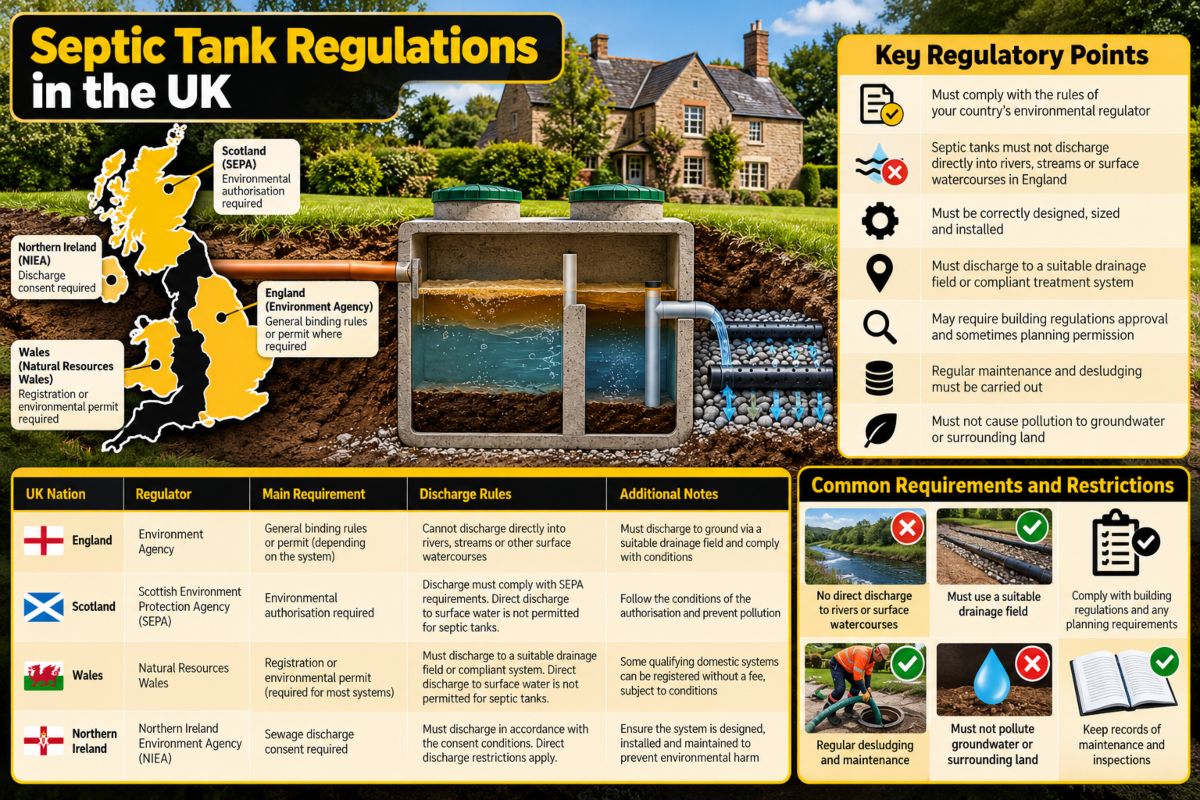
Private sewage systems are subject to environmental controls, and the relevant requirements vary across the four UK nations.
England: General Binding Rules
In England, septic tanks are regulated under the Environment Agency’s general binding rules for small sewage discharges.
For qualifying domestic discharges to ground, the general binding rules can allow operation without an individual environmental permit.
However, the system must meet the applicable conditions, including requirements relating to design, capacity, discharge location and pollution prevention.
A particularly important restriction is that septic tanks must not discharge directly into streams, rivers or other surface watercourses.
Where a property has an unsuitable direct discharge, corrective measures may include installing an appropriate drainage field, connecting to a public sewer or upgrading to a suitable sewage treatment plant.
For new installations, building regulations approval is also required, and planning permission may be necessary.
Scotland: Environmental Authorisation
In Scotland, private sewage discharges are regulated by the Scottish Environment Protection Agency.
Appropriate environmental authorisation is generally required, depending on the nature of the discharge.
Owners must follow the conditions applicable to their system and ensure that wastewater does not cause pollution.
Wales: Registration and Permits
In Wales, private sewage systems generally require registration with Natural Resources Wales or an appropriate environmental permit.
Some qualifying domestic systems can be registered without a fee.
The requirements depend on the installation, discharge location and environmental circumstances.
Northern Ireland: Discharge Consent
In Northern Ireland, private sewage discharges are regulated by the Northern Ireland Environment Agency.
Relevant systems require discharge consent and must comply with the conditions attached to their authorisation.
UK Regulatory Overview
UK Nation | Regulator | Key Consideration |
England | Environment Agency | General binding rules and permits where required |
Scotland | SEPA | Appropriate environmental authorisation |
Wales | Natural Resources Wales | Registration or environmental permit |
Northern Ireland | NIEA | Sewage discharge consent |
Owners should check the rules that apply to their particular installation rather than assuming requirements are identical throughout the UK.
How Much Does a Septic Tank Cost in the UK?
Septic tank costs depend on tank capacity, construction material, excavation requirements, access and the complexity of the drainage field.
For budgeting purposes, a small domestic installation may cost several thousand pounds, with more complicated projects costing substantially more.
The figures below are broad planning estimates, not verified supplier quotations.
Cost Component | Indicative UK Budget |
Septic tank supply | £700 to £2,500+ |
Excavation and tank installation | £1,500 to £4,000+ |
Drainage field construction | £2,000 to £6,000+ |
Surveys, testing and approvals | £300 to £1,500+ |
Complete domestic installation | £4,500 to £12,000+ |
Routine professional desludging | Approximately £150 to £300+ per visit |
These costs should not be added together mechanically because contractor quotations may already combine several items.
Unusual ground conditions, difficult access, large drainage fields and extensive pipework can significantly increase the final price.
Factors Affecting Installation Costs
The most significant cost factors include:
- Number of occupants the system must serve.
- Required septic tank capacity.
- Soil conditions and drainage field size.
- Depth and complexity of excavation.
- Groundwater management requirements.
- Access for machinery and delivery vehicles.
- Existing underground services.
- Distance between the building, tank and drainage field.
- Planning, surveying and approval requirements.
A professional site survey is the most reliable way to establish an appropriate budget.
How Big Should a Septic Tank Be?
Septic tank sizing depends primarily on the amount of wastewater the installation is designed to receive.
In the UK, professional designers normally consider the maximum potential occupancy of the property rather than simply counting the people currently living there.
A three-bedroom property, for example, must not automatically be sized only for a couple who happen to occupy it.
Future changes in occupancy can significantly increase wastewater production.
Tank manufacturers and designers use the relevant British Standards and design guidance to calculate the required capacity.
Undersized tanks may not allow sufficient time for solids to settle, increasing the likelihood of material entering the drainage field.
Oversizing is not necessarily beneficial either, as the entire installation must be designed for appropriate operating conditions.
Tank selection should be based on a qualified design assessment, not a generic litres-per-bedroom estimate.
What Can Go into a Septic Tank?
A septic tank is designed to receive ordinary domestic wastewater.
This includes wastewater from:
- Toilets and normal toilet paper use.
- Baths and showers.
- Bathroom sinks.
- Kitchen sinks.
- Washing machines.
- Dishwashers.
Normal household cleaning products can generally be used in accordance with their instructions, but excessive quantities of harsh chemicals should be avoided.
The presence of a septic tank also makes careful kitchen waste management particularly important.
Large quantities of grease and food waste should not enter the drainage system.
What Should Never Go into a Septic Tank?
Material | Potential Effect |
Wet wipes | Blockages and persistent solid waste |
Sanitary products | Pipe and tank obstructions |
Cooking oil and grease | Scum accumulation and drainage problems |
Nappies | Non-biodegradable waste accumulation |
Paints and solvents | Interference with treatment and pollution |
Medicines | Unnecessary pharmaceutical contamination |
Excessive bleach or disinfectants | Possible disruption of microbial activity |
Pesticides | Harmful chemical contamination |
Rainwater from gutters | Hydraulic overloading |
Petrol and diesel | Serious pollution and safety risks |
Rainwater deserves particular attention.
Roof gutters and surface-water drains should not be incorrectly connected to a septic tank because large volumes of stormwater can overload the system.
Surface water requires an appropriate separate drainage arrangement.
How Often Should a Septic Tank Be Emptied?
Septic tanks gradually accumulate sludge and scum that cannot be eliminated through biological treatment alone.
In England, official guidance recommends desludging at least once a year or according to the manufacturer’s instructions, with sludge removed before it exceeds the system’s capacity.
The appropriate servicing schedule can also depend on:
- Tank size.
- Maximum and actual occupancy.
- Wastewater production.
- Quantity of solids entering the tank.
- Previous sludge measurements.
- Manufacturer recommendations.
- System condition.
Some older advice suggests emptying intervals of several years, but homeowners should not rely on these figures without considering applicable UK rules and the specific system.
A registered waste carrier should remove the accumulated sewage for lawful treatment or disposal.
Never attempt to enter a septic tank or remove sewage manually.
Why Do Septic Tanks Fail?
Many septic tank problems develop gradually due to poor design, unsuitable ground conditions or neglected maintenance.
Understanding the common causes helps homeowners prevent expensive repairs.
Incorrect Tank Size
An undersized tank can receive more wastewater than it was designed to handle.
This reduces settlement efficiency and increases the possibility of solids reaching the drainage field.
Excessive Grease and Fat
Fats, oils and grease can accumulate inside the system and contribute to blocked pipes.
They may also reduce effective separation within the tank.
Surface Water Entering the System
Rainwater connected to foul drainage can introduce large quantities of additional water.
This may disturb settled waste and overload both the tank and drainage field.
Poor Drainage Field Design
A drainage field installed in unsuitable soil may struggle to absorb and treat effluent.
Even a correctly functioning septic tank cannot compensate for an inadequate drainage field.
Irregular Desludging
If sludge accumulates beyond the recommended level, it may escape through the outlet.
This can contribute to blockage and long-term drainage field deterioration.
Structural Damage
Ground movement, incorrect installation, tree roots and ageing components can cause leaks or pipe damage.
High Groundwater Levels
Rising groundwater may reduce the capacity of the drainage field to accept effluent.
It can also increase the risk of infiltration into defective underground systems.
Warning Signs of Septic Tank Problems
A malfunctioning septic system may produce warning signs before a complete failure occurs.
Warning Sign | Possible Cause |
Slow-draining toilets and sinks | Pipe blockage or drainage field problems |
Sewage smells outdoors | Leakage, poor ventilation or system failure |
Standing water near the drainage field | Saturated soil or escaping effluent |
Toilets backing up | Blocked pipes or overloaded system |
Unusually green, wet patches of grass | Possible wastewater escaping underground |
Repeated need for emergency emptying | Outlet obstruction, groundwater infiltration or design issues |
Gurgling household drains | Airflow or drainage restrictions |
Visible sewage on the ground | Serious failure requiring urgent attention |
These symptoms do not always mean that the tank needs emptying.
A qualified drainage specialist should investigate the actual cause.
Repeated pumping may temporarily reduce a high liquid level without solving a blocked or failed drainage field.
How Long Does a Septic Tank Last?
A properly designed and installed septic tank can last for several decades.
However, the lifespan varies considerably according to the materials used and the conditions surrounding the installation.
Concrete tanks may remain operational for many years but can deteriorate through cracking, corrosion or ground movement.
Plastic and fibreglass tanks are corrosion-resistant but depend on appropriate installation and structural support.
The drainage field is equally important.
A tank may remain structurally sound while the drainage field becomes blocked or otherwise unsuitable.
Regular inspection, responsible wastewater use and professional desludging can help extend the working life of the overall system.
Septic Tank Maintenance Checklist
Homeowners can improve septic tank performance through simple preventative measures.
Maintenance Activity | Recommended Approach |
Check for sewage smells | Investigate persistent or unusual odours |
Monitor household drains | Watch for slow drainage and repeated blockages |
Reduce excessive water use | Repair leaks and spread laundry loads |
Avoid unsuitable waste | Keep grease, wipes and chemicals out of drains |
Inspect surrounding ground | Look for unexpected wet patches or sewage |
Protect the drainage field | Avoid vehicle traffic and heavy construction |
Arrange professional desludging | Follow applicable guidance and manufacturer requirements |
Keep maintenance records | Record services, inspections and repairs |
Avoid Excessive Water Consumption
Spreading water usage across the day can reduce sudden hydraulic loading.
Fix dripping taps and leaking toilets promptly.
Keep the Drainage Field Clear
Do not park vehicles, build structures or store heavy equipment above the drainage field.
Soil compaction can reduce drainage performance.
Prevent Root Intrusion
Avoid planting large trees close to underground drainage infrastructure.
Seek professional advice where roots are already affecting pipes.
Use Household Chemicals Carefully
Avoid excessive disinfectants, concentrated chemical drain cleaners and unsuitable waste products.
A conventional septic tank normally contains the microorganisms needed for its natural treatment process.
Maintain Professional Access
Ensure that access covers remain secure and that contractors can reach the installation when servicing is required.
Damaged or unsafe covers should be repaired promptly.
Is a Septic Tank Environmentally Friendly?
A correctly designed and maintained septic system can provide effective wastewater management where a public sewer connection is not practical.
Gravity-operated installations may also require very little electricity.
However, septic tanks are not automatically environmentally friendly simply because they rely on natural processes.
They provide only partial treatment, and the drainage field must safely manage the remaining contaminants.
Poorly maintained systems can release harmful microorganisms and nutrients into soil and groundwater.
A failing installation may affect local water quality, wildlife habitats and neighbouring land.
Environmental performance therefore depends on the whole system, including the tank, drainage field, ground conditions and maintenance arrangements.
Can You Use a Septic Tank for More Than One Property?
A septic tank can sometimes serve multiple properties, provided it is designed for the combined wastewater load and meets relevant requirements.
Shared private drainage systems may be used by neighbouring rural houses, small developments or groups of cottages.
However, shared installations introduce additional responsibilities.
The owners or operators must establish who is responsible for:
- Maintenance and desludging.
- Repairs and replacement costs.
- Access to underground infrastructure.
- Environmental compliance.
- Monitoring system performance.
- Keeping appropriate records.
A shared septic system must be sized and authorised for the total discharge rather than treated as an ordinary single-household installation.
Important Considerations When Buying a House with a Septic Tank
A property with a septic tank may require more investigation than a house connected to public sewers.
Before completing a purchase, buyers should establish what type of private sewage system exists and whether it operates legally.
Confirm the System Type
Do not assume that an underground sewage tank is necessarily a septic tank.
It could be a cesspit, package treatment plant or another private drainage arrangement.
Identify the Discharge Location
Find out where the liquid leaving the tank is discharged.
For properties in England, a conventional septic tank discharging directly into a watercourse is a particularly important compliance concern.
Check Maintenance Records
Ask for records showing recent desludging, inspections and repairs.
Missing records do not prove that the system is defective, but they create additional uncertainty.
Inspect the Drainage Field
The drainage field may be more expensive to repair or replace than the tank itself.
Professional investigation is worthwhile where the system’s condition or location is unclear.
Review Shared Responsibilities
If neighbouring properties share the installation, establish who has legal responsibility for maintenance and costs.
Understand Future Replacement Costs
Older systems may require upgrading to comply with environmental requirements or to accommodate changing property usage.
Understanding these obligations before purchase helps avoid unexpected expenses.
Is a Septic Tank the Right Choice for Your Property?
A septic tank may be a suitable option where the property cannot reasonably connect to a public sewer and the ground conditions support an appropriate drainage field.
However, several circumstances may make an alternative more appropriate.
A package sewage treatment plant may be necessary where higher treatment standards are required.
A sealed cesspit may be considered in certain circumstances, although frequent emptying can make it expensive to operate.
Connection to a public foul sewer may also be preferable or required were reasonably available.
Property owners should assess the complete drainage system before choosing equipment.
For readers researching domestic tanks, storage systems and related property infrastructure, 123 Oil provides information intended to help homeowners understand different tank applications and their maintenance considerations.
Conclusion
A septic tank is primarily used to collect and partially treat domestic wastewater from properties that are not connected to the public sewer network.
Its main functions are to separate solid and liquid waste, support natural biological breakdown and direct partially treated effluent towards a suitable drainage field.
For rural homes and other eligible off-mains properties, septic tanks can provide a reliable wastewater management solution with relatively simple operating requirements.
However, their effectiveness depends on much more than the underground tank itself.
Correct sizing, suitable soil conditions, compliant discharge arrangements and regular maintenance are essential for long-term performance.
Homeowners should also understand the differences between septic tanks, cesspits and sewage treatment plants before installing or replacing a private drainage system.
When properly designed, maintained and operated within UK environmental regulations, a septic tank can remain an effective part of a property’s wastewater infrastructure for many years.
Frequently Asked Questions
The main purpose of a septic tank is to collect and partially treat domestic wastewater from properties without access to mains sewerage. It separates sludge, scum and liquid waste before allowing partially treated wastewater to move into a suitable drainage field for further treatment.
Yes. A septic tank normally receives wastewater from toilets, showers, baths, bathroom sinks, kitchen sinks and washing machines. However, cooking grease, excessive food waste and harmful chemicals should be kept out of the drainage system to prevent blockages and treatment problems.
Wastewater leaving a conventional septic tank normally enters a drainage field, where it passes through suitable soil for further treatment. In England, a septic tank cannot legally discharge directly into a river, stream or other surface watercourse under the general binding rules.
Most conventional gravity-operated septic tanks do not require electricity for their basic treatment process. However, electricity may be necessary where the installation includes pumps, alarms or additional treatment equipment. Requirements depend on the individual system design.
A conventional septic tank requires an appropriate arrangement for further wastewater treatment and discharge. In England, a septic tank normally discharges to ground through a compliant drainage field. Where suitable ground conditions are unavailable, an alternative treatment or sewage disposal system may be required.
A septic tank normally remains filled with liquid up to its operating level. The problem occurs when sludge accumulates excessively or wastewater cannot leave through the outlet. This may cause slow drainage, sewage backups, odours or overflowing wastewater. Professional inspection is necessary to identify the cause.
A septic tank is not necessarily better than mains sewerage. It provides a practical solution where a public sewer connection is unavailable or unreasonable, but it requires private maintenance and environmental compliance. Mains sewerage generally transfers wastewater treatment responsibilities to the public sewerage system.