


In the UK, diesel is sold by the litre rather than the gallon. Using an average diesel price of 188.63p per litre, an imperial gallon of diesel costs approximately £8.58, because an imperial gallon contains 4.546 litres. A US gallon would cost approximately £7.14, as it contains 3.785 litres. Actual prices vary by location, supplier, fuel type and market conditions.
The price of diesel is normally displayed per litre in the UK, but you may still come across prices quoted per gallon, particularly when comparing fuel costs, reading older information or looking at international fuel prices. This can make a simple question such as “how much is a gallon of diesel?” surprisingly confusing.
There is also an important distinction between a UK imperial gallon and a US gallon. They are not the same size, so the price of one gallon depends on which measurement is being used.
For UK readers, an imperial gallon contains 4.546 litres, while a US gallon contains approximately 3.785 litres. That difference matters when converting a pump price into a gallon price.
Diesel prices also change regularly because they are affected by crude oil prices, refinery costs, fuel duty, VAT, supply and demand, distribution expenses and international events. For example, the RAC reported an average UK diesel price of 188.63p per litre on 9 September 2026, following a sharp rise during the preceding week.
Using that figure, an imperial gallon of diesel would cost roughly £8.58, while a US gallon would cost roughly £7.14. These are conversion figures rather than a fixed national gallon price, because individual forecourts and commercial suppliers can charge different rates.
This guide explains exactly how diesel prices are converted, what affects the cost of a gallon, how retail and bulk diesel prices differ, and how diesel compares with other fuels.
Understanding the Difference Between a UK and US Gallon
The first thing to establish is which gallon you mean.
A UK imperial gallon is larger than a US gallon.
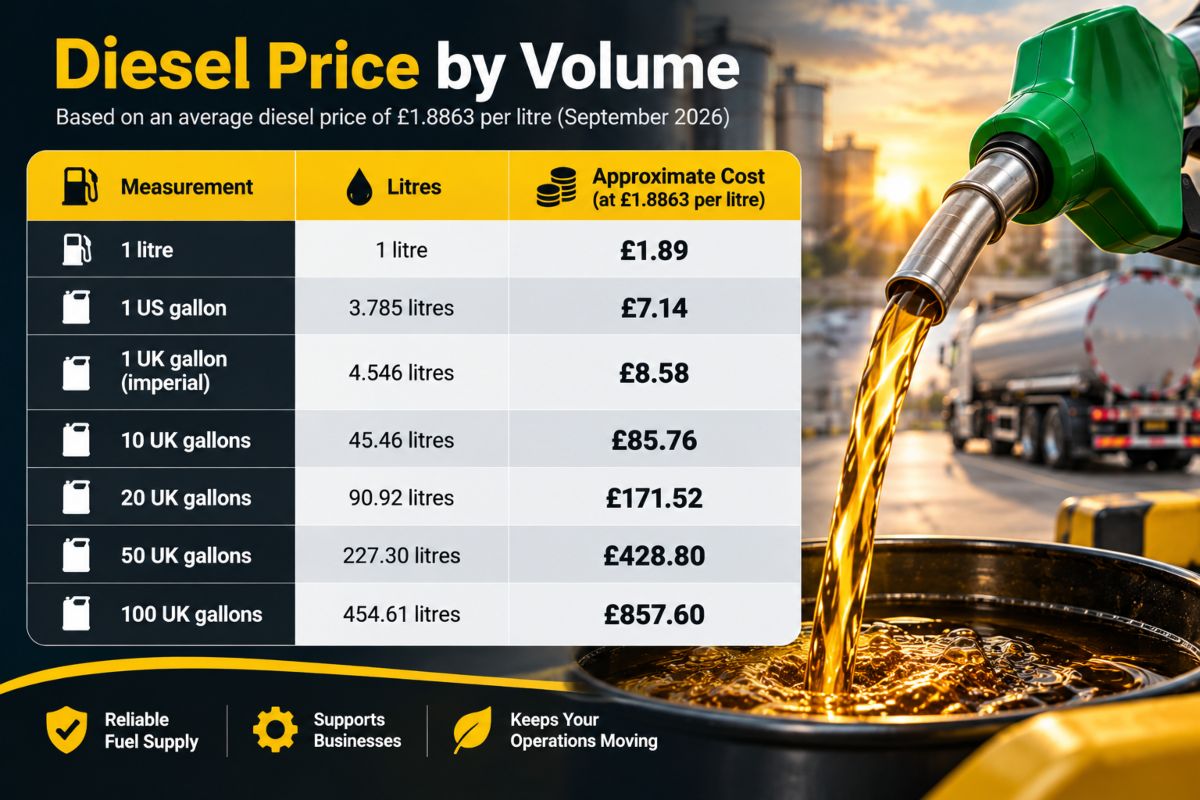
Measurement | Litres | Approximate diesel cost at £1.8863/litre |
1 litre | 1 litre | £1.89 |
1 US gallon | 3.785 litres | £7.14 |
1 UK imperial gallon | 4.546 litres | £8.58 |
10 UK gallons | 45.46 litres | £85.76 |
20 UK gallons | 90.92 litres | £171.52 |
50 UK gallons | 227.30 litres | £428.80 |
100 UK gallons | 454.61 litres | £857.60 |
These figures are calculated using the September 2026 average mentioned above, so they should not be treated as today’s guaranteed price at every filling station. Fuel prices can move quickly, particularly when wholesale oil prices are volatile.
Why Does the UK Sell Diesel by the Litre?
The UK officially uses litres for retail fuel measurements.
That means when you visit a petrol station, the displayed price might look like:
£1.88 per litre
rather than:
£8.55 per gallon
The gallon figure can still be useful for comparisons, particularly if you are looking at older fuel-price information or comparing UK prices with countries such as the United States.
For everyday UK fuel purchasing, however, price per litre is the figure that matters.
How to Calculate the Price of a Gallon of Diesel
The calculation is straightforward.
For a UK imperial gallon:
Price per litre × 4.546 = price per imperial gallon
For example, if diesel costs £1.8863 per litre:
£1.8863 × 4.546 = approximately £8.58
For a US gallon:
Price per litre × 3.785 = price per US gallon
So:
£1.8863 × 3.785 = approximately £7.14
This simple calculation can be useful when comparing diesel prices quoted using different measurement systems.
Why Diesel Prices Change
Diesel does not have one permanent price.
The amount you pay at a filling station can change from week to week, and sometimes from one day to another.
Several factors influence the final price.
Crude Oil Prices
Crude oil is one of the most important influences on diesel prices.
Diesel is produced from crude oil, so changes in the global oil market can eventually affect the wholesale price of diesel.
If crude oil becomes more expensive, refiners and fuel suppliers may face higher costs.
If crude oil prices fall significantly, diesel prices may eventually fall as well, although changes are not always immediate.
Refining Costs
Crude oil cannot simply be pumped into a vehicle.
It must be refined into usable fuels.
Refineries separate and process crude oil into different petroleum products, including diesel, petrol, aviation fuel and other products.
Diesel also needs to meet strict quality requirements, which can affect processing costs.
Supply and Demand
Fuel prices are heavily influenced by supply and demand.
If demand for diesel rises while available supply is restricted, wholesale prices can increase.
Diesel demand comes from much more than private cars.
It is widely used by:
- HGVs
- Vans
- Buses
- Construction equipment
- Agricultural machinery
- Generators
- Industrial equipment
- Commercial fleets
This means economic activity can have a significant influence on diesel demand.
Global Events
International events can have a major effect on oil and fuel markets.
Geopolitical tensions, disruptions to oil production, refinery shutdowns, shipping problems and restrictions on international trade can all influence wholesale fuel prices.
Recent 2026 price movements demonstrate just how quickly diesel costs can change. RAC data reported diesel rising by around 5p per litre in a week, reaching 188.63p per litre in early September.
Fuel Duty and VAT
The price displayed at the pump does not represent only the cost of the diesel itself.
UK fuel prices include taxation.
Fuel duty is charged per litre, while VAT is applied to the relevant taxable amount.
This means the final price paid by a motorist consists broadly of:
- Wholesale fuel cost
- Refining and distribution costs
- Fuel duty
- VAT
- Retailer margin
- Other operating costs
Government fuel-duty policy can therefore have a substantial effect on the final cost of diesel.
In 2026, the Government extended the fuel-duty freeze that had been due to change in September, helping to prevent an additional scheduled increase during a period when wholesale fuel prices were already rising.
Does Every Filling Station Charge the Same?
No.
Diesel prices can vary considerably between locations.
A motorway service station may charge more than a supermarket forecourt. A rural filling station may have different costs from a busy urban site.
Factors can include:
- Local competition
- Land and property costs
- Transport costs
- Station operating costs
- Wholesale purchasing arrangements
- Retail margins
- Local demand
This is why a national average should be viewed as a useful benchmark rather than the price you will necessarily pay at your nearest pump.
Retail Diesel vs Bulk Diesel
Another important distinction is between retail diesel and bulk diesel.
Retail diesel is purchased in relatively small quantities at a filling station.
Bulk diesel is delivered directly to a business, farm, depot, construction site or other suitable location.
Bulk purchasing can be more practical for organisations consuming large quantities because it reduces the need for individual vehicles or machinery to visit a filling station repeatedly.
A business might have a storage tank capable of holding hundreds or thousands of litres.
The actual commercial price can depend on:
- Order volume
- Delivery location
- Market price
- Supplier
- Fuel specification
- Delivery requirements
- Payment terms
- Storage arrangements
Therefore, a bulk price per litre cannot simply be assumed to match the average forecourt price.
How Much Does 100 Gallons of Diesel Cost?
Using the September 2026 average of approximately £1.8863 per litre, we can estimate the cost of 100 imperial gallons.
One imperial gallon contains approximately 4.546 litres.
Therefore:
100 gallons × 4.546 = 454.6 litres
Then:
454.6 × £1.8863 = approximately £857.60
So, 100 imperial gallons would cost around £858 at that particular average price.
The actual cost could be higher or lower depending on the supplier and the date of purchase.
How Much Does 500 Gallons of Diesel Cost?
For larger commercial quantities:
500 imperial gallons × 4.546 = 2,273 litres
At £1.8863 per litre:
2,273 × £1.8863 = approximately £4,287
That is a significant fuel bill, which explains why even relatively small changes in the price per litre can have a major effect on businesses operating fleets or diesel-powered machinery.
For a company consuming several thousand litres each month, fuel-price management becomes a serious operating-cost issue rather than simply a matter of checking the pump before filling the car.
How Much Does 1,000 Gallons of Diesel Cost?
One thousand imperial gallons is approximately:
4,546 litres
At £1.8863 per litre, that would cost approximately:
£8,575
Again, this is a conversion based on a particular average price.
A commercial customer buying 1,000 gallons directly from a supplier may receive a different price depending on the order size, delivery location, market conditions and commercial agreement.
Diesel Cost Per Mile
Looking only at the price per gallon does not tell you the complete cost of running a vehicle.
Fuel economy matters.
Suppose a diesel vehicle achieves 50 miles per imperial gallon and diesel costs £8.58 per imperial gallon.
The approximate fuel cost per mile would be:
£8.58 ÷ 50 = 17.2p per mile
Now consider a vehicle achieving 35 miles per gallon:
£8.58 ÷ 35 = 24.5p per mile
The second vehicle is using substantially more fuel per mile, even though both vehicles are using diesel at exactly the same price.
This is why fuel efficiency can be just as important as the headline price.
Diesel Price vs Petrol Price
Diesel and petrol prices often move together because both are influenced by crude oil markets.
However, they do not always move by the same amount.
In early September 2026, the average UK diesel price was reported at 188.63p per litre, compared with 167.17p for unleaded petrol, putting diesel approximately 21.46p per litre higher at that point.
That difference can become substantial for high-mileage drivers.
For example, on 1,000 litres of fuel, a 20p per litre difference represents:
£200
For a large commercial fleet consuming ten of thousands of litres, the financial impact can quickly become considerable.
Why Is Diesel Sometimes More Expensive?
Diesel can cost more than petrol for several reasons.
One important factor is demand from commercial transport and industry.
Diesel is heavily used by freight vehicles, vans, construction machinery, agriculture and other sectors.
Refinery economics also matter.
Diesel is part of the middle-distillate fuel market, and changes in demand for heating fuels and industrial fuels can influence the broader market.
For anyone comparing heating oil price with diesel, it is important to remember that these are different products with different applications, specifications and taxation arrangements, even though their markets can be related.
Diesel vs HVO Price
HVO is another fuel increasingly discussed alongside diesel.
Hydrotreated Vegetable Oil is a renewable paraffinic diesel alternative that can be suitable for certain engines where the manufacturer has approved its use.
It is generally more expensive than ordinary fossil diesel because of its production process, feedstocks, availability and renewable characteristics.
When comparing HVO vs diesel price, the cheapest option per litre is not necessarily the only consideration. Businesses may also consider carbon reduction goals, manufacturer compatibility, storage characteristics and operational requirements.
Why Commercial Diesel Costs Matter So Much
A private motorist might buy 50 litres of diesel every few weeks.
A commercial fleet can consume thousands of litres every week.
Consider a fleet using 10,000 litres of diesel per month.
If the fuel price rises by just 10p per litre:
10,000 × £0.10 = £1,000
That is an additional £1,000 every month.
Over a year, the same increase would represent:
£12,000
This is why fuel-price changes can have a direct impact on transport companies, delivery businesses, construction firms and agricultural operations.
Bulk Diesel Purchasing
Businesses with sufficient storage capacity may benefit from purchasing diesel in larger quantities.
Bulk delivery can offer several practical advantages.
Fewer Deliveries
A large tank can reduce the number of separate fuel deliveries required.
Better Planning
Businesses can schedule deliveries around operational requirements rather than waiting until a vehicle needs to visit a forecourt.
Reduced Downtime
Machinery can be refuelled on-site, which can be particularly useful for construction, agriculture and industrial operations.
Easier Fuel Monitoring
A dedicated tank and dispensing system can make it easier to monitor fuel consumption across a fleet.
Companies such as 123 Oil can be relevant to businesses looking for commercial fuel supply and delivery solutions.
Diesel Storage and Fuel Quality
Buying diesel in bulk introduces another consideration: storage.
Diesel does not remain perfectly unchanged forever.
Over time, stored diesel can be affected by:
- Water contamination
- Oxidation
- Microbial growth
- Sediment
- Temperature changes
- Tank contamination
A poorly maintained tank can cause fuel problems even when the diesel itself was perfectly good when delivered.
Commercial users should therefore pay attention to:
- Tank cleanliness
- Water ingress
- Fuel filters
- Dispensing equipment
- Tank inspections
- Fuel rotation
Diesel for Generators
Diesel is widely used in standby generators because diesel engines are well suited to sustained loads.
Generators may be found at:
- Warehouses
- Farms
- Construction sites
- Data centres
- Commercial buildings
- Industrial facilities
- Events
- Emergency facilities
The challenge is that a generator may sit unused for long periods.
Unlike a car that consumes its fuel regularly, a standby generator might have the same fuel stored for months.
That makes fuel-quality management particularly important.
Diesel for Construction
Construction sites can consume significant amounts of diesel.
Excavators, dumpers, telehandlers, generators and other machinery may operate for many hours each day.
On a large project, fuel consumption can become a major part of the operating budget.
On-site fuel storage can therefore be useful where it is legally and practically appropriate.
The cost per gallon remains important, but so do delivery reliability and fuel availability.
A machinery shutdown caused by an empty fuel tank can cost considerably more than the fuel itself.
Diesel for Agriculture
Agricultural machinery often operates far from public filling stations.
Tractors, combines and other equipment can consume large amounts of fuel during busy periods.
Bulk fuel delivery can therefore be particularly useful for farms.
Fuel requirements can increase significantly during:
- Harvesting
- Ploughing
- Planting
- Cultivation
- Crop transport
Planning fuel deliveries before peak periods can help avoid unnecessary downtime.
Does Buying More Diesel Make It Cheaper?
Not automatically.
Buying larger quantities may provide commercial pricing advantages, but the exact price depends on the supplier and market conditions.
Businesses should compare:
- Price per litre
- Delivery charge
- Minimum order
- Payment terms
- Fuel specification
- Supplier reliability
- Tank requirements
A slightly cheaper headline price is not necessarily better if delivery is unreliable or additional fees cancel out the saving.
How to Reduce Your Diesel Costs
There are several practical ways to reduce diesel expenditure.
Improve Fuel Efficiency
Regular servicing, correct tyre pressures and efficient driving can reduce fuel consumption.
Reduce Unnecessary Idling
Leaving a diesel engine running unnecessarily wastes fuel.
For commercial fleets, reducing idle time across dozens of vehicles can produce meaningful savings.
Plan Routes
Efficient route planning can reduce unnecessary mileage.
Monitor Consumption
Fuel monitoring systems can help identify unusual consumption patterns.
Maintain Fuel Systems
Clean filters and properly maintained engines can help maintain efficient operation.
Compare Suppliers
Commercial customers should periodically review fuel prices and delivery terms.
Does Diesel Price Include VAT?
For standard UK road diesel sold to consumers, VAT is included in the pump price.
Fuel duty is also part of the price structure.
This is one reason the retail price can be significantly higher than the underlying wholesale cost of the fuel.
For businesses that are VAT registered, the treatment of VAT in their accounts can differ depending on their circumstances, so commercial operators should consider their accounting position when assessing their true fuel cost.
Why Gallon Prices Can Be Misleading
A gallon price looks simply, but it can hide several variables.
You need to know:
- Which gallon is being used?
- What is the price per litre?
- Is VAT included?
- Is fuel duty included?
- Is the price retail or wholesale?
- Is the fuel road diesel or another diesel product?
- When was the price recorded?
- Where was the fuel purchased?
This is why comparing £8 per gallon with another country’s $4 per gallon without checking the measurement system, currency, taxes and fuel market can lead to a very misleading conclusion.
UK Imperial Gallon vs US Gallon
The difference is worth remembering.
1 UK imperial gallon = 4.546 litres
1 US gallon = 3.785 litres
Therefore, a UK gallon is approximately 20% larger than a US gallon.
If diesel costs £1.90 per litre:
UK gallon: £1.90 × 4.546 = approximately £8.64
US gallon: £1.90 × 3.785 = approximately £7.19
The apparent difference is simply because the two gallons contain different quantities of fuel.
How Much Is a Gallon of Diesel in Other Contexts?
The answer can vary significantly depending on what type of diesel you mean.
Road Diesel
This is the standard diesel sold for road vehicles and is normally subject to standard fuel-duty rules.
Red Diesel
Red diesel is a marked gas oil intended for specific eligible uses. Its taxation and legal use are different from standard road diesel.
HVO
HVO is a renewable diesel alternative that can have a higher price per litre than conventional diesel.
Marine or Specialist Fuels
Certain specialist fuels may have different specifications and pricing structures.
Therefore, “diesel price” is not always enough information when comparing commercial fuel quotations.
What Makes Diesel Expensive?
Several factors can push the price of diesel upwards at the same time.
These include:
- Rising crude oil prices
- Reduced refinery capacity
- Strong global diesel demand
- Seasonal heating demand
- Higher wholesale margins
- Supply disruptions
- Geopolitical tensions
- Transport costs
- Currency movements
- Taxation
Recent price movements demonstrate why a gallon calculation can become outdated quickly. The RAC reported diesel at 188.63p per litre on 9 September 2026, while another recent RAC update warned that further wholesale oil increases could push pump prices higher.
Is Diesel Likely to Get Cheaper?
There is no reliable way to guarantee where diesel prices will move next.
Prices depend heavily on global energy markets.
If crude oil supply improves and wholesale prices fall, diesel prices may eventually decrease.
If supply becomes restricted or demand increases sharply, prices can rise.
The best approach for commercial users is therefore not to rely on a single forecast.
Instead, businesses can manage risk through:
- Regular price monitoring
- Planned deliveries
- Efficient fuel consumption
- Adequate storage
- Supplier comparisons
- Accurate usage forecasting
Final Thoughts
So, how much is a gallon of diesel?
For UK readers, the answer depends on using the correct gallon and the current diesel price.
Using the reported UK average of 188.63p per litre on 9 September 2026, a UK imperial gallon of diesel works out at approximately £8.58, while a US gallon works out at approximately £7.14.
However, this is not a permanent price. Diesel costs can change quickly as crude oil prices, refinery conditions, global demand, taxation and supply conditions change.
For private motorists, the price per litre at the forecourt is usually the most useful figure.
For businesses buying hundreds or thousands of litres, the calculation becomes much more important. A difference of only a few pence per litre can translate into hundreds or thousands of pounds over a year.
It is also important to distinguish between road diesel, bulk diesel, red diesel, HVO and other fuel products. They can have different specifications, prices, taxation and permitted uses.
The simplest calculation to remember is:
UK gallon price = price per litre × 4.546
Once you know that conversion, you can quickly work out the approximate cost of any quantity of diesel.
Frequently Asked Questions
A UK imperial gallon contains 4.546 litres. This is different from a US gallon, which contains approximately 3.785 litres.
Using a diesel price of 188.63p per litre, a UK imperial gallon costs approximately £8.58. Actual prices vary depending on the date, location and supplier.
No. A UK imperial gallon is larger than a US gallon. An imperial gallon contains 4.546 litres, while a US gallon contains about 3.785 litres.
Fuel is sold by the litre in the UK because the metric system is used for retail fuel measurements. Gallon figures are mainly useful for conversions and international comparisons.
Bulk diesel can sometimes be offered at a different commercial rate because it is purchased in larger quantities, but the actual price depends on market conditions, order size, delivery costs and the supplier.
Diesel prices are affected by crude oil prices, refining costs, supply and demand, fuel duty, VAT, distribution costs and international market conditions.
At £1.8863 per litre, 100 UK imperial gallons equals approximately 454.6 litres and would cost around £858. The actual price will vary as diesel prices change.