

Fleet fuel consumption can be monitored by tracking fuel purchases, analysing mileage, measuring vehicle efficiency and using technology such as telematics and fuel management software. Regular fuel reports, driver behaviour analysis and vehicle maintenance checks help businesses identify fuel waste and reduce operating costs.
Fuel is one of the biggest operational expenses for any business that manages multiple vehicles. Whether you operate delivery vans, transport vehicles, construction equipment or company cars, controlling fuel consumption has a direct impact on profitability.
Many businesses focus only on the price they pay for fuel, but the bigger challenge is understanding how efficiently that fuel is being used. A fleet can experience unnecessary fuel costs because of poor driving habits, inefficient routes, excessive idling, vehicle maintenance problems or inaccurate fuel tracking.
Without proper monitoring, it becomes difficult to answer important questions:
- Which vehicles are consuming more fuel than expected?
- Are drivers using fuel efficiently?
- Is a sudden increase in fuel usage caused by vehicle problems?
- Where are the biggest opportunities to reduce costs?
Learning how to monitor fleet fuel consumption allows businesses to move from simply recording fuel expenses to actively managing efficiency. By analysing fuel data, vehicle performance and driver behaviour, companies can reduce waste, improve productivity and make better decisions about their fleet.
Modern fuel monitoring methods range from simple fuel records and fuel cards to advanced telematics systems that provide real-time information about vehicles. Choosing the right approach depends on fleet size, business requirements and the level of control needed.
Why Fleet Fuel Consumption Monitoring Is Important
Fuel consumption monitoring is not only about reducing fuel bills. It provides valuable information about how a fleet operates on a daily basis.
When businesses monitor fuel usage properly, they can identify problems before they become expensive.
For example, if one delivery van suddenly starts using more fuel than similar vehicles, it may indicate:
- Engine problems
- Incorrect tyre pressure
- Poor driving habits
- Excessive idling
- Inefficient routes
Without monitoring, these issues can continue for months and increase operating expenses.
A proper fuel monitoring system helps businesses:
- Control fuel costs
- Improve vehicle performance
- Reduce unnecessary fuel usage
- Train drivers effectively
- Plan future fleet investments
Understanding Fleet Fuel Consumption
Fleet fuel consumption refers to the amount of fuel vehicles use during their daily operations.
Fuel efficiency is affected by many factors, including:
- Vehicle type
- Vehicle age
- Driver behaviour
- Route conditions
- Traffic levels
- Vehicle load
- Maintenance quality
For example, a van making frequent urban deliveries may naturally consume more fuel than a vehicle travelling mainly on motorways. However, if fuel usage becomes higher than expected compared with similar vehicles, further investigation is needed.
Understanding normal fuel patterns allows fleet managers to recognise unusual changes quickly.
Important Metrics to Track Fleet Fuel Consumption
Tracking the right data is essential for effective fuel management. Looking only at total fuel spending does not provide enough information.
Businesses should monitor several key measurements.
Fuel Metric | What It Measures | Why It Is Important |
Miles Per Gallon (MPG) | Distance travelled compared with fuel used | Shows overall vehicle efficiency |
Fuel Cost Per Mile | Cost of fuel for each mile travelled | Helps calculate running expenses |
Fuel Usage Per Vehicle | Individual vehicle consumption | Identifies inefficient vehicles |
Idling Time | Fuel wasted while vehicles are stationary | Highlights unnecessary fuel usage |
Driver Efficiency | Driving habits affecting fuel use | Helps improve driver performance |
Miles Per Gallon (MPG)
Miles per gallon is one of the most common ways to measure fuel efficiency.
The calculation is:
Distance travelled ÷ Fuel used = MPG
A higher MPG figure means the vehicle is travelling further using less fuel.
Comparing MPG between vehicles helps businesses identify:
- High-performing vehicles
- Vehicles requiring maintenance
- Drivers needing additional training
Fuel Cost Per Mile
Fuel cost per mile shows how much a vehicle costs to operate based on fuel usage.
This measurement is useful because fuel prices change regularly. Instead of only looking at litres or gallons purchased, businesses can understand the actual cost of operating each vehicle.
This helps with:
- Budget planning
- Vehicle replacement decisions
- Route evaluation
Fuel Usage Per Vehicle
Every vehicle in a fleet should have its own fuel record.
Tracking individual vehicles helps identify:
- Unexpected increases in consumption
- Older inefficient vehicles
- Maintenance issues
- Unusual usage patterns
A fleet manager can compare similar vehicles and quickly identify which ones require attention.
Different Ways to Monitor Fleet Fuel Consumption
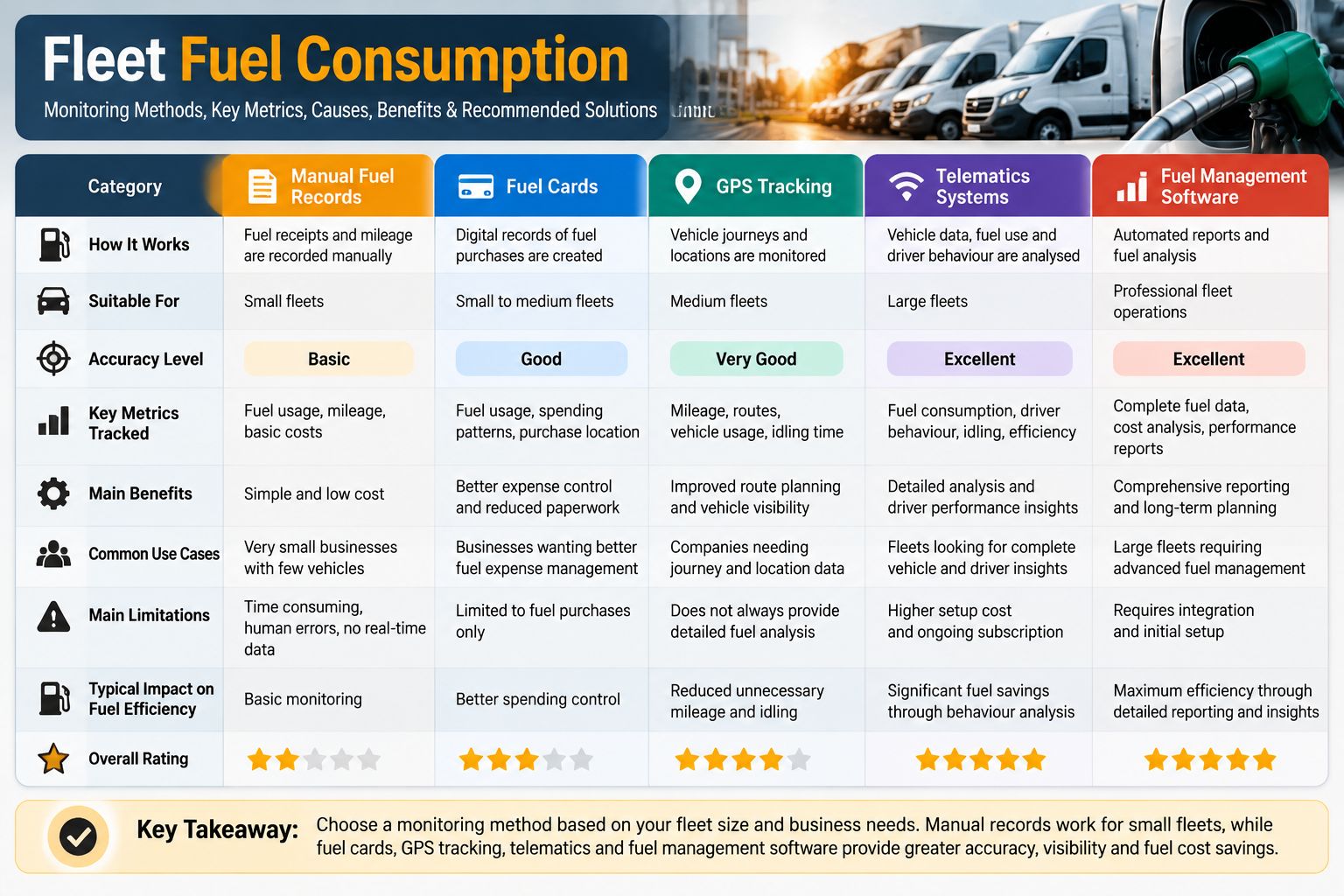
Businesses can monitor fuel consumption using different methods depending on their fleet size and requirements.
Monitoring Method | How It Works | Suitable For | Accuracy |
Manual Fuel Records | Fuel receipts and mileage are recorded manually | Small fleets | Basic |
Fuel Cards | Digital records of fuel purchases are created | Small to medium fleets | Good |
GPS Tracking | Vehicle journeys and locations are monitored | Medium fleets | Very Good |
Telematics Systems | Vehicle data, fuel use and driver behaviour are analysed | Large fleets | Excellent |
Fuel Management Software | Automated reports and fuel analysis | Professional fleet operations | Excellent |
Manual Fuel Tracking
Manual fuel tracking is the simplest method.
Businesses record information such as:
- Fuel purchase amount
- Mileage reading
- Vehicle details
- Date of purchase
This method can work for smaller fleets where only a few vehicles are involved.
However, manual tracking has limitations:
- Takes more administrative time
- Information can be entered incorrectly
- Difficult to analyse large amounts of data
- No real-time visibility
For growing fleets, more advanced solutions usually provide better control.
Using Fuel Cards
Fuel cards provide a more organised way to track fuel purchases.
They allow businesses to record:
- Fuel quantity
- Purchase location
- Vehicle information
- Spending patterns
Benefits include:
- Reduced paperwork
- Easier expense management
- Better control over fuel spending
- Improved reporting
Fuel cards are useful for businesses that want better visibility without installing complex monitoring equipment.
Telematics and GPS Tracking Systems
Telematics systems provide detailed information about fleet operations.
They combine GPS tracking with vehicle performance data to show:
- Vehicle location
- Journey history
- Driving patterns
- Idling behaviour
- Fuel efficiency
For example, a telematics system can identify whether fuel usage is increasing because of longer routes, excessive idling or inefficient driving.
This allows businesses to take action based on real information rather than assumptions.
Fuel Management Software
Fuel management software collects data from different sources and turns it into useful reports.
These systems can analyse:
- Fuel consumption trends
- Vehicle performance
- Driver efficiency
- Fuel costs
- Operational patterns
For businesses managing larger fleets, automated reporting saves time and provides deeper insights.
Benefits of Monitoring Fleet Fuel Consumption
Effective fuel monitoring creates several advantages.
Reducing Fuel Costs
The biggest benefit is reducing unnecessary fuel spending.
Monitoring helps businesses identify:
- Fuel wastage
- Inefficient routes
- Poor driving behaviour
- Vehicle problems
Even small improvements can create significant savings across a large fleet.
Improving Driver Efficiency
Drivers have a major impact on fuel consumption.
Fuel monitoring helps identify behaviours such as:
- Harsh acceleration
- Sudden braking
- Excessive speeding
- Long idling periods
Businesses can use this information to provide driver training and encourage more economical driving.
Improving Vehicle Maintenance
A sudden increase in fuel consumption may indicate a mechanical issue.
Possible causes include:
- Low tyre pressure
- Engine problems
- Dirty filters
- Poor servicing
Monitoring fuel patterns allows businesses to identify problems earlier and reduce repair costs.
Improving Route Planning
Poor routes increase fuel consumption.
Fuel monitoring data can highlight:
- Unnecessary journeys
- Longer-than-required routes
- Traffic-related delays
Better route planning reduces fuel usage while improving productivity.
Factors That Increase Fleet Fuel Consumption
Many issues can cause vehicles to use more fuel than expected.
Cause | Effect on Fuel Consumption | Solution |
Excessive Idling | Fuel wasted without distance travelled | Reduce unnecessary engine running |
Poor Driving Habits | Increased fuel demand | Provide driver training |
Incorrect Tyre Pressure | Higher rolling resistance | Regular tyre checks |
Poor Maintenance | Reduced vehicle efficiency | Follow servicing schedules |
Inefficient Routes | More miles travelled | Improve route planning |
How Driver Behaviour Affects Fuel Usage
Driver behaviour is one of the biggest factors affecting fleet efficiency.
Fuel consumption can increase when drivers:
- Accelerate aggressively
- Brake suddenly
- Drive at excessive speeds
- Leave engines running unnecessarily
Encouraging smoother driving habits can improve fuel efficiency and reduce vehicle wear at the same time.
Role of Vehicle Maintenance in Fuel Efficiency
A well-maintained vehicle operates more efficiently.
Regular maintenance should include:
- Engine servicing
- Oil changes
- Tyre inspections
- Filter replacements
- Fuel system checks
Poor maintenance does not only increase repair costs; it can also increase fuel consumption.
Best Strategies to Reduce Fleet Fuel Costs
Businesses can improve fuel efficiency by following practical strategies.
Monitor Performance Regularly
Fuel data should be reviewed consistently rather than only when costs become a problem.
Train Drivers
Driver education can improve fuel efficiency significantly.
Maintain Vehicles Properly
Preventive maintenance keeps vehicles operating efficiently.
Optimise Routes
Reducing unnecessary mileage lowers fuel usage.
Set Efficiency Targets
Clear targets encourage better fleet performance.
Choosing the Right Fuel Monitoring System
The ideal monitoring solution depends on the size and complexity of the fleet.
Fleet Size | Recommended Solution |
Small Fleet | Fuel records and fuel cards |
Medium Fleet | Digital fuel monitoring and GPS tracking |
Large Fleet | Telematics and automated fuel management systems |
Businesses should choose a system that provides useful information without adding unnecessary complexity.
Reliable fuel planning is also important for businesses that depend on consistent supply. Working with suppliers such as 123 Oil can help companies manage their fuel requirements more effectively.
Common Mistakes Businesses Should Avoid
Only Tracking Fuel Spending
Knowing how much fuel was purchased does not explain why consumption changes.
Ignoring Driver Behaviour
Drivers directly influence fuel efficiency.
Not Reviewing Data Regularly
Fuel data is only valuable when businesses analyse and act on it.
Using Outdated Tracking Methods
Large fleets often require automated systems for accurate monitoring.
Final Thoughts
Monitoring fleet fuel consumption is an essential part of modern fleet management. It allows businesses to understand how vehicles are being used, identify areas of waste and make informed decisions that improve efficiency.
The most effective fleet fuel monitoring strategy combines accurate fuel tracking, vehicle performance analysis and technology such as telematics systems.
Fuel management is not only about reducing expenses; it is also about improving productivity, maintaining vehicles properly and creating a more efficient operation.
By monitoring important factors such as MPG, fuel cost per mile, driver behaviour and vehicle condition, businesses can gain better control over their fleet performance.
Whether managing a small number of vehicles or a large commercial fleet, investing in proper fuel monitoring can create long-term financial and operational benefits.
Frequently Asked Questions
Fleet fuel consumption can be monitored by tracking fuel purchases, mileage, vehicle performance and driver behaviour using fuel cards, telematics systems or fuel management software.
The best ways include monitoring fuel usage, improving driver behaviour, maintaining vehicles regularly and planning efficient routes.
Telematics systems analyse vehicle data, driving behaviour, journey history and fuel efficiency to identify areas where fuel is being wasted.
Higher fuel usage can be caused by poor maintenance, inefficient routes, aggressive driving, excessive idling or vehicle problems.
Yes, training drivers to use smoother acceleration, braking and efficient driving techniques can reduce fuel consumption.
Fuel performance should be reviewed regularly, with many businesses analysing data monthly or more frequently for larger fleets.
Common technologies include fuel cards, GPS tracking, telematics systems and fuel management software.