


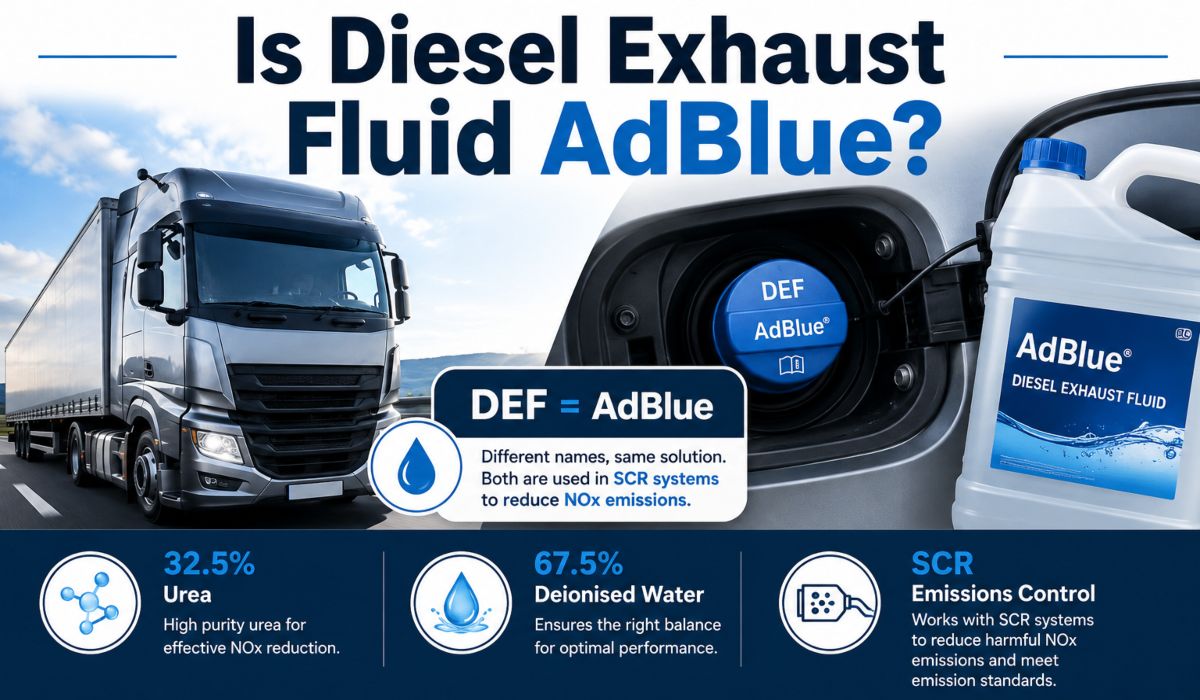
So, the Answer is: Yes. Diesel Exhaust Fluid (DEF) and AdBlue are essentially the same type of fluid when they meet the required ISO 22241 specification. Both contain approximately 32.5% high-purity urea and 67.5% deionised water and are used in Selective Catalytic Reduction (SCR) systems to reduce nitrogen oxide emissions from diesel engines.
DEF is the generic term commonly used internationally, particularly in North America, while AdBlue is a registered trademark used widely across the UK and Europe.
The UK Government also refers to AdBlue as Diesel Exhaust Fluid and explains that it is used as the consumable reagent in SCR systems.
Modern diesel vehicles rely on more than fuel alone to keep emissions under control. If you drive a newer diesel car, van, lorry or operate commercial machinery, you may have seen terms such as Diesel Exhaust Fluid, DEF, AdBlue, AUS 32 and SCR. With several names being used for what appears to be the same product, confusion is understandable.
So, is diesel exhaust fluid AdBlue? In practical terms, yes. Diesel Exhaust Fluid, commonly abbreviated to DEF, and AdBlue refer to the same type of high-purity urea solution used in Selective Catalytic Reduction systems to reduce harmful nitrogen oxide emissions from diesel engines. However, there is an important naming distinction: DEF is a generic description, while AdBlue is a registered trademark of the German Association of the Automotive Industry, known as the VDA.
That distinction matters when buying, storing and using the product because the fluid must meet strict quality requirements. Putting poor-quality or contaminated fluid into an SCR system can potentially cause expensive problems.
This detailed guide explains what Diesel Exhaust Fluid and AdBlue are, how they work, their composition, benefits, limitations, storage requirements and common mistakes to avoid.
What Is Diesel Exhaust Fluid?
Diesel Exhaust Fluid is a specially manufactured liquid designed for diesel vehicles equipped with Selective Catalytic Reduction technology.
Despite its name, DEF is not diesel fuel. It does not improve diesel quality, boost engine power or clean the fuel system. Instead, it works within the exhaust after-treatment system.
The fluid consists primarily of:
- 32.5% high-purity automotive-grade urea
- 67.5% deionised or demineralised water
The 32.5% concentration is carefully controlled. It is not an arbitrary mixture that can safely be recreated using ordinary fertiliser-grade urea and tap water.
UK government technical guidance describes DEF as an aqueous urea solution containing precisely 32.5% urea and 67.5% deionised water.
The fluid is stored in its own dedicated tank and injected into the exhaust gases when required.
What Is AdBlue?
AdBlue is the best-known European trade name for the same type of aqueous urea solution.
The AdBlue name is a globally registered trademark owned by the VDA. Products marketed officially under the AdBlue name must comply with specified quality requirements associated with the ISO 22241 standard.
According to the VDA, AdBlue is an AUS 32 urea solution used in Selective Catalytic Reduction systems and must be stored separately from diesel fuel.
This means that although people commonly use “AdBlue” as a general name for diesel exhaust fluid, technically the word refers to a licensed trademark.
It is a little like people using a famous brand name to describe an entire category of products. Chemically and functionally, compliant DEF and AdBlue perform the same job.
Diesel Exhaust Fluid vs AdBlue: Comparison Table
Feature | Diesel Exhaust Fluid | AdBlue |
Common abbreviation | DEF | AdBlue |
Main market terminology | Common internationally and in North America | Common throughout the UK and Europe |
Product type | Aqueous urea solution | Aqueous urea solution |
Urea concentration | Approximately 32.5% | Approximately 32.5% |
Water content | Approximately 67.5% deionised water | Approximately 67.5% deionised water |
Main standard | ISO 22241 | ISO 22241 |
Primary purpose | Reduce NOx emissions through SCR | Reduce NOx emissions through SCR |
Added to diesel tank? | No | No |
Separate storage tank required? | Yes | Yes |
Trademarked name? | Generic terminology | Yes, registered VDA trademark |
Suitable for SCR diesel vehicles? | Yes, when specification is correct | Yes |
Therefore, if you have been wondering is diesel exhaust fluid the same as AdBlue, the practical answer is yes, provided the product is manufactured to the correct specification.
How Diesel Exhaust Fluid and AdBlue Work
To understand why AdBlue is needed, it helps to understand what happens inside a diesel engine.
Diesel combustion produces several exhaust gases. Among them are nitrogen oxides, usually shortened to NOx.
Nitrogen oxide emissions contribute to air pollution and can negatively affect air quality. Modern emissions legislation has therefore encouraged vehicle manufacturers to develop increasingly sophisticated exhaust-treatment systems.
One widely used technology is Selective Catalytic Reduction.
Step 1: Diesel Combustion Produces Exhaust Gases
Fuel is burned inside the engine to generate power.
The resulting exhaust gases travel through the exhaust system.
Step 2: DEF Is Injected into the Exhaust
A controlled quantity of AdBlue is sprayed into the hot exhaust stream.
It is not sprayed directly into the combustion chamber.
Step 3: Heat Breaks the Urea Down
As the fluid encounters hot exhaust gases, chemical reactions convert the urea into ammonia.
Step 4: The SCR Catalyst Processes NOx
The ammonia reacts with nitrogen oxides inside the SCR catalyst.
The chemical reaction converts much of the harmful NOx into mainly nitrogen and water.
Both substances occur naturally in the environment.
The UK Vehicle Market Surveillance Unit states that SCR systems can reduce nitrogen oxide emissions by up to 95% when operating effectively at suitable temperatures.
Why Modern Diesel Vehicles Need AdBlue
Older diesel vehicles may not have an AdBlue system at all.
Modern diesel engines, particularly those designed to comply with stricter European emissions requirements, commonly use SCR technology.
AdBlue allows manufacturers to reduce NOx emissions without relying entirely on changes inside the engine.
It is particularly common in:
- Diesel passenger cars
- Commercial vans
- HGVs
- Coaches
- Buses
- Agricultural machinery
- Construction equipment
- Industrial diesel engines
- Certain generators and specialist equipment
Whether a particular vehicle requires AdBlue depends on its engine and emissions-control system.
Never assume that every diesel vehicle needs it.
Is AdBlue Added to Diesel Fuel?
No.
This is one of the most important points to understand.
AdBlue belongs in a completely separate tank.
The VDA specifically states that AdBlue is stored separately near the diesel tank and must not be added to diesel fuel.
Depending on the vehicle, the AdBlue filler may be located:
- Beside the diesel filler cap
- Inside the fuel-filler area
- Under the bonnet
- In the boot area
- Behind a separate exterior flap
The filler cap is often blue to distinguish it from diesel.
Never rely solely on colour, though. Always check the vehicle manual.
What Happens If AdBlue Is Put into the Diesel Tank?
Putting AdBlue into the diesel tank can cause serious problems.
AdBlue is largely water-based and is completely different from diesel fuel. If it enters the diesel system, it can contaminate components and potentially damage:
- Fuel pumps
- Injectors
- Fuel lines
- Filters
- High-pressure fuel-system components
If AdBlue has accidentally been poured into the diesel tank, do not start the engine.
Starting the engine can circulate the contaminated mixture through the fuel system, potentially turning a relatively manageable tank-draining job into a much more expensive repair.
Contact a suitable fuel-drainage or vehicle-recovery specialist.
What Happens If Diesel Is Put into the AdBlue Tank?
The reverse mistake can also be damaging.
SCR systems are designed for high-purity aqueous urea solution, not petroleum fuel.
Even relatively small amounts of diesel contamination may interfere with the dosing equipment and SCR components.
If diesel has entered the AdBlue tank, avoid operating the vehicle until professional advice has been obtained.
The fluid tank and associated system may require draining and cleaning.
Benefits of Diesel Exhaust Fluid and AdBlue
Reduced Nitrogen Oxide Emissions
The primary benefit is emissions control.
SCR technology uses AdBlue to convert much of the NOx contained in diesel exhaust into less harmful substances.
This helps modern diesel vehicles meet stringent emissions requirements.
Allows Efficient Diesel Engine Operation
SCR technology can allow manufacturers to optimise diesel engines while treating NOx further downstream in the exhaust system.
This makes the after-treatment system an important part of modern diesel-engine design.
Widely Available
AdBlue availability has expanded significantly.
Drivers and businesses can purchase it from:
- Fuel stations
- Automotive retailers
- Commercial fuel suppliers
- Vehicle dealerships
- Bulk-fluid distributors
- Online suppliers
For fleets and businesses consuming larger quantities, specialist AdBlue Suppliers in UK can provide drums, intermediate bulk containers or bulk deliveries depending on operational requirements.
Straightforward to Refill
In most vehicles, topping up the tank is relatively simple once the correct filler location is identified.
Commercial fleets may also use dedicated storage and dispensing equipment.
Helps Vehicles Maintain Emissions Compliance
Operating the SCR system correctly is important for maintaining the emissions performance for which the vehicle was designed.
AdBlue is therefore not merely an optional maintenance product on vehicles that require it.
Potential Drawbacks of AdBlue
Although useful, AdBlue adds another maintenance requirement to diesel ownership.
It Must Be Refilled
AdBlue is gradually consumed during vehicle operation.
Drivers therefore need to monitor its level and refill periodically.
Running Out Can Prevent Restarting
Modern vehicles normally provide dashboard warnings before the fluid runs out.
If those warnings are repeatedly ignored, some vehicles may limit performance or prevent the engine from restarting once it has been switched off.
Government emissions-testing information notes that systems may provide warnings and restrict performance or prevent engine restart when reagent levels are not replenished.
It Requires Correct Storage
AdBlue quality can be affected by contamination and unsuitable storage.
Businesses handling large amounts therefore need appropriate tanks, pumps, pipework and dispensing equipment.
It Can Freeze
AdBlue freezes at approximately -11°C.
This sounds alarming, but vehicle manufacturers design SCR systems with freezing conditions in mind.
The VDA states that freezing itself does not damage AdBlue and that the fluid can be used again after thawing.
DEF, AdBlue, DPF and EGR: What Is the Difference?
These terms often appear together, but they describe different parts of diesel-emissions control.
Term | Meaning | Main Function |
DEF | Diesel Exhaust Fluid | Supplies urea solution to SCR system |
AdBlue | Trademarked DEF/AUS 32 product name | Performs the same function as compliant DEF |
SCR | Selective Catalytic Reduction | Reduces NOx emissions |
DPF | Diesel Particulate Filter | Captures soot or particulate matter |
EGR | Exhaust Gas Recirculation | Recirculates exhaust gas to reduce combustion-related NOx |
Diesel fuel | Engine fuel | Powers the engine |
AdBlue does not clean the DPF directly.
Likewise, adding more AdBlue will not repair a blocked DPF or faulty EGR valve.
These systems work together but perform different roles.
AdBlue vs Diesel: They Are Not the Same Product
One of the easiest mistakes is confusing Diesel Exhaust Fluid with diesel itself because the word “diesel” appears in the name.
The distinction is simple:
Diesel = fuel
AdBlue/DEF = exhaust-treatment fluid
Diesel is burned inside the engine to generate energy.
AdBlue never serves as a fuel. Instead, it is injected into the exhaust after combustion.
This difference also explains why the two liquids must remain completely separated.
How Much AdBlue Does a Diesel Vehicle Use?
Consumption varies substantially.
Factors that can influence AdBlue use include:
- Vehicle type
- Engine size
- Mileage
- Load
- Driving conditions
- Emissions calibration
- Temperature
- Duty cycle
A large HGV operating continuously will naturally consume far more than a passenger car completing modest annual mileage.
Many passenger vehicles can travel thousands of miles between AdBlue refills.
Rather than relying on a universal consumption figure, check the manufacturer’s guidance for your specific vehicle.
How Do You Know When AdBlue Is Running Low?
Vehicles equipped with SCR systems normally monitor the tank level electronically.
A dashboard notification may show:
- Low AdBlue warning
- Remaining mileage
- Number of miles before restart becomes impossible
- Refill quantity recommendation
- SCR system warning
Do not ignore these messages.
Refilling early is much easier than reaching a situation where the vehicle refuses to restart.
Can You Drive Without AdBlue?
A vehicle with a functioning SCR system may continue running temporarily after a low-level warning appears.
However, once the system reaches its minimum threshold, the vehicle may restrict operation or eventually prevent restart.
Attempting to bypass or disable AdBlue equipment is not a sensible solution.
The UK Government specifically identifies manipulation of SCR and DEF systems, sometimes described as “AdBlue Delete”, as an emissions-control modification of concern.
Apart from legal considerations, disabling emissions systems can create warning lights, diagnostic problems and potential MOT or compliance issues.
Does AdBlue Improve Engine Performance?
AdBlue is not designed as a performance enhancer.
It does not function like:
- Cetane booster
- Injector cleaner
- Lubricity additive
- Fuel-system cleaner
- Octane or combustion additive
Its job is emissions treatment.
A properly functioning SCR system helps the overall vehicle operate as its manufacturer intended, but pouring additional AdBlue into the tank will not increase horsepower or improve fuel economy.
Can You Use Any Brand of Diesel Exhaust Fluid?
Brand name alone is less important than quality and specification.
For vehicles requiring AdBlue, choose fluid meeting the appropriate ISO 22241 quality requirements and follow the vehicle manufacturer’s recommendations.
The VDA explains that AdBlue quality requirements are defined within the ISO 22241 series and apply to licensed AdBlue products.
Cheap contaminated fluid is not worth the risk.
SCR components can be expensive, particularly dosing pumps, injectors, sensors and catalysts.
Why AdBlue Purity Matters
SCR systems depend on extremely accurate chemical reactions.
Contamination can interfere with those reactions or physically damage components.
Potential contaminants include:
- Tap water
- Diesel
- Petrol
- Oil
- Dust
- Dirt
- Cleaning chemicals
- Rust
- Incorrect urea products
This is why equipment used to transfer and store AdBlue should be dedicated specifically to the product.
Do not use an old fuel container simply because it looks clean.
Trace amounts of petroleum contamination may still remain.
Proper AdBlue Storage
Correct storage becomes particularly important for fleet operators and businesses buying in bulk.
AdBlue should generally be kept:
- In dedicated containers
- Away from direct contamination
- Sealed when not in use
- Away from unsuitable materials
- Within manufacturer-recommended temperature conditions
- Protected from prolonged excessive heat
- In clean dispensing systems
Government technical guidance recommends using containers, pipework, valves and nozzles specifically designed for urea solution.
Businesses storing significant quantities should also have appropriate procedures for spills and environmental protection.
Is AdBlue Dangerous?
AdBlue is not classified in the same way as highly hazardous fuels, but that does not mean it should be handled carelessly.
Direct contact may irritate skin or eyes in some circumstances.
Large spills can also create environmental problems.
UK Environment Agency guidance warns that AdBlue can be highly polluting if substantial quantities enter surface water or groundwater and notes that it is soluble in water.
For this reason:
- Clean spills appropriately
- Prevent fluid reaching drains
- Use proper storage
- Follow supplier safety instructions
- Wear suitable protective equipment when required
What Happens When AdBlue Freezes?
AdBlue begins freezing at approximately -11°C.
The water and urea freeze together at the designed concentration, so normal freezing does not permanently ruin the fluid.
After thawing, correctly stored AdBlue can generally continue to be used.
Many SCR-equipped vehicles also incorporate heating arrangements to help the system function in very cold conditions.
In normal British weather, freezing is unlikely to be a frequent problem for most vehicle owners.
Common AdBlue Mistakes to Avoid
Filling the Wrong Tank
Always identify the AdBlue filler before pouring anything.
Adding Water
Never dilute AdBlue yourself.
The concentration has been carefully designed to meet specification.
Using Agricultural Urea
Automotive urea has strict purity requirements.
Ordinary fertiliser products are not substitutes.
Ignoring Dashboard Warnings
Waiting until the tank is completely empty can leave you with a vehicle that refuses to restart.
Using Dirty Funnels or Containers
A funnel previously used for diesel or engine oil can contaminate the fluid.
Buying Questionable Fluid
Choose a reputable supplier and appropriate specification.
A few pounds saved on poor fluid makes little sense if it damages an expensive SCR system.
Applications Beyond Passenger Cars
AdBlue is particularly important in commercial transport.
Heavy Goods Vehicles
HGVs travel high annual mileages and have substantial diesel consumption, making NOx control particularly significant.
Vans
Modern diesel vans commonly use SCR systems, especially those operating under newer emissions standards.
Buses and Coaches
Public and private passenger transport fleets frequently use SCR technology.
Construction Machinery
Certain modern excavators, loaders and other diesel machines rely on DEF as part of their emissions-treatment equipment.
Agricultural Equipment
Some tractors and other modern agricultural machines use SCR systems to control exhaust emissions.
Industrial Equipment
Stationary engines and specialist diesel-powered equipment may also require DEF depending on their design and emissions standard.
Businesses with substantial consumption may purchase AdBlue in containers, drums or bulk volumes rather than small retail bottles. A specialist supplier such as 123 Oil may therefore be more practical for commercial users managing fleets or multiple operating sites.
Diesel Exhaust Fluid vs AdBlue: Pros and Cons
Because they are essentially the same fluid category, their advantages and disadvantages are largely identical.
Advantages
- Helps substantially reduce NOx emissions
- Supports SCR-equipped diesel vehicles
- Widely available across Britain
- Simple to refill correctly
- Suitable for passenger and commercial vehicles
- Standardised quality requirements
- Supports emissions compliance
- Available in small and bulk quantities
Disadvantages
- Creates an additional running cost
- Requires periodic refilling
- Needs dedicated storage equipment
- Can cause damage if added to diesel
- Can become contaminated easily
- Freezes at approximately -11°C
- A vehicle may refuse to restart if the tank runs empty
How to Choose the Right AdBlue
Before purchasing, consider several practical points.
Check the Specification
Look for a product manufactured to the appropriate ISO 22241 requirements.
Check Vehicle Requirements
Read the owner’s manual, especially if the vehicle is unfamiliar or recently purchased.
Choose the Right Container Size
A private motorist may only require a small bottle.
A fleet operator may achieve better practicality through:
- 10-litre containers
- 20-litre containers
- 200-litre drums
- IBCs
- Bulk storage systems
Consider Consumption
Businesses should track usage so that they can arrange replenishment before stocks become critically low.
Protect the Product from Contamination
Proper storage is every bit as important as buying the right fluid initially.
Final Verdict
Yes, but there is a small terminology detail worth remembering.
Diesel Exhaust Fluid is the generic term for the high-purity aqueous urea solution used by Selective Catalytic Reduction systems.
AdBlue is a registered trademark commonly used for compliant AUS 32 fluid throughout Britain and Europe.
In practical vehicle use, a compliant DEF product and genuine AdBlue perform the same function: supplying the SCR system with the urea solution required to reduce nitrogen oxide emissions.
Both products should contain approximately 32.5% high-purity urea and 67.5% deionised water when manufactured to the relevant standard.
The far more important distinction is between AdBlue and diesel fuel. The two are completely different liquids and belong in separate tanks.
Always purchase the correct specification, keep the fluid clean, follow manufacturer guidance and refill before dashboard warnings become critical.
Frequently Asked Questions
Yes, provided the Diesel Exhaust Fluid meets the correct ISO 22241 specification required by your vehicle. DEF is the generic name for the type of aqueous urea solution widely sold under the AdBlue trademark in Europe.
Yes. Correctly manufactured products consist of approximately 32.5% high-purity urea and 67.5% deionised water. The precise composition and purity are important for protecting SCR equipment.
No. AdBlue must go into its dedicated tank. Putting it into the diesel tank can contaminate the fuel system and potentially damage injectors, pumps and other components. If this happens, do not start the engine.
The vehicle normally provides warnings well before the tank becomes completely empty. If the warnings are ignored, some vehicles may reduce performance or prevent the engine from restarting after it has been switched off.
No. Only diesel vehicles equipped with an SCR emissions-control system require AdBlue. Many newer diesel cars use SCR technology, while numerous older vehicles do not. Check the owner's manual if you are unsure.
No. AdBlue is not mixed with diesel and does not operate as a conventional fuel additive. It is stored separately and injected into the exhaust system to assist the SCR catalyst in reducing nitrogen oxide emissions.
AdBlue has a storage life and can deteriorate more rapidly when exposed to excessive heat, contamination or unsuitable storage conditions. Keep it sealed in appropriate containers and follow the storage guidance supplied by the manufacturer.