


Metal oil tanks in the UK must be safely constructed, securely supported and positioned to reduce fire and pollution risks. In England, new or replacement domestic tanks must meet Building Regulations, and a bund capable of holding at least 110% of the tank capacity is required where specified pollution risks exist or the tank holds more than 2,500 litres. Rules differ in Wales, Scotland and Northern Ireland, so the relevant national regulations should be checked before installation.
Metal oil tanks remain a practical choice for many properties that rely on heating oil rather than mains gas. Steel tanks are strong, available in a wide range of capacities and can be suitable for locations where durability is particularly important. However, installing one is not simply a matter of placing a tank in the garden and connecting it to the boiler.
The rules governing oil storage are designed to reduce the risks of fire, leaks, groundwater contamination and pollution. They cover issues such as tank construction, location, foundations, secondary containment, pipework and safe access for fuel deliveries. Importantly, there is not one identical set of oil-tank rules across the whole UK. England, Wales, Scotland and Northern Ireland have their own building and environmental regulatory frameworks.
For homeowners, understanding metal oil tank regulations UK requirements is particularly important when installing a new tank, replacing an ageing tank or changing the position of an existing oil-storage system.
What Regulations Apply to Metal Oil Tanks in the UK?
For domestic properties in England, a new or replacement heating-oil storage container must comply with Building Regulations. GOV.UK also states that a domestic storage container capable of holding 3,501 litres or more falls under the rules applicable to businesses rather than the standard domestic guidance.
Approved Document J provides detailed guidance for heating-oil installations in England. Requirement J6 applies to fixed oil storage tanks with capacities greater than 90 litres and their connecting pipework. The guidance specifically addresses domestic heating-oil storage systems, including fire protection and pollution prevention.
Wales has its own Approved Document J covering combustion appliances and fuel-storage systems, while Scotland operates its own building standards system. Northern Ireland also has separate Building Regulations guidance governing combustion appliances and fuel storage.
Because of these differences, homeowners should not assume that guidance for a property in England automatically applies unchanged to a home in Scotland, Wales or Northern Ireland.
Do Metal Oil Tanks Need to Be Bunded?
A bund provides secondary containment. Its purpose is to retain oil if the primary storage tank leaks or fails, reducing the risk of fuel escaping into soil, drains or water.
In England, a domestic tank does not automatically require a bund simply because it is made from metal. Instead, the installer should carry out an environmental risk assessment. GOV.UK states that secondary containment is required where certain risk factors are present, and the bund must be capable of containing 110% of the tank’s capacity and must be impermeable to oil and water.
A bund is required under the England domestic guidance were, for example:
- the tank holds more than 2,500 litres
- a spill could enter an open drain or loose-fitting manhole
- the tank is within 10 metres of inland fresh water or coastal water
- it is within 50 metres of a drinking-water source, such as a well, borehole or spring
- spilled oil could travel across hard ground towards water
- the vent cannot be seen from the filling point
- the tank is located within Groundwater Source Protection Zone 1.
This means a relatively small metal tank can still require secondary containment if its location creates a significant pollution risk.
Is a Double-Skinned Metal Tank the Same as a Bunded Tank?
Not necessarily. This distinction causes plenty of confusion.
For installations where environmental oil-storage regulations apply, a double skin alone should not automatically be treated as compliant secondary containment. GOV.UK’s business oil-storage guidance specifically distinguishes double-skinned or twin-walled tanks from compliant secondary containment. Fixed tanks covered by those rules require an appropriate bund.
An integrally bunded steel tank, by contrast, is specifically designed with primary storage surrounded by compliant secondary containment. Approved Document J recognises integrally bunded tanks as one method of providing secondary containment where it is required.
When buying a tank, therefore, check its certification and intended use rather than relying solely on descriptions such as “double skin”.
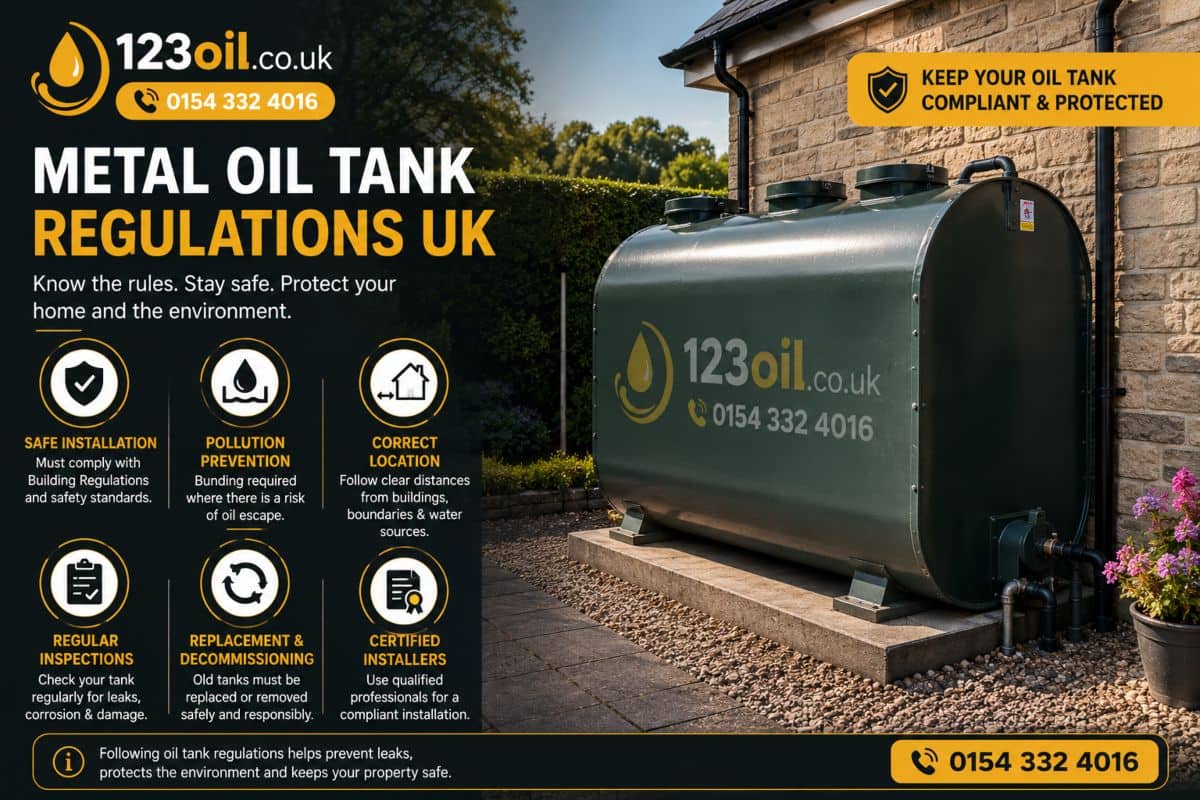
Metal Oil Tank Location and Fire-Safety Distances
The position of a metal heating-oil tank matters for both fire safety and pollution control.
For domestic installations in England, Approved Document J gives guidance stating that where a tank is at least 1,800 mm from a building and at least 760 mm from a boundary, no additional fire-protection measures are normally necessary under that particular table. Where those clearances cannot be achieved, appropriate fire-resistant construction or screening may be required.
If a tank is less than 1,800 mm from part of a building, the guidance describes measures such as suitable fire-resistant walls or a fire wall between the tank and the affected part of the building. If it is less than 760 mm from a boundary, suitable fire-resistant protection is also normally required.
These figures should not be treated as a DIY installation formula. Doors, windows, eaves, boundaries, neighbouring structures, drainage and the layout of the site can affect the final design.
What Base Does a Metal Oil Tank Need?
A filled steel oil tank is extremely heavy, so it needs a stable and properly constructed supporting surface.
Approved Document J’s England guidance describes a hard surface beneath the tank, such as concrete or suitable paving slabs, as a way of helping prevent vegetation from growing around the installation and contributing to fire risk. It refers to paving slabs at least 42 mm thick, with the hard surface extending at least 300 mm beyond the perimeter of the tank.
The supporting base must also be capable of taking the fully loaded weight of the tank without significant settlement or distortion. Metal tanks should not simply be positioned on unstable soil, timber offcuts or an improvised platform.
An uneven base can place unnecessary stress on the tank and fittings, potentially increasing the risk of distortion, movement or leakage.
Metal Tank Construction and Corrosion Protection
One of the main issues specific to steel oil tanks is corrosion.
Scottish building guidance, for example, specifically states that fixed oil-storage tanks should be sufficiently strong to resist physical damage and corrosion so that the risk of oil spillage is minimised. It identifies recognised standards for steel tanks, including standards covering steel tanks with or without integral bunding.
External corrosion can develop where protective coatings become damaged or where moisture is repeatedly trapped against the steel. Internal corrosion can also occur, particularly where water accumulates at the bottom of a tank.
Surface rust is not always evidence that a tank is about to fail, but deep corrosion, pitting, blistering paint, wet patches or deteriorated seams should never be ignored.
Why Pipework Is Part of Oil Tank Compliance
The tank itself is only one part of the storage system. Oil can also escape through pipework, valves, filters and connections.
Approved Document J states that a way of meeting the relevant fire-safety requirement is to use fuel pipework resistant to the effects of fire and install a proprietary fire-valve system in accordance with appropriate technical recommendations.
In Scotland, technical guidance similarly emphasises minimising pipework joints and using a direct route between the tank and burner where practical.
Pipework should therefore form part of the installation assessment rather than being treated as an afterthought.
Can a Metal Oil Tank Be Installed Next to a House?
Potentially, but additional fire precautions may be necessary.
In England, the Approved Document J guidance identifies 1.8 metres as an important separation distance between an oil tank and a building for the fire-protection arrangements described in its table. Where the tank is closer, suitable fire resistance or screening can be needed.
A common mistake is assuming that a metal tank itself is fireproof and can therefore be placed almost anywhere. The regulations are concerned not only with whether the storage vessel burns but also with the behaviour of its contents and the risk of fire spreading between the tank and nearby structures.
A competent installer should assess the actual site before choosing the final tank position.
Oil Tank Rules Near Drains and Watercourses
Environmental protection is a major part of heating-oil regulation.
Heating oil can spread quickly across hard surfaces and enter drainage systems. Even a relatively small leak can therefore become an expensive pollution incident.
In England, bunding may be necessary if a tank is close to fresh or coastal water, near a drinking-water source, positioned where oil could enter an open drain, or situated where spilled fuel could travel over hard ground and reach water.
Scotland’s building guidance also identifies risks including tanks within 10 metres of the water environment, locations where spills could reach open drains, and tanks within 50 metres of boreholes or springs.
This is why two houses with identical 1,200-litre tanks may require different containment arrangements.
Regulations for Metal Oil Tanks in Scotland
Scotland has its own building standards and environmental regulation system.
Scottish technical guidance covers the strength, corrosion resistance, installation and secondary containment of domestic oil-storage tanks. The guidance states that steel tanks should be constructed to recognised standards and identifies circumstances where secondary containment should be provided.
The Scottish regulatory framework has also changed in recent years. From 1 November 2025, water, waste-management and industrial regulatory activities moved under the Environmental Authorisations (Scotland) Regulations 2018 framework, and current Scottish building-standards procedures direct users to SEPA for requirements relating to regulated oil storage.
For a Scottish installation, current advice from the relevant local-authority verifier and SEPA should therefore be checked before work begins.
Metal Oil Tank Rules in Wales
Wales has its own version of Approved Document J dealing with combustion appliances and fuel-storage systems. The Welsh Government’s current page for this guidance was last updated in January 2025.
Homeowners in Wales should therefore use Welsh Building Regulations guidance rather than simply copying installation specifications taken from an England-only source.
This distinction becomes particularly important for alterations, tank relocation and replacement projects where Building Control requirements may need to be considered.
Metal Oil Tank Regulations in Northern Ireland
Northern Ireland also operates a separate system.
Official guidance confirms that there are Building Control rules covering the siting of domestic oil tanks. It recommends using a suitably registered technician, who can install the tank in accordance with Building Control standards and provide the appropriate commissioning documentation.
Environmental rules also apply to certain above-ground commercial, industrial and institutional oil stores. DAERA states that the Control of Pollution oil-storage regulations set minimum standards for the design, location and construction of covered above-ground storage facilities and require secondary containment for installations within their scope.
Domestic properties should therefore distinguish between domestic Building Control requirements and the separate rules that can apply to larger or non-domestic storage.
Do You Need Building Control Approval for a New Oil Tank?
In England, a new or replacement domestic oil-storage container must comply with Building Regulations. GOV.UK recommends choosing an installer registered with an appropriate competent-person scheme because that installer can self-certify compliant work.
If an installer is not registered under an appropriate competent-person scheme, the homeowner may need to deal directly with Building Control and arrange the necessary inspection and approval. GOV.UK warns that compliance certificates can also become important when selling a property.
Keeping installation and commissioning paperwork is therefore well worth doing. Future buyers, surveyors and insurers may want evidence showing when and how the installation was completed.
When Should an Old Steel Oil Tank Be Replaced?
There is no sensible rule that every tank must automatically be discarded once it reaches one exact birthday. Condition and installation circumstances matter.
An Oil Tank Replacement should be considered where significant corrosion, leakage, damaged welds, weakened supports or other structural defects mean the tank can no longer be relied upon to retain its contents safely. It can also be an opportunity to bring an older arrangement up to the requirements applicable to the new installation.
Do not wait for visible fuel on the ground before taking deterioration seriously. A slow leak can travel beneath paving or through soil before it becomes obvious.
Inspecting a Metal Heating Oil Tank
Metal tanks should be checked periodically for rust, pitting, damaged coatings, damp patches, staining and deterioration around seams, valves and pipe connections.
A professional Tank Inspection can assess areas that are easy for homeowners to overlook, including the base, supports, fittings, pipework and whether environmental or fire-safety risks have changed since the original installation.
For example, a later extension, new fence, shed or drainage alteration may change the surroundings of a tank even though the tank itself has not moved.
Northern Ireland’s environmental authority has specifically advised homeowners to look for rusting, pitting and blistering paint on metal tanks and recommends arranging an annual assessment by a competent person.
What Happens When a Metal Oil Tank Is Removed?
Removing an old tank requires more care than simply disconnecting it and taking it to a scrap-metal yard. Residual heating oil and sludge may remain inside and need controlled handling.
Proper Tank Decommissioning should include safely removing usable fuel, dealing with residues, isolating pipework and ensuring that the tank is handled and disposed of through an appropriate route. In England, current Environment Agency guidance places conditions on contractors storing and draining removed domestic oil tanks and requires measures to prevent residues escaping during the process.
Attempting to cut open an uncleaned tank is particularly unwise because residues and vapours may remain inside.
Above-Ground vs Underground Metal Oil Tanks
Above-ground tanks are generally easier to monitor because their exterior, fittings and surrounding area remain visible.
Underground storage introduces additional challenges. Leaks can remain hidden for longer, and inspection, maintenance and eventual removal are more difficult. England’s Approved Document J notes that below-ground oil storage is not recommended where alternative arrangements are available because underground tanks are difficult to inspect and leaks may not immediately be obvious.
Specialist advice should therefore be obtained before installing, retaining or replacing a buried steel tank.
Common Metal Oil Tank Compliance Mistakes
Several seemingly minor installation choices can create much bigger problems later.
Common issues include placing the tank too close to buildings or boundaries without appropriate fire protection, using an unsuitable base, failing to assess nearby drains, assuming a double-skinned tank is automatically a compliant bund, allowing vegetation to grow against the tank and ignoring corrosion.
Another mistake is relocating a tank because it is visually inconvenient without reassessing fire and environmental risks. A location that looks tidier may actually be less suitable if it puts the tank closer to a drain, watercourse, window, boundary or combustible structure.
A competent installer should consider the entire installation rather than only whether the tank physically fits into the available space.
How to Keep a Metal Oil Tank Safe
Homeowners can reduce the likelihood of leaks and unexpected problems through straightforward preventative care.
Check the visible surface of the tank regularly, keep the surrounding area clear enough to see the tank properly, watch for staining or unusual oil smells and investigate sudden changes in fuel consumption. Do not paint over serious corrosion simply to hide it.
After fuel deliveries, occasionally check the tank, valves and exposed pipework for signs of damage or leakage.
It is also worth keeping records of installation work, servicing and professional assessments. This creates a useful history if concerns develop later.
When arranging heating-oil deliveries through a supplier such as 123 Oil, maintaining a safe and accessible tank also helps ensure that deliveries can be completed without unnecessary difficulties.
Why Compliance Matters
The rules surrounding oil storage exist because failure can have consequences beyond losing a tank of heating oil.
A leak can contaminate soil, drains, groundwater or nearby watercourses. GOV.UK warns that legal action may follow where an oil spill causes water pollution.
There may also be significant clean-up costs, disruption to the property and complications with insurance. Preventative installation and maintenance are considerably less painful than digging contaminated soil out of a garden. Oil has a remarkable talent for making a small problem expensive.
Conclusion
Metal oil tanks can provide robust and dependable heating-oil storage, but their installation must be planned around more than tank size and available garden space.
The main metal oil tank regulations UK considerations include structural integrity, corrosion resistance, a suitable supporting base, safe separation from buildings and boundaries, pollution risk, appropriate secondary containment and properly installed pipework.
For homes in England, new and replacement tanks must comply with Building Regulations, with specific guidance covering bunding and fire protection. Wales, Scotland and Northern Ireland have their own regulatory systems, so the correct national guidance should always be checked before work is started.
Most importantly, do not assume an old installation remains suitable simply because it has never leaked before. Regular checks and professional assessment can identify corrosion or compliance issues before they turn into costly failures.
Frequently Asked Questions
Not every domestic metal tank automatically needs a bund. In England, secondary containment is required where specified pollution risks exist or where the tank capacity exceeds 2,500 litres. Other UK nations have their own requirements, so the installation location must be assessed under the applicable national rules.
For England, Approved Document J's standard fire-protection guidance uses 1.8 metres from a building as an important threshold. Tanks positioned closer may require suitable fire-resistant construction or screening.
England's Approved Document J guidance uses 760 mm from a boundary in its standard arrangement. Where a tank is closer, suitable fire-resistant protection may be necessary.
A tank should have an appropriate stable supporting base rather than simply being placed on soft or uneven ground. England's Approved Document J describes a suitable hard surface such as concrete or appropriate paving as part of its guidance.
Light surface corrosion does not necessarily mean immediate failure, but pitting, blistered coatings, deep corrosion or deterioration around seams and fittings can indicate a developing problem. Northern Ireland's environmental guidance specifically advises householders to check metal tanks for rusting, pitting and blistering paint.
A new or replacement domestic tank in England must comply with Building Regulations. Using an appropriately registered competent installer simplifies certification; otherwise Building Control involvement may be required. Similar national requirements should be checked in Wales, Scotland and Northern Ireland.
Not automatically. A double-skinned tank and an integrally bunded tank are not necessarily the same thing. Where compliant secondary containment is required, the chosen system must satisfy the applicable containment requirements rather than simply having two skins.