

SCR stands for Selective Catalytic Reduction. It is an emissions-control system used mainly in diesel vehicles to reduce harmful nitrogen oxide (NOx) emissions. It works by using AdBlue and an SCR catalyst to convert NOx into nitrogen and water vapour.
If you own or operate a modern diesel vehicle, you may have come across the term SCR when reading about emissions, AdBlue, exhaust systems or diesel engine maintenance. It is an important piece of technology found in many modern diesel cars, vans, lorries and commercial vehicles, yet its purpose is not always obvious to drivers.
In simple terms, SCR = Selective Catalytic Reduction, and its main purpose is to reduce nitrogen oxide emissions from diesel engines.
What Is Selective Catalytic Reduction?
Selective Catalytic Reduction is an exhaust after-treatment process designed to make diesel engines cleaner.
Diesel engines are popular because they can offer good fuel efficiency, high torque and durability. However, the combustion process can also produce nitrogen oxides, usually referred to collectively as NOx.
Nitrogen oxide emissions contribute to air pollution and are therefore tightly controlled through vehicle emissions standards.
Instead of fundamentally changing how the engine operates, an SCR system treats the exhaust gases after combustion has taken place. It uses a reducing agent and a catalyst to trigger chemical reactions that significantly reduce the amount of NOx released through the exhaust.
The technology has become particularly important as emissions regulations have become stricter.
What Does SCR Mean on a Diesel Vehicle?
When SCR appears in information relating to a diesel car, van, lorry or other vehicle, it normally refers to its Selective Catalytic Reduction emissions system.
The SCR system forms part of the vehicle’s wider exhaust and emissions-control equipment.
Depending on the vehicle, this may work alongside other components, including:
- Diesel particulate filters (DPFs)
- Diesel oxidation catalysts
- Exhaust gas recirculation (EGR) systems
- NOx sensors
- AdBlue injection equipment
- Temperature sensors
- Engine and emissions control modules
These technologies perform different jobs.
For example, a DPF is primarily designed to capture particulate matter or soot. An SCR system, on the other hand, focuses mainly on reducing nitrogen oxide emissions.
This distinction is important because people sometimes assume that the DPF, EGR and SCR systems are different names for the same thing. They are not.
How Does an SCR System Work?
The principle behind SCR sounds complicated, but the basic process is relatively straightforward.
The engine burns diesel fuel and produces exhaust gases. Before those gases are released from the exhaust pipe, they pass through several emissions-control components.
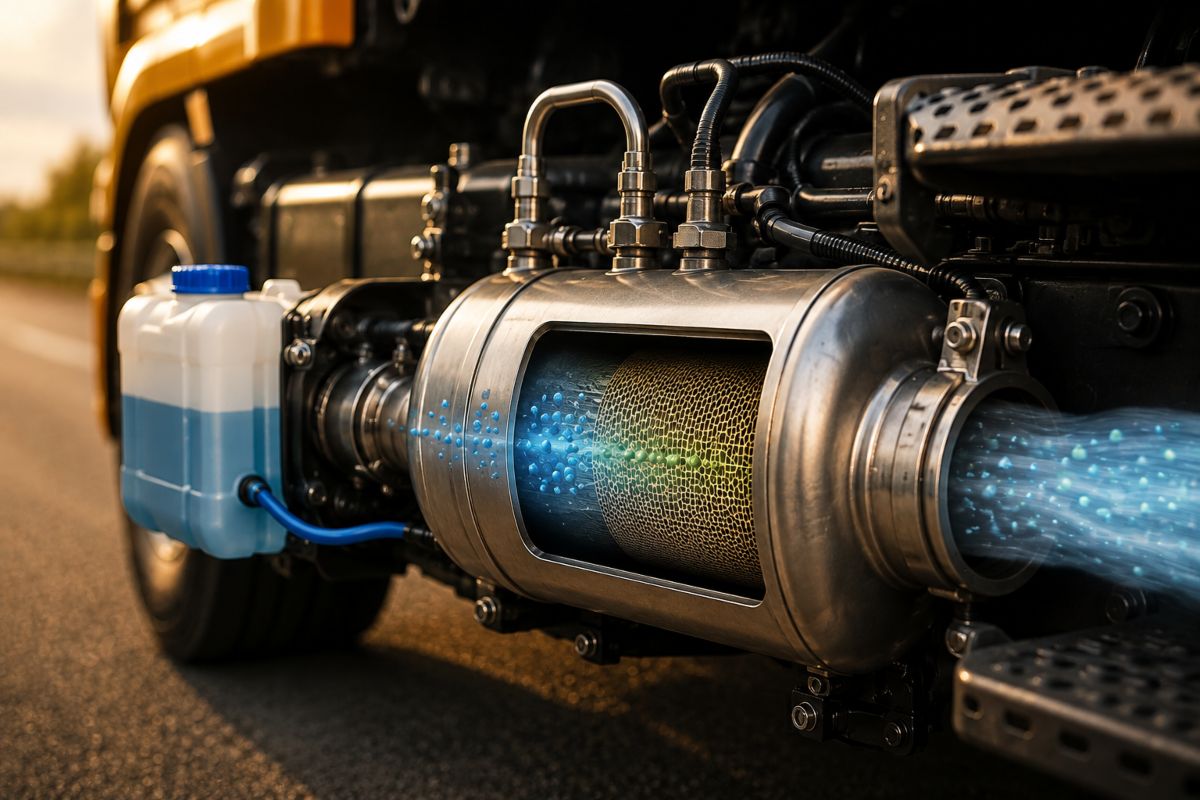
Within an SCR-equipped vehicle, a urea-based solution is introduced into the exhaust stream. In the UK and across much of Europe, drivers will usually recognise this solution by the name AdBlue.
The process can be broken down into several stages.
1. The Diesel Engine Produces Exhaust Gases
Diesel is burned inside the engine to produce power. Combustion produces several exhaust gases, including nitrogen oxides.
These gases travel from the engine into the exhaust and after-treatment system.
2. AdBlue Is Injected Into the Exhaust
The vehicle has a separate AdBlue tank.
A carefully controlled amount of AdBlue is injected into the hot exhaust stream. The quantity required is managed electronically according to factors such as engine operation, exhaust conditions and information received from the vehicle’s sensors.
AdBlue is not diesel fuel and is not mixed directly with diesel inside the fuel tank.
3. Ammonia Is Produced
Under the appropriate conditions, the urea contained in AdBlue breaks down and produces ammonia.
This ammonia plays a central role in the SCR process.
4. Exhaust Gases Enter the SCR Catalyst
The exhaust gases and ammonia then pass through the SCR catalyst.
Inside the catalyst, chemical reactions take place between the ammonia and nitrogen oxides.
5. Nitrogen Oxides Are Converted
The chemical reactions convert much of the harmful NOx into mainly nitrogen and water.
Nitrogen is already naturally abundant in the atmosphere, while water vapour is considerably less problematic than the nitrogen oxide emissions being treated.
The treated exhaust gases can then continue through the exhaust system.
Why Is SCR Called “Selective” Catalytic Reduction?
The word “selective” is important.
The process is described as selective because the reducing agent reacts preferentially with nitrogen oxides within the catalyst under suitable operating conditions.
The technology is therefore targeted towards controlling NOx rather than simply removing every component present in the exhaust gas.
“Catalytic” refers to the catalyst that facilitates the necessary chemical reactions, while “reduction” relates to the chemical process used to transform nitrogen oxides.
Put everything together and you get Selective Catalytic Reduction.
What Is AdBlue and Why Does SCR Need It?
AdBlue is closely associated with SCR technology.
It is a fluid made from a high-purity urea solution and demineralised water. It is stored in a separate tank and should never be poured into the diesel fuel tank.
The SCR system needs this fluid because the urea ultimately provides the ammonia required for the reactions that reduce NOx within the catalyst.
Without sufficient AdBlue, an SCR-equipped vehicle cannot operate its emissions-control system as intended.
This is why modern diesel vehicles may display dashboard warnings when the AdBlue level becomes low.
Depending on the vehicle, ignoring these warnings can eventually result in operating restrictions or prevent the engine from restarting after it has been switched off. The exact behaviour varies between manufacturers and models.
Drivers should therefore treat an AdBlue warning as something that needs attention rather than simply another dashboard notification to ignore.
Is AdBlue the Same as Diesel?
No. AdBlue and diesel are completely different fluids.
Diesel is a fuel used by the engine to generate power.
AdBlue is an exhaust treatment fluid used by an SCR system to help reduce nitrogen oxide emissions.
They also have separate tanks.
This is a particularly important distinction because putting AdBlue into a diesel tank, or diesel into an AdBlue tank, can cause serious problems.
If you accidentally put the wrong fluid into either tank, avoid starting the engine and seek professional assistance.
Where Is SCR Technology Used?
Selective Catalytic Reduction is strongly associated with diesel road vehicles, but its applications are much broader.
SCR technology can be found in various types of diesel-powered machinery and equipment where NOx emissions need to be controlled.
Common applications can include:
Cars
Many newer diesel passenger cars use SCR technology to comply with modern emissions requirements.
Vans
Diesel vans used by tradespeople, delivery companies and businesses frequently incorporate SCR and AdBlue systems.
HGVs and Lorries
Heavy goods vehicles have been major users of SCR technology because diesel engines remain widely used for transporting heavy loads over long distances.
Buses and Coaches
Public and private passenger transport vehicles may use SCR systems to reduce emissions from their diesel engines.
Agricultural Machinery
Some tractors and other modern agricultural machines use SCR technology as part of their emissions-control systems.
Construction and Industrial Equipment
Depending on the engine and applicable emissions requirements, SCR technology can also appear in diesel-powered construction and industrial machinery.
The exact system varies considerably according to the engine, manufacturer and application.
Why Do Diesel Engines Need SCR?
Diesel engines present manufacturers with a difficult emissions challenge.
They need to provide efficient combustion and useful performance while meeting increasingly strict limits on pollutants such as nitrogen oxides and particulate matter.
SCR helps address the NOx side of this challenge.
By treating exhaust gases after combustion, SCR technology enables manufacturers to reduce nitrogen oxide emissions while maintaining the characteristics that make diesel engines useful for many applications.
This is particularly valuable for larger commercial vehicles, where diesel engines are commonly chosen for their torque, range and suitability for heavy-duty work.
What Are NOx Emissions?
To understand why SCR matters, it helps to understand NOx.
NOx is a collective term commonly used for nitrogen oxides, particularly nitrogen monoxide (NO) and nitrogen dioxide (NO₂), produced during high-temperature combustion.
Road transport is one source of these pollutants.
Nitrogen oxides can contribute to poor air quality and the formation of other atmospheric pollutants. Exposure to elevated concentrations of nitrogen dioxide is also associated with adverse effects on respiratory health.
Reducing NOx emissions has therefore become an important part of vehicle emissions regulation and air-quality policy.
SCR technology helps tackle the problem before exhaust gases leave the vehicle.
What Is the Difference Between SCR and DPF?
SCR and DPF systems are often mentioned together, but they tackle different emissions.
SCR systems primarily target nitrogen oxides (NOx).
A Diesel Particulate Filter (DPF) primarily captures particulate matter, including soot, from diesel exhaust gases.
A modern diesel vehicle may contain both systems.
The DPF traps particulate matter and periodically needs conditions that allow accumulated soot to be burned away through regeneration. The SCR system uses AdBlue and a catalyst to reduce NOx emissions.
So, although both form part of the emissions-control system, they should not be confused.
What Is the Difference Between SCR and EGR?
Exhaust Gas Recirculation, or EGR, is another method used to control NOx emissions.
However, it operates differently from SCR.
EGR redirects a controlled amount of exhaust gas back into the engine’s intake system. This can reduce combustion temperatures and consequently help limit the formation of nitrogen oxides.
SCR works further downstream by treating NOx already present in the exhaust gases.
Some diesel engines use both technologies as part of an integrated emissions-control strategy.
Does Every Diesel Vehicle Have SCR?
No.
Whether a diesel vehicle has an SCR system depends on factors including its age, manufacturer, engine design, vehicle type and applicable emissions standards.
Many modern diesel vehicles use SCR, particularly those designed to meet more stringent emissions requirements.
Older diesel vehicles may not have an SCR system at all.
One obvious indication is the presence of an AdBlue filler. However, if you are uncertain, the safest approach is to check the vehicle handbook or manufacturer information.
Never assume a vehicle requires AdBlue simply because it runs on diesel.
How Can You Tell If Your Vehicle Uses SCR?
There are several potential signs.
Your vehicle may have a separate AdBlue filler cap. Depending on the model, this could be located beside the diesel filler, beneath the bonnet or elsewhere on the vehicle.
The dashboard may also display messages relating to:
- AdBlue level
- AdBlue range
- SCR system faults
- Emissions system faults
- NOx sensors
- Engine restart restrictions
The owner’s handbook should provide the clearest information about whether your particular vehicle uses SCR and where the AdBlue tank is located.
What Happens If the SCR System Develops a Fault?
An SCR system relies on several components working together.
A problem with one component can cause the vehicle’s engine or emissions warning light to illuminate.
Potential SCR-related faults can involve components such as:
- NOx sensors
- AdBlue injectors
- AdBlue pumps
- Level sensors
- Temperature sensors
- Wiring and electrical connections
- SCR catalysts
- Control modules
The vehicle may display a specific warning message rather than simply an engine management light.
In some cases, continued operation with an unresolved emissions fault may lead to reduced performance or other restrictions. The precise response depends on the vehicle.
An SCR warning should therefore be properly diagnosed rather than ignored.
What Happens If You Run Out of AdBlue?
The exact consequences depend on the vehicle, but modern SCR-equipped vehicles are designed to warn drivers before the AdBlue tank becomes completely empty.
You may initially receive a low-level warning showing an estimated remaining range.
Further warnings can become more urgent as the level continues to fall.
If the AdBlue supply is completely exhausted, some vehicles may prevent the engine from restarting after it has been switched off. This is linked to the vehicle’s emissions compliance strategy.
The sensible approach is simple: refill the AdBlue when the vehicle asks for it rather than waiting until the tank is empty.
How Often Does AdBlue Need Refilling?
There is no universal refill interval.
AdBlue consumption varies according to the vehicle, engine, journey type, load, driving conditions and manufacturer calibration.
A heavily used commercial diesel vehicle may consume considerably more AdBlue than a passenger car covering relatively few miles.
Rather than relying on a fixed mileage figure, drivers should monitor the vehicle’s AdBlue level and respond to dashboard warnings.
Some vehicles allow the AdBlue level or remaining range to be checked through the driver’s information display.
Does SCR Affect Fuel Consumption?
SCR is an emissions-control technology rather than a fuel-saving device.
Its primary purpose is to reduce nitrogen oxide emissions.
However, SCR allows engine and emissions strategies to be designed around a combination of combustion efficiency and after-treatment. Its overall relationship with fuel consumption is therefore more complicated than simply saying SCR directly increases or decreases fuel economy.
For drivers, the important point is that diesel and AdBlue consumption should be treated separately.
AdBlue is an additional operating fluid, not a replacement or additive for diesel fuel.
Is SCR Only Important for Vehicle Owners?
No.
SCR is particularly relevant to businesses operating diesel fleets, commercial vehicles, agricultural equipment and other diesel-powered machinery.
For fleet operators, keeping vehicles properly fuelled and maintaining their emissions systems can help reduce unnecessary downtime.
Businesses that depend on diesel fuel should also plan fuel supplies carefully. 123 Oil can support commercial and operational fuel requirements, while vehicle operators should separately monitor any AdBlue requirements specified by their equipment manufacturers.
Can You Drive With an SCR Warning Light?
That depends on the warning and the vehicle.
A low AdBlue warning may simply mean the fluid needs topping up soon.
An SCR system fault, however, can indicate a problem requiring diagnosis.
Because dashboard symbols and warning messages vary between manufacturers, drivers should check the owner’s manual rather than assuming every SCR warning means the same thing.
If the warning indicates a serious emissions fault, restricted mileage or an impending no-restart condition, professional attention should be sought promptly.
Ignoring the warning may turn a relatively manageable problem into an inconvenient breakdown or a vehicle that cannot be restarted.
How Can You Look After an SCR System?
SCR systems are designed to work automatically, so drivers do not normally need to manually control the process.
However, a few sensible habits can help avoid preventable problems.
Use the correct AdBlue specification recommended for the vehicle. Never add diesel, water or another fluid to the AdBlue tank.
Keep an eye on dashboard warnings and refill the tank before it becomes empty.
Avoid contamination when filling AdBlue, as the system is designed to operate with a specific fluid quality.
If an SCR or emissions warning remains illuminated after the AdBlue level has been corrected, have the system professionally diagnosed.
Most importantly, do not attempt to bypass or disable emissions-control equipment. Apart from the environmental implications, modifications to emissions systems can create legal, inspection and vehicle reliability problems.
Why Is SCR Important for Modern Diesel Vehicles?
Selective Catalytic Reduction has become an important part of modern diesel emissions technology because it tackles one of diesel combustion’s major pollutants: nitrogen oxides.
Instead of allowing these gases to pass directly through the exhaust, SCR provides an additional treatment stage.
For everyday drivers, much of the process happens unnoticed.
The main interaction most people have with the system is topping up AdBlue and responding to warning messages when necessary.
Behind the scenes, however, sensors, electronic controls, injection equipment and the SCR catalyst work together to control exhaust emissions.
Final Thoughts
SCR stands for Selective Catalytic Reduction, an exhaust after-treatment technology primarily used to reduce harmful nitrogen oxide (NOx) emissions from diesel engines.
In an SCR-equipped diesel vehicle, a urea-based fluid such as AdBlue is introduced into the exhaust system. Through reactions within the SCR catalyst, much of the NOx is converted into mainly nitrogen and water vapour before the exhaust gases are released.
Understanding SCR is particularly useful if you drive a modern diesel car, van or commercial vehicle. It explains why your vehicle needs AdBlue, what an SCR dashboard warning means and how this technology fits alongside systems such as the DPF and EGR.
For most drivers, there is no need to understand every chemical reaction taking place inside the exhaust. Remember the essentials: SCR controls NOx, AdBlue supports the SCR process, and diesel and AdBlue must always remain in their separate tanks.
Frequently Asked Questions
SCR stands for Selective Catalytic Reduction. It is an exhaust emissions-control technology used to reduce nitrogen oxides produced by diesel engines. It typically works with AdBlue and an SCR catalyst.
Most automotive SCR systems use a urea-based Diesel Exhaust Fluid, commonly sold as AdBlue in the UK and Europe. The fluid helps provide the ammonia needed for chemical reactions that reduce NOx within the SCR catalyst.
No. An SCR system mainly reduces nitrogen oxide emissions, while a Diesel Particulate Filter primarily captures soot and particulate matter. Modern diesel vehicles may use both technologies.
Not every diesel engine is fitted with SCR, particularly older vehicles. However, if a vehicle was designed to operate with an SCR system, faults or a lack of AdBlue can trigger warnings and, depending on the vehicle, operating or restart restrictions.
Most vehicles provide several warnings before the AdBlue tank becomes empty. If it runs out completely, some vehicles may not restart once the engine has been switched off until the AdBlue supply has been replenished.
SCR faults can be associated with several components, including NOx sensors, AdBlue injectors, pumps, temperature sensors, wiring or the SCR catalyst itself. Proper diagnostics are needed to identify the actual cause.
No. Many modern diesel vehicles use SCR technology, but not every diesel car has the same emissions-control system. Check the owner's handbook or manufacturer specifications to confirm whether a particular vehicle uses SCR.