


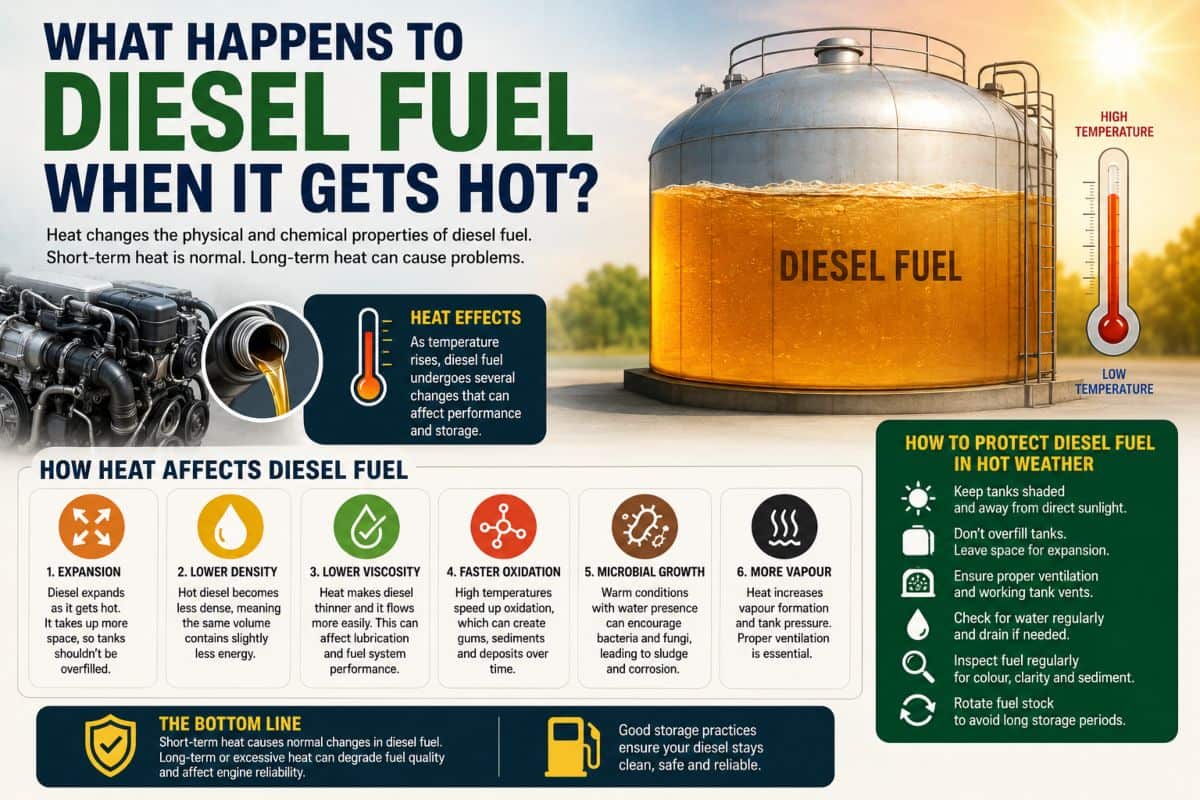
When diesel fuel gets hot, it expands and becomes less dense, meaning the same volume contains slightly less energy than cooler diesel. Higher temperatures also reduce its viscosity, allowing it to flow more easily. If diesel stays hot for long periods, oxidation and fuel degradation can accelerate, potentially creating gums, sediments and deposits that may affect filters, injectors and engine performance.
Diesel fuel is designed to perform across a wide range of operating conditions, but temperature still has a noticeable effect on its behaviour. When diesel gets hot, it expands, becomes less dense, flows more easily and may become more vulnerable to oxidation and degradation if it remains exposed to high temperatures for extended periods.
For drivers, fuel distributors, agricultural businesses and commercial operators, understanding what happens to diesel fuel when it gets hot is important. Excessive heat does not normally cause diesel to suddenly become unusable, but prolonged exposure can reduce fuel quality, increase storage problems and potentially affect engine efficiency.
Modern diesel systems also operate under considerable heat and pressure, meaning good fuel storage, maintenance and temperature management are essential for keeping equipment reliable.
How Does Heat Affect Diesel Fuel?
Diesel is a mixture of hydrocarbons, and like most liquids, its physical characteristics change as temperature rises.
The most immediate changes occur in its volume, density and viscosity. These changes are generally reversible when temperatures return to normal. However, prolonged or repeated exposure to excessive heat can trigger chemical changes that are harder to reverse.
The effects of heat depend on several factors, including:
- How high the temperature becomes
- How long the diesel remains hot
- The type and quality of fuel
- Exposure to oxygen
- The condition of the storage tank
- Presence of water or contaminants
- Frequency of fuel turnover
Diesel stored correctly in a suitable tank will normally tolerate normal summer temperatures without major problems. The risk increases when fuel is stored for long periods in poorly ventilated or sun-exposed tanks.
Diesel Fuel Expands as It Gets Hot
One of the most noticeable effects of heating diesel fuel is thermal expansion.
When diesel becomes warmer, its molecules move more actively and spread slightly farther apart. As a result, the overall volume of the fuel increases.
This means a litre of warm diesel contains slightly less actual fuel mass than a litre of colder diesel.
The difference is usually small during everyday vehicle use, but it can become significant when storing or transferring thousands of litres of fuel.
This is one reason commercial fuel tanks should never be filled completely to the top. Adequate expansion space must remain inside the tank so the fuel has room to expand when temperatures rise.
Failing to leave sufficient space can increase the risk of:
- Fuel overflow
- Tank pressure
- Spillage
- Environmental contamination
- Damage to tank components
Fuel storage systems should therefore be designed with thermal expansion in mind.
Diesel Becomes Less Dense When Heated
Density describes how much mass is contained within a particular volume.
As diesel heats up and expands, its density decreases. In simple terms, warmer diesel weighs slightly less per litre than cooler diesel.
This matters because the energy stored in diesel is closely linked to its mass rather than simply its volume.
Consequently, a litre of hot diesel may contain slightly less energy than the same measured litre at a lower temperature.
For a normal driver, the difference is unlikely to be noticeable. However, fuel wholesalers, logistics operators and large industrial users pay closer attention because small density variations can become financially important when dealing with bulk quantities.
Businesses relying on Heating Oil Suppliers may also encounter temperature-adjusted measurements when receiving larger fuel deliveries.
Heat Reduces Diesel Viscosity
Another important change involves viscosity.
Viscosity describes how easily a liquid flows. Cold diesel is thicker, while hot diesel is thinner and flows more easily.
When diesel temperature rises, its viscosity decreases.
A moderate reduction in viscosity can help fuel move through pipes, pumps and fuel systems. However, excessively thin diesel can alter the lubrication provided to certain fuel-system components.
Modern diesel engines use extremely precise fuel injectors operating at very high pressures. Fuel properties therefore need to remain within suitable limits.
Extremely high fuel temperatures could potentially contribute to:
- Reduced fuel-system lubrication
- Injector wear
- Changes in spray patterns
- Lower fuel density
- Slight reductions in engine efficiency
Normally, vehicle fuel systems are designed to manage expected operating temperatures, so these issues are more relevant when systems are damaged, poorly maintained or exposed to unusual heat.
Can Hot Diesel Lose Energy?
Yes, but the situation is slightly more complicated than simply saying hot diesel becomes weaker.
The energy contained within a particular mass of diesel does not suddenly disappear because the fuel becomes warm.
However, because hot diesel expands and becomes less dense, the amount of fuel mass contained within each litre decreases slightly.
Therefore, when fuel is measured purely by volume, hot diesel may effectively contain slightly less energy per litre than cooler diesel.
Modern fuel systems compensate for normal temperature variations, so this usually has little noticeable effect on everyday driving.
For large commercial fuel users, however, temperature compensation can be important when monitoring fuel inventories and consumption.
High Temperatures Can Accelerate Diesel Oxidation
One of the more serious long-term effects of heat is oxidation.
Diesel naturally reacts with oxygen over time. This chemical process gradually changes the fuel and can produce unstable compounds.
Heat speeds up many chemical reactions, including oxidation.
Therefore, diesel stored at high temperatures for long periods can degrade faster than fuel kept in cooler, stable conditions.
Oxidation may eventually produce:
- Sticky gums
- Varnish-like deposits
- Insoluble particles
- Sediment
- Darkened fuel
- Unpleasant odours
These contaminants can circulate through the fuel system and cause operational problems.
Businesses that depend heavily on diesel may therefore use professional fuel management services such as Nationwide Red Diesel Suppliers to maintain reliable fuel availability and reduce the risks associated with long-term storage.
Hot Diesel Can Cause More Fuel Vapour
Diesel is less volatile than petrol, which means it does not evaporate as easily under normal conditions.
However, heating diesel still increases evaporation and vapour formation.
As fuel temperature rises, more volatile components can begin moving into the vapour space above the liquid.
This does not mean diesel becomes as volatile as petrol, but proper tank ventilation remains essential.
Fuel tanks are designed to manage changes in pressure caused by temperature fluctuations.
Blocked or damaged vents can allow pressure to build inside a tank, increasing the risk of leaks or equipment damage.
This is particularly important for above-ground tanks exposed directly to sunlight.
Does Diesel Catch Fire When It Gets Hot?
Diesel does not normally ignite simply because the weather becomes hot.
Its flash point is considerably higher than that of petrol, making diesel less likely to produce ignitable vapours at normal ambient temperatures.
However, diesel is still a combustible fuel.
If it is exposed to sufficiently high temperatures, an ignition source or the correct fuel-air conditions, it can burn.
Fuel should therefore always be stored away from:
- Open flames
- Welding equipment
- Electrical sparks
- Hot machinery surfaces
- Smoking areas
- Other ignition sources
Good fuel storage procedures remain essential even though diesel is generally less volatile than petrol.
What Happens to Diesel Stored in Hot Weather?
Diesel stored during summer requires additional attention, particularly when using above-ground tanks.
Sunlight can significantly increase the temperature inside dark-coloured or exposed storage tanks.
Repeated heating and cooling can also encourage condensation.
During the day, the air inside the tank warms and expands. At night, temperatures fall, and moisture may condense on the internal surfaces.
That water can eventually collect at the bottom of the tank.
Water contamination creates several potential problems, including corrosion and microbial growth.
Keeping tanks appropriately filled, regularly inspected and protected from severe temperature fluctuations can help reduce condensation.
For businesses facing unexpected shortages during extreme weather or operational peaks, an Emergency Oil Delivery service can help maintain continuity without forcing fuel to remain stored unnecessarily for excessive periods.
Heat Can Encourage Microbial Fuel Problems
Microbial contamination is sometimes called diesel bug.
Bacteria, yeasts and fungi can develop where water meets diesel fuel, particularly inside storage tanks.
Warm conditions can make microbial growth more favourable if water contamination is already present.
Microorganisms feed on components within the fuel and can form thick sludge.
This material may cause:
- Blocked fuel filters
- Reduced fuel flow
- Tank corrosion
- Injector problems
- Pump damage
- Poor combustion
Removing water from the tank is one of the most effective ways to prevent microbial contamination.
Fuel tanks should therefore be regularly inspected for water, sludge and other contaminants.
Diesel Colour Can Change with Heat and Age
Fresh diesel should generally appear clear and bright, although its exact colour depends on the fuel specification and any dyes or additives.
As fuel degrades through heat, oxidation or contamination, it may gradually become darker.
Colour changes alone do not always mean diesel is unusable, but unusually dark fuel can indicate ageing or degradation.
Other warning signs include:
- Visible sediment
- Cloudiness
- Sticky residues
- Strong unusual odours
- Frequent filter blockage
If stored fuel appears significantly different from when it was delivered, professional fuel testing may be worthwhile before using it in expensive equipment.
How Heat Affects Diesel Engine Performance
The diesel inside a vehicle naturally becomes warmer during operation.
Fuel may absorb heat from:
- The engine compartment
- High-pressure pumps
- Fuel injectors
- Return fuel lines
- The surrounding environment
Most engines are designed to manage these temperature changes.
However, excessively high fuel temperatures may lower density and alter combustion characteristics.
Some engines use fuel temperature sensors that allow the engine control unit to adjust injection calculations.
This helps maintain accurate fuelling even when diesel temperature changes.
If a fuel temperature sensor fails, performance symptoms can potentially include poor starting, reduced power or unusual fuel consumption.
Can Diesel Go Bad Faster in Heat?
Yes.
Diesel does not have an unlimited storage life, and high temperatures can accelerate degradation.
Fuel stored in cool, clean, dry conditions generally lasts longer than diesel stored in hot environments with regular exposure to oxygen and moisture.
Factors that shorten diesel storage life include:
- Excessive heat
- Water contamination
- Oxygen exposure
- Dirty tanks
- Rust
- Microbial growth
- Long storage periods
Businesses that maintain substantial fuel reserves should implement regular tank inspections and fuel-quality monitoring.
Rotating fuel stock can also help prevent diesel from remaining unused for excessive periods.
What About HVO and Alternative Fuels?
Alternative fuels can behave differently from conventional petroleum diesel.
For example, HVO Fuel is produced from renewable feedstocks through hydrotreatment and is commonly valued for its cleaner combustion characteristics and good storage stability.
While renewable diesel alternatives still respond to changes in temperature, their chemical composition and oxidation behaviour can differ from conventional diesel.
Users should therefore follow the storage recommendations provided for the specific fuel being used rather than assuming every diesel-type fuel behaves identically.
Can Heat Cause Diesel Tanks to Overflow?
Yes, particularly when tanks are overfilled.
Diesel expands as its temperature rises. If a tank is filled completely during cooler conditions, there may not be enough room for expansion when temperatures increase.
This can push fuel through vents or overflow points.
Besides wasting fuel, spills can create significant environmental and safety concerns.
A suitable ullage space, meaning unused capacity within the tank, should always be maintained.
Professional bulk fuel suppliers can advise businesses about suitable filling levels and storage practices.
123 Oil also support commercial users that require dependable fuel supply and practical solutions for managing diesel requirements.
How to Protect Diesel Fuel During Hot Weather
Good storage practices significantly reduce heat-related fuel problems.
Keep Storage Tanks Shaded
Whenever practical, tanks should be positioned away from prolonged direct sunlight.
Reducing solar heating can help keep the fuel temperature more stable.
Maintain Adequate Tank Ventilation
Tank vents allow air and vapour to move safely as fuel expands and contracts.
Blocked vents should be repaired immediately.
Avoid Overfilling Tanks
Leave sufficient space for thermal expansion, particularly during warm weather.
Check for Water
Water should be removed before it creates corrosion or microbial contamination.
Tank bottoms are particularly important because water is heavier than diesel and tends to collect there.
Inspect Fuel Regularly
Look for changes in colour, clarity, smell and sediment.
Regular monitoring makes it easier to identify degradation before it causes equipment problems.
Rotate Stored Fuel
Try to use older fuel before newer deliveries.
A sensible fuel-rotation system prevents diesel from remaining in storage longer than necessary.
Fuel Filters May Reveal Heat-Related Degradation
Fuel filters often provide one of the earliest signs of poor diesel quality.
If diesel has oxidised or developed microbial contamination, filters may become clogged more frequently.
Operators may notice:
- Shorter filter service intervals
- Dark deposits on filter elements
- Reduced fuel pressure
- Poor engine performance
- Difficulty starting
Repeated filter problems should not simply be solved by constantly replacing filters.
The fuel and tank should also be investigated to determine the underlying cause.
This is especially important for standby generators, agricultural machinery and industrial equipment where fuel can sit unused for long periods.
Does Hot Diesel Damage Fuel Injectors?
Normal warm diesel should not damage injectors because diesel engines are designed to operate with changing fuel temperatures.
However, heavily degraded diesel can create deposits and contamination that may affect injector performance.
Modern common-rail diesel injectors use extremely small tolerances.
Contaminants such as gums, sludge or fine particles can interfere with fuel spray and injector operation.
Maintaining good fuel quality is therefore far more important than worrying about normal temperature changes.
Biofuels and Heat
Biofuel blends may have different storage characteristics from conventional diesel.
Depending on their composition, some biofuels may be more sensitive to oxidation, water absorption or microbial contamination.
For applications such as combined heat and power systems, specialist fuels such as CHP Biofuel may be selected to meet specific operational and environmental requirements.
Storage conditions should always match the fuel specification, particularly when equipment may remain unused for extended periods.
Is Cold Diesel Better Than Hot Diesel?
Not necessarily.
Very cold diesel creates its own problems because wax crystals can form and restrict fuel flow.
Extremely hot diesel can reduce density and accelerate degradation.
The ideal situation is therefore not simply keeping diesel as cold as possible. Instead, fuel should be maintained within stable and appropriate storage conditions.
Avoiding extreme temperatures is generally better for long-term fuel quality.
Common Mistakes When Storing Diesel in Hot Conditions
Several storage mistakes can make heat-related problems worse.
Filling the Tank Completely
This leaves little space for fuel expansion.
Ignoring Water Contamination
Water combined with warm temperatures creates favourable conditions for microbial growth.
Leaving Tanks in Direct Sunlight
Long periods of solar heating increase temperature fluctuations and may accelerate fuel ageing.
Storing Diesel for Too Long
Even good-quality diesel can degrade if stored indefinitely.
Ignoring Tank Maintenance
Rust, sediment and damaged vents can all contribute to fuel-quality problems.
Mixing Contaminated Fuel with Fresh Fuel
Adding new diesel does not necessarily solve contamination.
In some situations, it simply spreads the problem throughout a larger quantity of fuel.
Final Thoughts
So, what happens to diesel fuel when it gets hot?
The first effects are physical. Diesel expands, its density decreases and its viscosity becomes lower. These changes are normal and usually cause no serious problems during everyday vehicle use.
The bigger concern is prolonged exposure to high temperatures during storage. Heat can accelerate oxidation, encourage fuel degradation and contribute to microbial contamination when water is present.
Poor-quality fuel can eventually create deposits, blocked filters and problems within sensitive diesel injection systems.
The best approach is straightforward: keep diesel in suitable tanks, avoid overfilling, reduce unnecessary heat exposure, remove water contamination and monitor stored fuel regularly.
Diesel is generally robust, but proper storage remains essential for maintaining its quality, reliability and performance.
Frequently Asked Questions
Yes. Diesel undergoes thermal expansion as its temperature rises. The fuel takes up slightly more space while its density decreases. Storage tanks should therefore contain enough empty space to accommodate expansion safely.
Diesel can evaporate more quickly when heated, but it is considerably less volatile than petrol. Normal summer temperatures will not usually cause rapid diesel evaporation, although properly functioning tank ventilation remains important.
Hot weather can accelerate diesel oxidation and degradation, especially when the fuel is stored for long periods. High temperatures combined with oxygen, water and contamination can shorten the fuel's useful storage life.
Hot diesel becomes less dense, meaning each litre contains slightly less fuel mass. The energy content of the fuel itself does not suddenly disappear, but its energy per measured litre can decrease slightly as temperature rises.
Normal hot weather is unlikely to make diesel spontaneously ignite. However, diesel remains combustible and must always be stored away from flames, sparks and extremely hot surfaces.
Diesel should ideally be stored in a cool, dry and temperature-stable environment. Avoiding extreme heat, direct sunlight, water contamination and rapid temperature changes helps protect fuel quality.
Signs of degraded diesel may include dark colouring, cloudiness, sediment, sludge, unusual smells, frequent filter blockage or poor engine performance. Suspicious fuel should be inspected or tested before continued use.