


So, the answer is: B7 diesel is conventional diesel blended with up to 7% biodiesel, usually FAME, by volume, with the remainder primarily made up of fossil-derived diesel. It is the standard diesel commonly sold at UK filling stations and is designed for use in most diesel cars, vans, lorries and suitable machinery without vehicle modification.
Diesel sold at UK filling stations may look like ordinary fuel, but the small B7 label on the pump tells you something important about what is inside it. B7 diesel is a blend of conventional mineral diesel and a renewable biodiesel component, designed to reduce reliance on purely fossil-derived fuel while remaining suitable for the vast majority of diesel vehicles.
For most UK motorists, B7 is simply the standard diesel they already use every day. However, understanding what the B7 label means becomes more important when operating commercial fleets, storing fuel in bulk, running generators or comparing diesel with alternatives such as B10, B20 or HVO.
This guide explains what B7 diesel is, what it contains, how it is produced, its main benefits and drawbacks, compatibility, storage requirements, common uses and how it compares with other diesel fuels.
Understanding the Meaning of B7
The name is actually quite straightforward.
The letter B refers to biodiesel, while the number 7 refers to the maximum proportion of biodiesel present in the blend.
Therefore:
- B7 contains up to 7% biodiesel.
- The remaining proportion is primarily conventional diesel.
- The biodiesel component is usually FAME.
- The finished fuel must meet the relevant diesel quality standard.
One point often misunderstood is that B7 does not necessarily mean that every litre contains exactly 7% biodiesel.
It means the fuel specification allows a biodiesel content of up to 7%.
The UK diesel standard BS EN 590 requires standard road diesel to contain no more than 7% biodiesel.
What Is the Biodiesel Used in B7?
The renewable component of B7 is commonly Fatty Acid Methyl Ester, shortened to FAME.
FAME biodiesel can be manufactured from biological oils and fats, including materials such as:
- Used cooking oil
- Rapeseed oil
- Animal fats
- Vegetable oils
- Other suitable waste oils
The UK Government notes that biodiesel can be produced from biomass or waste vegetable and animal oils and fats, and that it can then be blended with conventional diesel for use in diesel engines.
The exact feedstock can vary depending on supplier, refinery and sustainability requirements.
This renewable component is added to conventional diesel before the finished product reaches filling stations, bulk storage tanks and commercial customers.
How B7 Diesel Is Produced
B7 production involves more than simply pouring some vegetable oil into ordinary diesel.
The biodiesel component must first be manufactured to the appropriate quality requirements.
A simplified process looks like this.
Biodiesel Feedstocks Are Collected
Suitable oils or fats are sourced.
These may include waste cooking oils, vegetable oils or animal-derived fats.
Feedstocks Are Processed
The raw materials are treated and converted into FAME through a chemical process generally known as transesterification.
This creates a fuel suitable for blending with mineral diesel.
Conventional Diesel Is Refined
Crude oil is processed through refineries to produce low-sulphur diesel suitable for modern engines.
The Fuels Are Blended
FAME is blended into diesel at a controlled percentage.
For B7, the finished blend may contain no more than 7% biodiesel under the normal UK road-diesel specification.
Quality Testing Is Carried Out
The finished fuel must comply with specifications covering factors such as:
- Cetane quality
- Density
- Sulphur content
- Lubricity
- FAME concentration
- Cold-flow performance
- Distillation characteristics
This ensures B7 behaves predictably in compatible diesel engines.
Why Biodiesel Is Added to Conventional Diesel
There are several reasons for blending renewable fuel into diesel.
One is to reduce the amount of fossil-derived fuel required.
Another is to support renewable transport-fuel targets.
Because biodiesel is produced from biological materials rather than crude oil, it can offer lifecycle greenhouse-gas savings depending on its feedstock and production method.
The Renewable Transport Fuel Obligation is one of the mechanisms used in Britain to encourage renewable fuels within road transport.
However, B7 should not be described as a completely renewable fuel.
At least around 93% of the blend can still be conventional diesel when the full 7% biodiesel proportion is used.
So B7 is best understood as a conventional diesel fuel containing a modest renewable component.
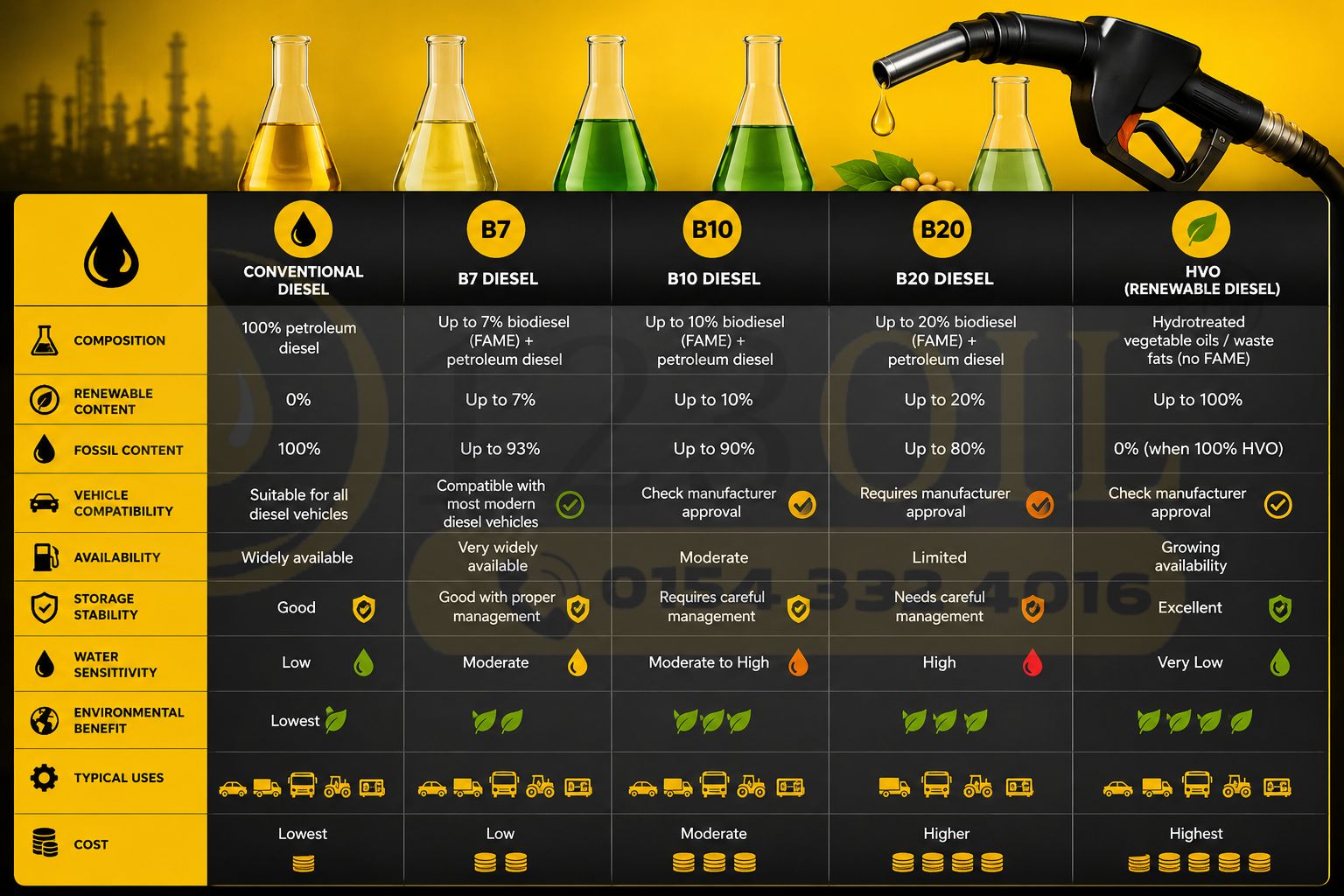
B7 Diesel vs Conventional Fossil Diesel
Older diesel fuel could contain little or no biodiesel.
Modern B7 incorporates renewable FAME while still retaining the familiar operating characteristics expected from road diesel.
Feature | B7 Diesel | Pure Fossil Diesel |
Biodiesel content | Up to 7% | None |
Main renewable component | FAME | None |
Fossil content | Majority of blend | Essentially all |
UK road availability | Very common | Less typical as standard forecourt diesel |
Most modern diesel vehicles | Compatible | Compatible |
Renewable component | Yes | No |
Water sensitivity | Slightly greater due to FAME | Generally lower |
Storage considerations | Requires careful management | Still requires proper storage |
Lifecycle renewable contribution | Moderate | None |
The key difference is therefore not that B7 is a completely different type of fuel.
It is still diesel, but with a controlled amount of biodiesel blended into it.
Main Benefits of B7 Diesel
Reduced Dependence on Fossil Fuel
The inclusion of biodiesel means a portion of every litre can come from renewable or waste-derived sources.
Across millions of litres of transport fuel, even a relatively small percentage can reduce the amount of petroleum diesel required.
Compatible With Most Diesel Vehicles
One of B7’s biggest strengths is widespread compatibility.
Most diesel vehicles designed for European road use can operate on B7 without modification.
This allows renewable fuel to be introduced into the existing fleet without requiring motorists to buy new vehicles.
Widely Available Across the UK
B7 is not a specialist product that motorists generally have to search for.
It is the standard diesel blend widely supplied through UK retail outlets.
The Government has stated that diesel sold at UK retail outlets can contain up to 7% biodiesel.
Supports Renewable Fuel Use
The FAME component can be produced from waste-derived feedstocks such as used cooking oil.
This provides a useful route for converting certain waste materials into usable transport energy.
Suitable for Commercial Fleets
Cars are only one application.
B7 can also be used across many commercial diesel operations, including vans and HGV fleets, where vehicle approval permits it.
Established Fuel Infrastructure
B7 can use the UK’s existing diesel distribution network.
It can be transported, supplied and dispensed through established infrastructure without requiring an entirely new national refuelling system.
Disadvantages of B7 Diesel
B7 is convenient, but the biodiesel component also introduces some characteristics that fleet and bulk-fuel users should understand.
Greater Affinity for Water
FAME is more hygroscopic than conventional mineral diesel, meaning it has a greater tendency to attract and retain moisture.
Water contamination inside fuel tanks can contribute to:
- Corrosion
- Microbial growth
- Sludge
- Filter blockage
- Poor fuel quality
This is particularly important when fuel is stored for long periods.
Potential Microbial Contamination
Microorganisms can grow where water and diesel meet inside a storage tank.
The biodiesel component can make storage conditions more favourable for microbial activity if tanks are poorly maintained.
Contamination may create dark sludge or biomass that can eventually block filters.
Lower Long-Term Storage Stability
FAME can oxidise and degrade more readily than some paraffinic fuels such as HVO.
This makes fuel management more important for standby generators and sites storing diesel for extended periods.
Cold-Weather Characteristics
Biodiesel can have different low-temperature characteristics depending on its feedstock.
Properly supplied UK road diesel is formulated according to seasonal specifications, but poor-quality or unsuitable fuel can still create cold-flow issues.
Material Compatibility in Very Old Equipment
Most modern diesel equipment is designed for B7.
However, very old engines, seals, hoses or fuel-system materials may require manufacturer confirmation.
B7 Diesel and Modern Engines
Modern diesel engines use extremely precise fuel-injection systems.
Common-rail systems operate at very high pressure, which means fuel cleanliness and quality are particularly important.
Properly specified B7 is designed to work with these engines.
It may be used in vehicles equipped with:
- Common-rail injection
- Diesel particulate filters
- Selective catalytic reduction
- AdBlue systems
- Exhaust gas recirculation
- Diesel oxidation catalysts
B7 itself does not replace any of these systems.
For example, a vehicle requiring AdBlue will still need AdBlue even when running on B7 diesel.
B7 and Diesel Particulate Filters
Diesel particulate filters capture soot from exhaust gases.
Eventually, the accumulated soot must be burned away during regeneration.
Using fuel that meets the proper diesel specification helps support reliable DPF operation.
Drivers should remember, however, that fuel choice is only one part of DPF health.
Frequent short journeys, failed sensors, unsuitable oil, injector faults and interrupted regeneration cycles can all cause DPF problems.
B7 should not be blamed automatically whenever a particulate filter develops a fault.
B7 Diesel vs B10 Diesel
B10 contains a higher percentage of biodiesel than B7.
Feature | B7 | B10 |
Maximum biodiesel content | 7% | 10% |
Fossil diesel proportion | Higher | Slightly lower |
UK vehicle compatibility | Very widespread | Vehicle-specific |
Renewable content | Lower | Higher |
Manufacturer approval needed | Normally standard | More important |
Forecourt availability | Common | More limited |
The biggest issue with B10 is compatibility.
A vehicle designed only for B7 should not automatically be filled with a higher biodiesel blend without manufacturer approval.
B7 vs B20 and B30
Higher biodiesel blends are also used in some parts of the transport and commercial sectors.
B20 can contain up to 20% biodiesel, while B30 can contain up to 30%.
Higher renewable content may offer greater potential fossil-fuel displacement, but compatibility becomes increasingly important.
The UK Government has previously noted that blends containing up to 30% biodiesel are available, although they are not approved for all vehicles and therefore tend to be used in dedicated fleets.
Fleet managers considering these fuels should check:
- Engine approval
- Warranty requirements
- Storage infrastructure
- Fuel-filter intervals
- Seasonal fuel behaviour
- OEM recommendations
B7 Diesel vs HVO
B7 and HVO are often grouped together because both can reduce dependence on conventional fossil diesel, but chemically they are very different.
Feature | B7 Diesel | HVO |
Renewable content | Up to 7% FAME | Can be fully renewable depending on product |
Main production process | FAME blended into fossil diesel | Hydrotreatment of renewable oils and fats |
FAME content | Up to 7% | Typically, zero |
Water affinity | Higher than HVO | Very low |
Storage stability | Good with proper management | Generally excellent |
Typical UK cost | Usually, lower | Usually, higher |
Vehicle compatibility | Extremely broad | Must be manufacturer-approved |
Carbon reduction potential | Limited by blend percentage | Potentially much greater |
HVO may therefore be attractive where businesses need larger lifecycle carbon reductions.
B7 remains attractive because it is inexpensive, familiar and widely compatible.
B7 vs Premium Diesel
Premium diesel and B7 are not opposites.
A premium diesel product can still be B7.
The B7 label describes biodiesel content, not whether the fuel is standard or premium grade.
Premium diesel may contain additional detergent, cetane-improving or performance additives while still containing up to 7% FAME.
So, a driver choosing between ordinary and premium diesel may actually be choosing between two different B7 products.
Fuel Economy with B7
Many drivers wonder whether the biodiesel portion noticeably reduces miles per gallon.
Biodiesel generally has slightly different energy characteristics from conventional fossil diesel.
However, because B7 contains only a relatively small proportion of FAME, the real-world difference is usually modest.
Fuel economy is far more heavily affected by factors such as:
- Driving style
- Vehicle weight
- Tyre pressure
- Traffic
- Engine condition
- Journey length
- Vehicle speed
- Weather
- Load
- Idling
A driver is unlikely to achieve meaningful savings simply by worrying about tiny variations within compliant B7 fuel.
Good vehicle maintenance and efficient driving usually matter far more.
Common Uses of B7 Diesel
Passenger Vehicles
Millions of diesel cars use B7 as their normal everyday fuel.
Commercial Vans
Courier vehicles, tradespeople and service companies commonly operate diesel vans using standard B7.
Heavy Goods Vehicles
Many lorries use B7 for long-distance haulage and distribution.
Buses and Coaches
Diesel passenger fleets can also operate on B7 where manufacturer-approved.
Construction Machinery
Some construction equipment can use B7, provided the engine specification permits EN 590 diesel.
Generators
B7 may be used in diesel generators, although long-term storage requires particular attention to water and fuel condition.
Agricultural Equipment
Modern diesel-powered agricultural machines may accept B7 depending on manufacturer requirements.
Storage of B7 Diesel
Bulk users need to take fuel storage more seriously than someone filling a car at a forecourt.
The FAME content means water management is especially important.
Keep Tanks Dry
Water is one of the biggest enemies of stored diesel.
Inspect for:
- Condensation
- Leaking caps
- Damaged seals
- Water ingress
- Poor tank ventilation
Check for Microbial Growth
Microbial contamination often develops at the fuel-water interface.
Signs can include:
- Dark sludge
- Frequent filter blockage
- Unusual deposits
- Poor engine performance
- Tank contamination
Rotate Fuel Stocks
Avoid leaving unnecessary quantities sitting unused for extremely long periods.
Fuel rotation reduces the risk of degradation.
Use Clean Equipment
Transfer pumps, hoses and tanks should be kept clean.
Contaminated dispensing equipment can ruin otherwise good-quality fuel.
Monitor Filters
Commercial users should inspect filtration systems regularly.
Unexpectedly rapid filter blockage can indicate contamination further upstream.
B7 Diesel for Backup Generators
Standby generators present a slightly different challenge from road vehicles.
A delivery van may consume its fuel within days.
A generator might sit with the same diesel in its tank for months.
That increases the importance of:
- Tank cleanliness
- Water removal
- Fuel sampling
- Tank inspections
- Fuel polishing where appropriate
- Stock rotation
Businesses relying on emergency generators should therefore treat fuel condition as part of preventative maintenance.
The generator itself can be mechanically perfect and still fail if its fuel has deteriorated badly.
Buying B7 Diesel in Bulk
Commercial buyers should consider more than headline price per litre.
Important factors include:
- Fuel specification
- Delivery quantity
- Supplier reliability
- Tank capacity
- Delivery access
- Fuel turnover
- Emergency supply requirements
- Quality assurance
- Site consumption
Companies comparing Biodiesel Suppliers in UK should also confirm whether they require ordinary B7 road diesel, a higher biodiesel blend or a specialised renewable alternative.
For fleets, construction businesses and other commercial users, suppliers such as 123 Oil may provide bulk diesel according to site requirements and consumption levels.
Is B7 Suitable for Older Diesel Cars?
Most diesel vehicles used in Britain are compatible with B7.
Vehicles built long before biodiesel blends became standard may deserve a little more attention.
Potential concerns can involve:
- Old rubber seals
- Fuel hoses
- Deposits inside the tank
- Fuel-system materials
- Manufacturer restrictions
If you own a classic or unusual diesel vehicle, check the handbook or obtain manufacturer-specific guidance.
For ordinary modern vehicles, B7 compatibility is generally expected.
Reading the B7 Label at Fuel Stations
Fuel pumps use standardised labels to help motorists identify fuel.
The B7 diesel label typically appears as:
B7 inside a square symbol
Petrol labels instead use an E designation, such as E5 or E10.
The UK introduced fuel labelling to make it easier for drivers to recognise petrol and diesel biofuel blends. Government guidance explains that diesel containing up to 7% biodiesel is labelled B7.
The label is particularly useful when travelling abroad, where a filling station may offer several diesel blends.
Common Misconceptions About B7 Diesel
B7 Is Not 7% Diesel
It is the other way around.
The “7” refers to the maximum biodiesel content.
B7 Is Not Pure Biodiesel
Pure biodiesel would have a dramatically higher renewable component.
B7 remains predominantly conventional diesel.
B7 Is Not the Same as HVO
FAME biodiesel and HVO are produced through different chemical processes and have different physical characteristics.
B7 Is Not Necessarily Premium Diesel
B7 describes biodiesel percentage, not fuel quality tier.
B7 Does Not Automatically Damage DPFs
Compliant B7 is designed for modern diesel vehicles.
DPF problems can result from many mechanical and driving-related causes.
Pros and Cons of B7 Diesel
Advantages
- Compatible with most modern diesel vehicles
- Widely available throughout the UK
- Includes a renewable fuel component
- Uses existing diesel infrastructure
- Suitable for private and commercial vehicles
- No vehicle conversion normally required
- Familiar operating characteristics
- Generally cost-effective
Disadvantages
- Still predominantly fossil-derived
- FAME can absorb more moisture
- Long-term storage requires care
- Greater microbial contamination risk
- Higher biodiesel blends may offer greater renewable content
- Not equivalent to fully renewable diesel
Is B7 Diesel a Good Fuel?
For most UK drivers, yes.
B7 has become standard precisely because it provides a practical compromise.
It allows a renewable component to be incorporated into road diesel while maintaining compatibility with the overwhelming majority of existing diesel vehicles.
Its main limitations become more noticeable in specialist environments, particularly where fuel is stored for long periods or where an organisation is trying to achieve substantial carbon reductions.
A private motorist filling their car regularly may never notice those issues.
A data centre storing thousands of litres for standby generators needs to think about them much more carefully.
Final Thoughts
Understanding what B7 diesel is makes the label on the fuel pump far less mysterious.
B7 is ordinary road diesel containing up to 7% biodiesel, typically FAME. The remaining proportion is primarily conventional mineral diesel.
It has become widely used because it offers a practical way of incorporating renewable fuel into existing transport without requiring major changes to vehicles or refuelling infrastructure.
Its advantages include excellent vehicle compatibility, widespread availability and a modest reduction in reliance on pure fossil diesel.
Its disadvantages mainly relate to the characteristics of FAME, particularly water affinity, microbial contamination risk and long-term storage stability.
For everyday motorists, B7 can normally be used exactly as the vehicle manufacturer intended.
For fleet operators, generator owners and bulk-fuel users, proper storage, tank maintenance and fuel-quality monitoring become more important.
B7 is therefore neither a revolutionary alternative fuel nor simply old-fashioned fossil diesel. It sits somewhere between the two: a familiar diesel fuel containing a controlled renewable component that has become a standard part of modern UK transport.
Frequently Asked Questions
B7 diesel can contain up to 7% biodiesel by volume, usually FAME. The remaining portion is primarily conventional petroleum-derived diesel. The actual biodiesel concentration does not necessarily have to be exactly 7%.
Yes, most modern diesel cars sold for use in the UK are designed to run on B7. Owners of very old, specialist or classic diesel vehicles should check manufacturer guidance before using biodiesel blends.
Yes. Standard diesel sold at UK retail filling stations can contain up to 7% biodiesel and is labelled B7.
No. B7 is predominantly conventional diesel with up to 7% biodiesel added. Higher biodiesel blends such as B20, B30 and B100 contain substantially larger renewable proportions.
Neither is automatically better. B10 contains more biodiesel and therefore potentially replaces more fossil diesel, but B7 has broader vehicle compatibility. Always check manufacturer approval before using higher blends.
It can be stored, but fuel condition must be monitored carefully. FAME has a greater affinity for water than conventional diesel, so tanks should be kept clean, dry and regularly inspected for microbial contamination.
It can be. B7 describes the maximum biodiesel percentage rather than the fuel's performance grade. Standard and premium diesel products can both meet the B7 specification.