


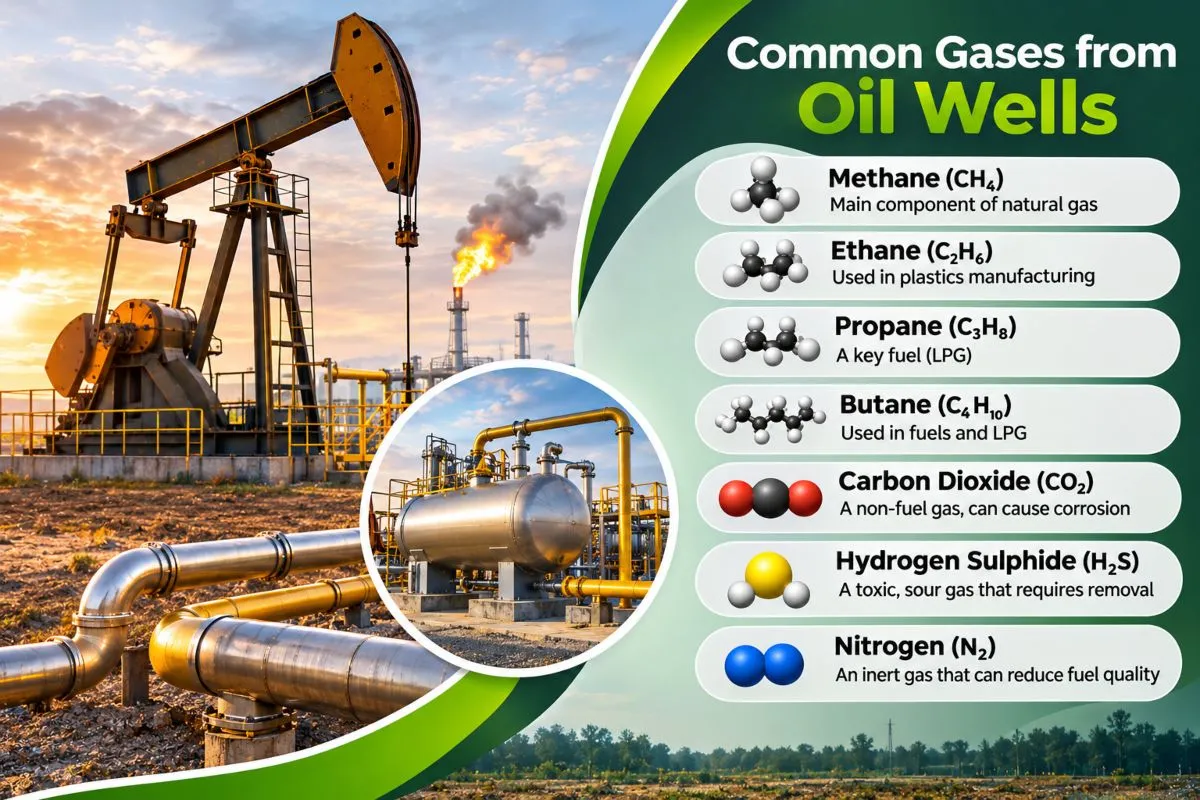
The main gas that comes out of oil wells is natural gas, primarily methane (CH₄). Known as associated gas, it is produced alongside crude oil and may also contain ethane, propane, butane, carbon dioxide, nitrogen and hydrogen sulphide. Some of these gases are valuable energy resources, while others require careful treatment because of their toxicity, corrosiveness or environmental effects.
Oil wells are commonly associated with extracting crude oil, but their production involves more than liquid petroleum. Deep underground, oil and natural gas often coexist within the same geological formations. When drilling reaches these reservoirs, changes in pressure allow both substances to travel towards the surface.
The gases released during oil production can provide additional commercial value, support energy generation and supply raw materials for manufacturing. However, their presence also creates important challenges involving processing, storage, transportation and emissions control.
Understanding which gases emerge from oil wells, how they form and what happens to them after extraction offers a clearer picture of modern petroleum production.
Why Does Gas Come Out of Oil Wells?
Gas comes out of oil wells because crude oil and natural gas can accumulate together in underground reservoirs. These resources originate largely from ancient organic material that underwent geological transformation under heat and pressure over millions of years.
As organic matter becomes buried beneath layers of sediment, increasing temperatures and pressures contribute to the formation of hydrocarbons. Depending on the geological conditions, these hydrocarbons may exist as liquids, gases or a combination of both.
Within an oil reservoir, natural gas may occur in two main forms:
- Dissolved gas: Natural gas held within crude oil under reservoir pressure.
- Free gas: Natural gas occupying a separate space in the reservoir, sometimes forming a gas cap above the oil.
When oil moves towards the surface, the surrounding pressure decreases. This reduction allows dissolved gases to separate from the liquid petroleum, rather like dissolved carbon dioxide escaping when a fizzy drink is opened.
However, reservoir behaviour is considerably more complex. The amount of gas released depends on pressure, temperature, fluid composition and the characteristics of the underground rock.
Consequently, two oil wells within the same producing region may release substantially different quantities and mixtures of gas.
What Is Associated Gas in Oil Production?
Associated gas is natural gas produced from an oil reservoir alongside crude oil. It is an important by-product of petroleum extraction and can sometimes represent a significant additional source of revenue.
Unlike non-associated natural gas, which is produced from reservoirs or wells primarily developed for gas extraction, associated gas forms part of a petroleum production system where crude oil is also recovered.
There are two important categories of associated gas.
Associated Dissolved Gas
This gas exists naturally within crude oil at high reservoir pressures. As oil enters the production equipment and pressure decreases, some of the dissolved gas escapes from the liquid.
The amount released depends on the crude oil’s properties and the conditions under which it is produced.
Gas-Cap Gas
Some petroleum reservoirs contain an accumulation of free natural gas above the oil-bearing section. This accumulation is known as a gas cap.
The gas cap can help maintain pressure within the reservoir, supporting the movement of oil towards production wells. Reservoir engineers therefore consider gas-cap behaviour carefully when planning extraction.
According to the US Geological Survey, associated natural gas is produced together with crude oil and is generally separated from the oil during surface production operations.
U.S. Geological Survey
What Types of Gas Come Out of Oil Wells?
Oil wells can produce several hydrocarbons and non-hydrocarbon gases. Although methane is usually the dominant component, the complete mixture varies between reservoirs.
Understanding the individual gases is important because each has different physical properties, commercial applications and handling requirements.
1. Methane (CH₄)
Methane is the principal component of most natural gas produced from oil wells. It is a colourless, highly flammable hydrocarbon consisting of one carbon atom bonded to four hydrogen atoms.
Its relatively simple chemical structure makes it an important fuel for domestic, commercial and industrial energy applications.
Methane recovered from oil production may be processed and transported through natural gas infrastructure, provided that it meets the required quality standards.
Its principal uses include electricity generation, industrial heating, domestic heating and chemical manufacturing.
However, methane is also a powerful greenhouse gas. When released directly into the atmosphere, it contributes significantly to global warming. This makes leak prevention and efficient gas recovery especially important throughout petroleum operations.
2. Ethane (C₂H₆)
Ethane is another hydrocarbon commonly present in associated natural gas. It contains two carbon atoms and six hydrogen atoms and is particularly valuable to the petrochemical industry.
Unlike methane, which is widely used as a fuel, ethane is often recovered for chemical manufacturing.
One of its most important applications involves producing ethylene through a process called steam cracking. Ethylene is then used to manufacture polyethylene and other chemical products.
These materials appear in packaging, containers, insulation and numerous everyday manufactured goods.
The concentration of ethane in oil-well gas varies considerably. Gas containing substantial quantities of ethane and heavier hydrocarbons can be especially attractive for natural gas liquids recovery.
3. Propane (C₃H₈)
Propane is a commercially valuable hydrocarbon that can be recovered from associated gas during processing.
It is commonly used as a liquefied petroleum gas (LPG), particularly where access to pipeline natural gas is limited.
Propane has several practical applications, including heating, cooking, agricultural equipment, industrial processes and certain transportation systems.
Under appropriate pressure and temperature conditions, propane can be stored as a liquid. This makes it convenient to transport in suitable cylinders and bulk storage tanks.
Recovering propane from associated gas provides an additional product for petroleum operators while reducing the quantity of valuable hydrocarbons left in the untreated gas stream.
4. Butane (C₄H₁₀)
Butane is another hydrocarbon found in some oil-well gas mixtures.
It commonly occurs in two structural forms: normal butane and isobutane. Although these compounds share the same molecular formula, their molecular structures give them different physical and chemical properties.
Butane is used in LPG mixtures, lighter fuels, aerosol propellants and petrochemical manufacturing. It can also contribute to petrol blending and other refinery-related applications.
Like propane, butane can be recovered during natural gas processing and stored as a liquid under suitable conditions.
Its commercial value depends on market demand, recovery costs and the composition of the produced gas.
5. Carbon Dioxide (CO₂)
Carbon dioxide is a non-hydrocarbon gas that may occur naturally within petroleum reservoirs.
Unlike methane, ethane, propane and butane, carbon dioxide does not provide useful fuel energy through combustion.
Its presence can reduce the heating value of untreated natural gas and may create additional processing requirements.
When carbon dioxide combines with water, it can contribute to corrosion in pipelines and production equipment. This makes gas composition analysis particularly important when selecting materials and designing treatment systems.
Carbon dioxide is often removed through gas-treatment processes before the remaining natural gas enters commercial distribution networks.
In some petroleum operations, captured carbon dioxide may be used for enhanced oil recovery, although its long-term environmental implications depend on how the entire operation is managed.
6. Hydrogen Sulphide (H₂S)
Hydrogen sulphide is among the most hazardous gases that may be encountered during oil production.
It is a colourless, highly toxic and flammable gas that can occur naturally in certain petroleum reservoirs.
Gas containing significant hydrogen sulphide is commonly described as sour gas, while gas with sufficiently low concentrations is generally described as sweet gas.
Hydrogen sulphide may produce a distinctive rotten-egg smell at low concentrations. However, relying on smell is extremely dangerous because exposure can rapidly impair the ability to detect its odour.
Even relatively brief exposure to elevated concentrations can cause severe injury or death.
Petroleum facilities handling hydrogen sulphide therefore require appropriate monitoring systems, engineering controls, emergency procedures and trained personnel.
The US Environmental Protection Agency identifies hydrogen sulphide as a serious hazard at certain oil and gas facilities, particularly around production and storage equipment.
US EPA
7. Nitrogen (N₂)
Nitrogen is another non-hydrocarbon gas occasionally found in oil and natural gas reservoirs.
It is generally chemically unreactive under ordinary conditions, but excessive nitrogen can lower the energy content of the produced gas.
High nitrogen concentrations may also make gas processing and commercial transportation more challenging.
Depending on the final product specifications, operators may need specialist nitrogen-rejection technology to reduce its concentration.
The amount of naturally occurring nitrogen differs substantially between geological formations.
Comparison of the Main Gases Found in Oil Wells
The following table summarises the properties, uses and main concerns associated with common oil-well gases.
Gas | Chemical formula | Main use or significance | Key concern |
Methane | CH₄ | Heating, electricity, chemical feedstock | Flammability and greenhouse emissions |
Ethane | C₂H₆ | Ethylene and plastics production | Flammability |
Propane | C₃H₈ | LPG, heating and industrial fuel | Fire and explosion hazards |
Butane | C₄H₁₀ | LPG, fuel and petrochemicals | Flammability |
Carbon dioxide | CO₂ | Selected industrial and recovery applications | Corrosion, asphyxiation and emissions |
Hydrogen sulphide | H₂S | Normally removed or treated | Extreme toxicity and corrosion |
Nitrogen | N₂ | Usually separated when excessive | Reduced fuel quality and oxygen displacement |
Although these gases may be present in the same reservoir, their concentrations vary substantially. Some wells produce gas rich in valuable liquid hydrocarbons, while others contain larger proportions of substances that must be removed.
How Is Gas Separated from Crude Oil?
Gas separation is one of the earliest and most important stages of oil production.
When fluids travel from the reservoir to the surface, they often contain a mixture of crude oil, natural gas and produced water.
These substances must be separated before further treatment, transportation or sale.
The process generally involves several stages.
Step 1: Bringing Reservoir Fluids to the Surface
Oil and gas travel through the wellbore under natural reservoir pressure or with the assistance of artificial lifting equipment.
As pressure decreases, some gas previously dissolved in crude oil begins to separate.
Step 2: Entering a Production Separator
The produced mixture enters specialised equipment called a separator.
A two-phase separator separates gas from liquid, while a three-phase separator separates gas, oil and water.
The equipment uses differences in physical properties, including density, to separate the incoming production stream.
Step 3: Treating the Recovered Gas
The separated gas may still contain water vapour, hydrogen sulphide, carbon dioxide and heavier hydrocarbons.
Depending on its composition, it may require dehydration, acid-gas removal and additional processing.
These treatments help protect infrastructure and ensure that the gas meets the required specifications.
Step 4: Recovering Valuable Hydrocarbons
Gas-processing facilities may extract propane, butane, ethane and other natural gas liquids.
These products can then be transported separately for commercial use.
Step 5: Transporting or Reusing the Gas
Once treated, the remaining gas may enter a pipeline network, supply suitable industrial equipment or be used for approved production operations.
The appropriate option depends on infrastructure, economics, environmental requirements and the quality of the gas.
What Is the Difference Between Wet Gas and Dry Gas?
The terms wet gas and dry gas describe differences in natural gas composition and processing.
Wet gas contains significant quantities of heavier hydrocarbons that may be recovered as natural gas liquids. These can include ethane, propane, butane and other components.
Dry gas consists predominantly of methane, with comparatively little recoverable heavier hydrocarbon content.
Associated gas from oil wells can be rich in natural gas liquids, making it commercially valuable beyond its methane content.
However, wet gas does not simply mean gas containing water. The term primarily concerns recoverable hydrocarbon liquids, although untreated gas may also contain water vapour that requires removal.
The US Energy Information Administration explains that raw natural gas from crude oil wells may contain several natural gas liquids and non-hydrocarbon components before processing.
U.S. Energy Information Administration (EIA)
What Happens to the Gas After Oil Extraction?
Once separated from crude oil, associated gas can follow several routes depending on the production facility and available infrastructure.
Gas Gathering and Commercial Sale
Where suitable infrastructure exists, recovered gas can enter gathering pipelines that transport it towards processing facilities.
After treatment, marketable gas may be supplied to energy companies, industrial consumers or distribution networks.
This approach transforms associated gas into an additional commercial product rather than treating it solely as a by-product.
Electricity Generation at Oilfields
Some oil production facilities use recovered natural gas as fuel for onsite electricity generation.
This can support pumps, compressors and other production equipment.
Using recovered gas locally may reduce reliance on externally supplied fuels, although combustion still produces greenhouse gas emissions.
Gas Reinjection into Reservoirs
In certain operations, gas may be compressed and injected back into an underground reservoir.
Reinjection can help maintain reservoir pressure, support oil recovery or manage gas until suitable infrastructure becomes available.
The suitability of this method depends on reservoir characteristics, equipment capacity and operational objectives.
Recovery of Natural Gas Liquids
Where associated gas contains sufficient quantities of heavier hydrocarbons, operators may recover natural gas liquids for sale.
Ethane, propane and butane are valuable feedstocks and fuels.
Their recovery can improve the overall economic performance of a producing field.
Why Is Gas Flared at Oil Wells?
Gas flaring involves burning natural gas through a controlled flare system.
The flames sometimes visible above oil production facilities are associated with this process.
Flaring may occur when recovered gas cannot be transported, processed, reinjected or otherwise handled through the available infrastructure.
It may also be used during certain maintenance activities, operational upsets or emergencies.
Historically, some production facilities have relied on flaring because transporting associated gas from remote locations was commercially difficult.
However, routine flaring wastes potentially valuable hydrocarbons and produces emissions.
When methane burns efficiently, it is converted primarily into carbon dioxide and water vapour. Incomplete combustion can also release unburnt methane and other pollutants.
Although controlled flaring can reduce methane emissions compared with directly releasing the same gas, it is not an environmentally neutral process.
The preferable long-term approach, where technically and economically feasible, is to prevent unnecessary gas production losses through recovery, processing, utilisation or reinjection.
Gas Venting vs Gas Flaring: What Is the Difference?
Venting and flaring are sometimes confused, but they are different activities with distinct environmental consequences.
Feature | Gas venting | Gas flaring |
Process | Gas is released without combustion | Gas is burned through a flare system |
Methane | Can be released directly into the atmosphere | Most methane is converted during effective combustion |
Main climate concern | Direct methane emissions | Carbon dioxide and incomplete combustion emissions |
Energy recovery | None | Normally none |
Environmental preference | Avoid unnecessary releases | Reduce unnecessary flaring and prioritise recovery |
Direct methane venting is particularly concerning because methane has a much stronger warming effect per tonne than carbon dioxide over shorter assessment periods.
Both activities therefore require responsible management.
Reducing methane leaks, preventing unnecessary venting and limiting routine flaring are important priorities for improving the environmental performance of petroleum production.
U.S. Energy Information Administration (EIA)+1
Is the Gas Released from Oil Wells Dangerous?
Gas produced from oil wells can create several hazards, depending on its composition, concentration and the surrounding conditions.
The risks extend beyond the gases themselves to include the pressure and equipment involved in production.
Fire and Explosion Hazards
Methane, propane, butane and several other hydrocarbons are flammable.
If these gases accumulate in air within their flammable ranges and encounter an ignition source, fires or explosions may occur.
Potential ignition sources include electrical faults, static electricity, hot equipment and open flames.
Toxic Gas Exposure
Hydrogen sulphide presents an especially serious hazard because it can cause rapid poisoning at dangerous concentrations.
Workers must use suitable gas-detection systems and follow established site safety procedures.
Oxygen Displacement
Some gases, including methane, nitrogen and carbon dioxide, can displace oxygen in enclosed or poorly ventilated spaces.
An oxygen-deficient atmosphere may cause unconsciousness or suffocation.
High-Pressure Equipment Risks
Oil and gas production systems operate under pressures that can create additional mechanical hazards.
Equipment failures, uncontrolled releases and unsuitable maintenance procedures can result in severe incidents.
For these reasons, petroleum facilities rely on engineering controls, atmospheric monitoring, appropriate protective equipment and trained personnel.
How Does Gas from Oil Wells Affect the Environment?
The environmental impact of oil-well gas depends largely on how it is extracted, processed, transported and used.
Methane emissions are a major concern because they contribute to climate change. Leaks can occur at valves, seals, compressors, storage facilities and other parts of petroleum infrastructure.
Flaring also contributes to atmospheric emissions, including carbon dioxide and, depending on combustion performance and gas composition, other pollutants.
In addition, certain untreated gas streams contain volatile organic compounds or sulphur-bearing substances that require careful management.
Environmental impacts can be reduced through effective operational practices.
These include leak detection and repair programmes, modern gas-recovery equipment, improved maintenance and the use of suitable processing infrastructure.
Digital monitoring technologies can help operators identify abnormal gas losses, while improved equipment design can reduce unintended emissions.
Nevertheless, recovering natural gas does not eliminate the environmental effects of burning it. Its climate impact must be considered across the wider production, transportation and consumption chain.
How Much Gas Does an Oil Well Produce?
The quantity of gas produced by an oil well varies widely.
Some wells release relatively small amounts of associated gas, while others produce substantial volumes alongside their crude oil output.
One common measurement is the gas-to-oil ratio (GOR), which compares the volume of produced gas with the volume of crude oil.
For example, a well producing 500 cubic feet of gas for every barrel of oil has a gas-to-oil ratio of 500 cubic feet per barrel.
This relationship helps reservoir engineers assess production behaviour and identify changes in reservoir conditions.
Several factors influence gas production:
- Reservoir pressure: Changes in pressure affect the release and movement of dissolved gas.
- Geological structure: Reservoir rock characteristics determine how fluids move underground.
- Crude oil composition: Different oils contain different quantities of dissolved gas.
- Stage of production: Gas-to-oil ratios may change as reservoir conditions evolve.
- Production strategy: Well placement, pressure management and recovery methods influence output.
A rising gas-to-oil ratio does not automatically indicate a problem. Its significance depends on the reservoir and production history.
Consequently, operators rely on production measurements, fluid analysis and reservoir modelling rather than a single gas-volume figure.
Can Gas from Oil Wells Be Used as Fuel?
Yes, gas recovered from oil wells can be used as fuel once it has been appropriately processed and meets the necessary specifications.
Methane-rich natural gas is widely used for heating, electricity generation and industrial applications.
Propane and butane recovered during processing can also be marketed as LPG or used in other industries.
However, untreated associated gas is not automatically suitable for direct use.
It may contain water, corrosive compounds, toxic contaminants or hydrocarbon liquids that interfere with equipment and create safety risks.
Processing helps ensure that the gas has the required composition, energy content and physical properties for its intended application.
The exact treatment requirements depend on the receiving infrastructure and applicable regulations.
Why Is Associated Gas Important to the Oil and Gas Industry?
Associated gas has become an important part of petroleum production because it provides economic opportunities while presenting operational and environmental responsibilities.
Rather than concentrating exclusively on crude oil output, producers can consider the combined value of oil, natural gas and recoverable natural gas liquids.
Efficient gas management can help operators increase resource utilisation, support local energy requirements and reduce avoidable waste.
It can also influence infrastructure investment decisions. A field containing substantial associated gas may require additional pipelines, compressors, processing equipment or reinjection facilities.
These requirements can affect project costs and the long-term commercial viability of production.
Companies involved in the wider petroleum supply chain, including 123 Oil, operate within an industry where understanding hydrocarbons, processing requirements and environmental responsibilities is increasingly important.
As expectations around emissions management develop, the ability to measure, recover and responsibly handle associated gas remains a central consideration for petroleum producers.
The Future of Gas Recovery from Oil Wells
The future of associated gas management is likely to place greater emphasis on improved measurement, lower emissions and more efficient resource recovery.
One important area is the development of smaller-scale processing technologies that may help operators recover gas from remote or lower-output fields.
Another is the use of advanced monitoring systems to identify methane emissions more accurately.
Satellite observations, aerial surveys, continuous sensors and other detection methods can provide additional information about emissions from production infrastructure.
Gas gathering networks and reinjection systems may also help reduce waste where their installation is practical.
However, technology alone cannot resolve every challenge. Economic conditions, local infrastructure, reservoir characteristics and regulatory requirements all influence what operators can achieve.
Ultimately, better gas management involves making informed decisions throughout the life of a petroleum field, from early development planning to the final stages of production.
Conclusion
Oil wells are more than sources of crude oil. They can also produce a commercially valuable mixture of gases that plays an important role in energy supply, petrochemical manufacturing and petroleum-field operations.
Methane is usually the main component, while ethane, propane and butane provide additional opportunities for fuel production and chemical processing. Other substances, including carbon dioxide, nitrogen and hydrogen sulphide, introduce processing requirements and potential safety concerns.
The composition and quantity of associated gas differ between reservoirs, making effective separation, testing and treatment essential.
As the petroleum industry faces growing pressure to improve resource efficiency and reduce emissions, responsible gas recovery will remain an important part of oilfield management. Understanding what comes out of an oil well is therefore not simply a matter of identifying methane. It is about recognising the economic value, operational complexity and environmental responsibilities connected to every gas stream.
Frequently Asked Questions
Yes, oil wells can produce the same principal fuel component used in domestic natural gas supplies: methane. However, untreated gas from an oil well may contain propane, ethane, water vapour, carbon dioxide and other impurities. It normally requires suitable processing and quality checks before entering a commercial gas distribution network.
Natural gas may flow from a reservoir because of its position, mobility and the pressure conditions surrounding the well. In reservoirs containing a gas cap, free gas can occupy the upper portion of the accumulation. However, gas does not always emerge before oil. Actual production depends on well placement, reservoir structure and operating conditions.
Hydrogen sulphide (H₂S) is a particularly dangerous gas found in some petroleum reservoirs. It is highly toxic, flammable and potentially fatal at elevated concentrations. Although it may smell of rotten eggs at low concentrations, its smell cannot be relied upon for safety. Specialist detection equipment and strict operational controls are essential wherever hydrogen sulphide may be present.
Yes. The relative quantities of oil and gas can change throughout a well's productive life. Some wells gradually develop higher gas-to-oil ratios as reservoir conditions change. Others naturally produce large quantities of gas compared with their liquid output. Production classification and commercial viability depend on the well's measured performance and applicable definitions.
Methane is separated from crude oil to make both products easier and safer to process, store and transport. Removing gas helps control the properties of produced oil while allowing the gas to undergo treatment for commercial use. Efficient separation also helps operators manage pressure, recover valuable resources and reduce uncontrolled gas releases.
No. Hydrogen sulphide is present in some oil and gas reservoirs but is absent or found at very low concentrations in others. Its occurrence depends on geological conditions and chemical or biological processes within the reservoir. Production facilities must assess the actual gas composition and apply suitable precautions because hydrogen sulphide exposure can be extremely dangerous.
Yes, FPSO technology has been used in UK offshore developments, including fields west of Shetland. Floating facilities can be suitable where their storage, processing and marine capabilities meet field requirements. Their use depends on factors such as water depth, existing infrastructure and commercial viability.