

Midstream in oil and gas refers to the collection, processing, transportation and storage of crude oil, natural gas and related products. It connects upstream production sites with downstream refineries, distributors and consumers through pipelines, terminals, processing plants, tankers and storage facilities.
The oil and gas industry is often divided into three connected sectors: upstream, midstream and downstream. Upstream companies locate and extract hydrocarbons, while downstream businesses refine, distribute and sell finished products. Midstream sits between these two stages and keeps energy moving from the production site to the facilities where it can be processed, refined, exported or supplied to customers.
So, what is midstream in oil and gas? In simple terms, it is the part of the energy supply chain responsible for gathering, processing, transporting and storing crude oil, natural gas and natural gas liquids. It includes an enormous network of pipelines, compressor stations, pumping facilities, storage tanks, terminals, processing plants, ships, rail systems and road tankers.
Without midstream infrastructure, newly produced oil and gas could remain stranded at a wellhead or offshore platform. Producers would have no practical way to move their output, and refineries or power stations would struggle to obtain reliable supplies.
Midstream may not receive the same public attention as drilling rigs, petrol stations or refineries, but it acts as the industry’s circulatory system. It quietly moves enormous volumes of energy across regions, countries and continents.
Understanding the Three Oil and Gas Sectors
Before examining midstream operations in detail, it helps to understand where they fit within the wider industry.
Upstream
Upstream oil and gas cover exploration and production. Companies search for hydrocarbon reserves, drill wells and extract crude oil or natural gas from underground formations.
Typical upstream activities include:
- Geological and seismic surveys
- Exploratory drilling
- Well development
- Offshore platform operations
- Oil and gas extraction
- Production testing
- Well maintenance
Once hydrocarbons have been produced, they must be collected and moved away from the field. This is where midstream operations begin.
Midstream
Midstream connects producing fields with processing plants, refineries, storage facilities, export terminals and distribution networks.
Its main responsibilities include:
- Gathering oil and gas from wells
- Treating and processing natural gas
- Separating natural gas liquids
- Transporting crude oil and gas
- Operating pipelines and terminals
- Storing hydrocarbons
- Loading products onto ships, trains or tankers
- Managing product quality and flow
Transmission pipelines commonly move crude oil and natural gas from gathering systems to processing, refining or storage facilities. They can also carry refined petroleum products towards customers and distribution networks.
Downstream
Downstream covers the conversion and sale of hydrocarbons. Crude oil is delivered to refineries, where it is separated and transformed into useful petroleum products such as petrol, diesel, jet fuel and heating oil.
Downstream activities generally include:
- Oil refining
- Petrochemical manufacturing
- Fuel distribution
- Petrol station operations
- Lubricant production
- Wholesale fuel supply
- Retail energy sales
The three sectors form a continuous chain. Upstream produces the resource, midstream moves and prepares it, and downstream converts and sells it.
What Does Midstream Include?
Midstream operations can vary between companies and regions. Some organisations focus only on pipelines, while others manage complete networks that include gathering, processing, storage and export facilities.
The following activities are usually considered part of the midstream sector.
1. Gathering Oil and Natural Gas
Gathering is the first stage of the midstream process. After hydrocarbons leave a well, small pipelines collect production from one or more well sites.
These gathering lines carry crude oil, natural gas or a mixture of gas, water and liquid hydrocarbons towards a central collection point. The material may then enter a processing facility, separation unit, storage tank or larger transmission pipeline.
Gathering systems are particularly important in production areas containing many wells. Instead of transporting output from every well separately, producers connect them to a shared network.
Oil gathering systems may carry crude oil to:
- Field storage tanks
- Central processing facilities
- Pipeline injection points
- Rail loading terminals
- Road tanker loading areas
Natural gas gathering systems usually deliver raw gas to treatment or processing plants. Raw natural gas may contain water vapour, carbon dioxide, hydrogen sulphide, sand, condensate and heavier hydrocarbons that must be removed before the gas can enter a major transmission network.
2. Natural Gas Processing
Natural gas taken directly from a field is not always ready for commercial use. It may contain unwanted substances or valuable hydrocarbon liquids that need to be separated.
At a processing plant, operators can remove:
- Water
- Carbon dioxide
- Hydrogen sulphide
- Nitrogen
- Sand and solid particles
- Condensate
- Natural gas liquids
Processing creates pipeline-quality natural gas that meets technical and safety specifications. It may also recover natural gas liquids such as propane, butane and ethane.
These liquids have their own commercial uses. Propane and butane may be used as fuels, while ethane can serve as a feedstock for petrochemical manufacturing.
Processing is not the same as crude oil refining. Natural gas processing mainly removes impurities and separates gas components, whereas refining transforms crude oil into finished petroleum products.
3. Pipeline Transportation
Pipelines are among the most recognisable parts of midstream infrastructure. They move oil, natural gas and petroleum products over short or long distances.
Energy pipelines may transport:
- Crude oil
- Natural gas
- Refined fuels
- Condensate
- Propane
- Butane
- Ethane
- Petrochemical feedstocks
- Carbon dioxide
Official pipeline guidance notes that natural gas pipelines transport gas, while liquid petroleum pipelines may carry crude oil, refined fuels and certain liquefied gases.
There are several broad types of pipelines.
Gathering Pipelines
Gathering pipelines collect hydrocarbons from individual wells and move them to central facilities.
Transmission Pipelines
Transmission pipelines carry large volumes over long distances. They connect production regions with refineries, processing plants, storage sites, export terminals and major demand centres.
Distribution Pipelines
Distribution pipelines usually belong to the downstream or utility side of the industry. They deliver natural gas from major transmission networks to homes, businesses and industrial users.
Oil pipelines use pumping stations to maintain movement and pressure. Natural gas pipelines rely on compressor stations, which restore pressure lost as the gas travels through the system.
4. Storage
Oil and gas production does not always match immediate customer demand. Storage gives companies a buffer between supply and consumption.
Midstream storage facilities may hold:
- Crude oil
- Refined petroleum products
- Natural gas
- Natural gas liquids
- Liquefied natural gas
- Condensate
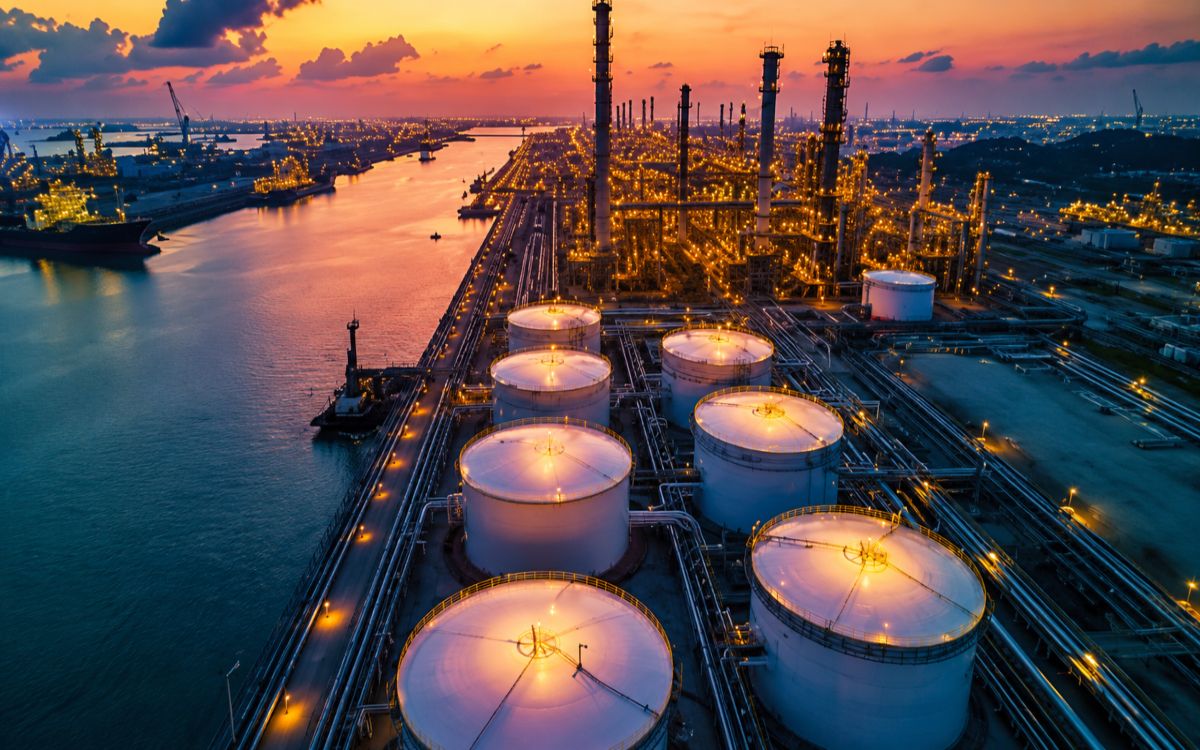
Crude oil and liquid products are commonly stored in large above-ground tanks. Natural gas may be stored underground in depleted reservoirs, salt caverns or aquifers. Liquefied natural gas is held in specially designed insulated tanks.
Storage supports the market in several ways. It allows companies to manage seasonal demand, respond to supply interruptions, maintain pipeline operations and hold products until transportation or processing capacity becomes available.
It can also help balance sudden changes in production. When a field produces more oil than a refinery or pipeline can accept, storage prevents operations from stopping immediately.
5. Terminals and Export Facilities
Terminals are strategic points where hydrocarbons are received, stored, measured, blended and transferred between different forms of transport.
A terminal may connect pipelines with:
- Oil tankers
- LNG carriers
- Barges
- Rail wagons
- Road tankers
- Refineries
- Storage depots
Crude oil terminals often include large tank farms, metering systems, pumps, loading arms and marine berths. Product terminals may store several fuel grades separately before loading them onto road tankers for regional delivery.
Export terminals are especially important in countries that produce more oil or gas than they consume. These facilities allow hydrocarbons to enter international markets.
6. Road, Rail and Marine Transportation
Pipelines are efficient for continuous, high-volume movement, but they cannot serve every location. Midstream companies may therefore use road, rail and marine transport.
Road Tankers
Road tankers offer flexibility and can collect liquids from remote fields or deliver products to facilities without pipeline access. However, they generally move smaller quantities than pipelines or ships.
Rail Transport
Rail can carry crude oil and petroleum products across long distances. It may be used when pipeline capacity is unavailable, when a production region is developing rapidly or when companies need access to different markets.
Marine Transport
Ships and barges carry enormous volumes of crude oil, LNG and petroleum products between ports. Marine transport is central to international energy trade because many producing and consuming countries are separated by oceans.
LNG transportation requires natural gas to be cooled into liquid form. Liquefaction reduces its volume dramatically, making large-scale shipping and storage practical where pipelines cannot connect suppliers with customers.
How Does the Midstream Process Work?
A typical midstream oil journey may follow these steps:
- Crude oil is produced at an onshore well or offshore platform.
- Gathering lines carry it to a central collection facility.
- Water, gas and sediment are separated from the crude.
- The oil is measured and tested for quality.
- Pumps move it into a transmission pipeline.
- It may be stored at a terminal or tank farm.
- The crude is delivered to a refinery or export terminal.
- Refined products may later enter another pipeline or storage network.
A natural gas journey can be more complex:
- Raw gas leaves the wellhead.
- Gathering pipelines carry it to a processing facility.
- Water, acid gases and contaminants are removed.
- Natural gas liquids are separated.
- The dry gas enters a high-pressure transmission pipeline.
- Compressor stations maintain pressure along the route.
- Gas may be placed in underground storage.
- It is delivered to power stations, industrial sites, export facilities or local distribution companies.
The exact route depends on geography, infrastructure, product quality and the final market.
The Difference Between Oil and Gas Midstream Operations
Oil and natural gas travel through many of the same stages, but their physical characteristics create different technical requirements.
Crude oil is a liquid and can usually be stored in conventional tanks. Pumps move it through pipelines, and operators monitor factors such as viscosity, pressure, temperature and sulphur content.
Natural gas is compressible and must remain under pressure during pipeline transportation. It also requires strict control of moisture, contaminants and heating value. Compressor stations are therefore essential parts of gas transmission systems.
Gas may also be liquefied for marine transport. This requires specialised liquefaction plants, cryogenic storage tanks and LNG carriers.
Oil infrastructure often focuses on pumping, tank storage and blending. Gas infrastructure places greater emphasis on compression, processing, pressure control and leak detection.
Essential Midstream Infrastructure
A complete midstream network may contain thousands of connected assets.
Common infrastructure includes:
- Gathering lines
- Transmission pipelines
- Pumping stations
- Compressor stations
- Metering stations
- Valve stations
- Separation equipment
- Gas treatment plants
- Fractionation facilities
- Storage tanks
- Underground gas storage sites
- LNG terminals
- Marine loading jetties
- Rail loading facilities
- Control rooms
- Leak detection systems
These assets must operate together reliably. A failure at one critical location can restrict production, interrupt refinery supplies or reduce gas availability for power generation.
Why Is Midstream Important?
Midstream enables the oil and gas market to function as an integrated system rather than a collection of isolated production sites.
It Connects Supply with Demand
Oil and gas fields are often far from cities, industrial areas and refineries. Midstream networks bridge that geographical gap.
It Prevents Production Bottlenecks
A producer can only sell hydrocarbons when there is sufficient gathering, processing and transportation capacity. Limited pipeline access can force companies to reduce production or rely on more expensive transport methods.
It Supports Energy Security
Storage facilities, terminals and alternative transport routes give countries and companies greater flexibility during disruptions. A diversified network can reduce dependence on a single pipeline, port or production region.
It Maintains Product Quality
Midstream operators measure, separate, treat and monitor hydrocarbons before delivery. This helps ensure that products meet pipeline, refinery or customer specifications.
It Enables International Trade
Export pipelines, oil terminals and LNG facilities connect producing countries with global markets. Without these assets, large-scale cross-border energy trade would be severely restricted.
How Do Midstream Companies Make Money?
Many midstream businesses earn revenue by charging customers for the use of infrastructure.
They may receive fees for:
- Gathering oil or gas
- Processing natural gas
- Transporting products
- Reserving pipeline capacity
- Storing hydrocarbons
- Loading or unloading ships
- Operating terminals
- Separating natural gas liquids
Some agreements are based on the volume transported or processed. Others reserve a fixed amount of capacity, meaning the customer pays for access whether or not the full capacity is used.
This fee-based approach can make some midstream earnings less directly exposed to commodity prices than upstream production. However, midstream companies are not completely protected from market movements. A prolonged fall in drilling, production or fuel demand can reduce the volume flowing through their assets.
Key Risks in the Midstream Sector
Midstream operations involve valuable products, high pressures, heavy machinery and large infrastructure networks. Companies must manage several categories of risk.
Pipeline Leaks and Ruptures
Corrosion, equipment failure, ground movement, construction damage or operational errors can cause a release. Regular inspections and integrity management are therefore essential.
Capacity Constraints
A production region may grow faster than its pipeline network. When takeaway capacity becomes limited, producers can face delays, higher costs or lower local prices.
Regulatory Requirements
Pipelines and terminals may require environmental reviews, land rights, planning approvals and safety authorisations. In the UK, the North Sea Transition Authority regulates the construction and use of oil and gas pipelines on the UK Continental Shelf under the relevant legal framework.
Demand Changes
Reduced refinery activity, industrial demand or gas consumption can affect transport and storage volumes.
Weather and Natural Hazards
Floods, storms, extreme temperatures, landslides and earthquakes can damage infrastructure or interrupt operations.
Cybersecurity
Modern pipelines rely on digital control systems, sensors and communication networks. A cyberattack could disrupt monitoring, scheduling or physical operations.
Community and Environmental Concerns
New infrastructure may affect landowners, wildlife, water resources and local communities. Developers must assess these impacts and communicate transparently throughout planning and construction.
Safety and Environmental Management
Safety is one of the most important responsibilities in midstream oil and gas.
Operators use a combination of physical inspections, pressure monitoring, corrosion control, emergency shut-off valves and computer-based detection systems.
Important practices include:
- Internal pipeline inspections
- Pressure testing
- Cathodic protection
- Aerial or ground patrols
- Leak detection
- Valve maintenance
- Emergency response planning
- Staff training
- Control-room monitoring
- Community awareness programmes
Environmental management also covers emissions from compressors, methane leakage, spills, wastewater, land disturbance and energy use.
Companies are increasingly using drones, satellite monitoring and advanced sensors to identify changes before they develop into serious incidents.
Technology in Modern Midstream Operations
Digital technology is changing how pipelines, terminals and processing facilities are operated.
Supervisory control and data acquisition systems allow control-room teams to monitor pressure, temperature, flow rates and valve positions across large networks.
Smart pipeline inspection tools can travel inside a pipeline and detect:
- Corrosion
- Cracks
- Dents
- Metal loss
- Weld defects
- Changes in pipeline shape
Predictive maintenance software uses operational data to estimate when equipment may fail. This allows repairs to be planned before a compressor, pump or valve causes an unplanned shutdown.
Other developing technologies include:
- Artificial intelligence
- Digital twins
- Automated inspections
- Methane-monitoring satellites
- Remote-operated drones
- Advanced flow modelling
- Real-time emissions monitoring
These technologies do not remove operational risk, but they can help companies spot problems earlier and use maintenance resources more effectively.
Midstream and the Energy Transition
Midstream companies are increasingly considering how existing infrastructure may support a lower-carbon energy system.
Certain pipelines, storage sites and terminals may potentially be adapted for:
- Hydrogen transportation
- Carbon dioxide transportation
- Renewable natural gas
- Biofuels
- Low-carbon liquid fuels
- Carbon capture and storage projects
Not every asset can be converted safely or economically. Hydrogen and carbon dioxide have different physical and chemical properties from conventional hydrocarbons, so pipelines may require new materials, compressors, seals and operating procedures.
Nevertheless, midstream expertise remains highly relevant. Transporting and storing future energy products will still require engineering, maintenance, measurement, safety systems and large infrastructure networks.
Midstream Operations in the UK
The UK’s midstream system includes offshore pipelines, onshore terminals, gas processing facilities, storage assets, ports and connections to refineries and distribution networks.
Offshore fields in the UK Continental Shelf rely on pipeline systems to move oil and gas towards coastal terminals and processing facilities. Some production is also loaded offshore and transported by tanker.
Pipeline access is particularly important in mature producing regions. Several fields may depend on shared infrastructure, meaning collaboration between operators can extend the commercial life of smaller developments.
The UK’s experience in offshore pipelines, terminals and subsea engineering may also support future hydrogen and carbon storage projects. The North Sea Transition Authority now regulates and influences oil and gas, offshore hydrogen and carbon storage activities as part of the changing North Sea energy landscape.
Midstream, Upstream and Downstream: The Main Differences
The easiest way to remember the three sectors is to follow the movement of the resource.
- Upstream finds and produces it.
- Midstream gathers, prepares, stores and transports it.
- Downstream refines, distributes and sells it.
There can be some overlap. A large integrated energy company may operate oil fields, pipelines, refineries and retail fuel stations. Certain processing activities may also be classified differently depending on the company or region.
However, the basic distinction remains useful because it shows where each operation fits within the broader energy value chain.
Conclusion
Midstream is the bridge between hydrocarbon production and the markets that use it. It includes gathering systems, gas processing plants, pipelines, compressor stations, storage facilities, tank farms, ports and transport networks.
The sector ensures that crude oil and natural gas can move safely and reliably from remote production sites to refineries, power stations, export terminals and distribution systems. It also balances changes in supply and demand by providing storage and alternative transport routes.
For businesses such as 123 Oil, understanding the midstream sector provides useful context for seeing how fuel moves through the energy supply chain before reaching commercial and domestic customers.
As energy systems change, midstream infrastructure will continue to evolve. Traditional oil and gas networks will remain important, while some assets and specialist skills may also support hydrogen, carbon dioxide and lower-carbon fuels.
Frequently Asked Questions
Midstream is the part of the oil and gas industry that collects, processes, transports and stores hydrocarbons after they are produced but before they are refined or sold to consumers.
Most gathering and transmission pipelines are considered midstream assets. They move crude oil, natural gas and related products between production fields, processing facilities, storage sites, refineries and terminals.
Yes. Natural gas processing is generally a midstream activity because it removes water, contaminants and natural gas liquids before the gas enters a transmission pipeline or is delivered to customers.
A midstream company may own and operate pipelines, compressor stations, gas processing plants, oil terminals or storage facilities. Some companies specialise in one service, while others manage complete transportation networks.
Midstream gathers, processes, stores and transports hydrocarbons. Downstream converts crude oil and gas products into finished fuels, chemicals and other products before distributing or selling them.
They commonly charge fees for gathering, processing, transporting, storing or loading hydrocarbons. Charges may be based on actual volumes, reserved capacity or long-term service agreements.
Storage helps balance differences between production and demand. It allows oil or gas to be held during transport delays, seasonal demand changes, refinery maintenance or supply disruptions.