


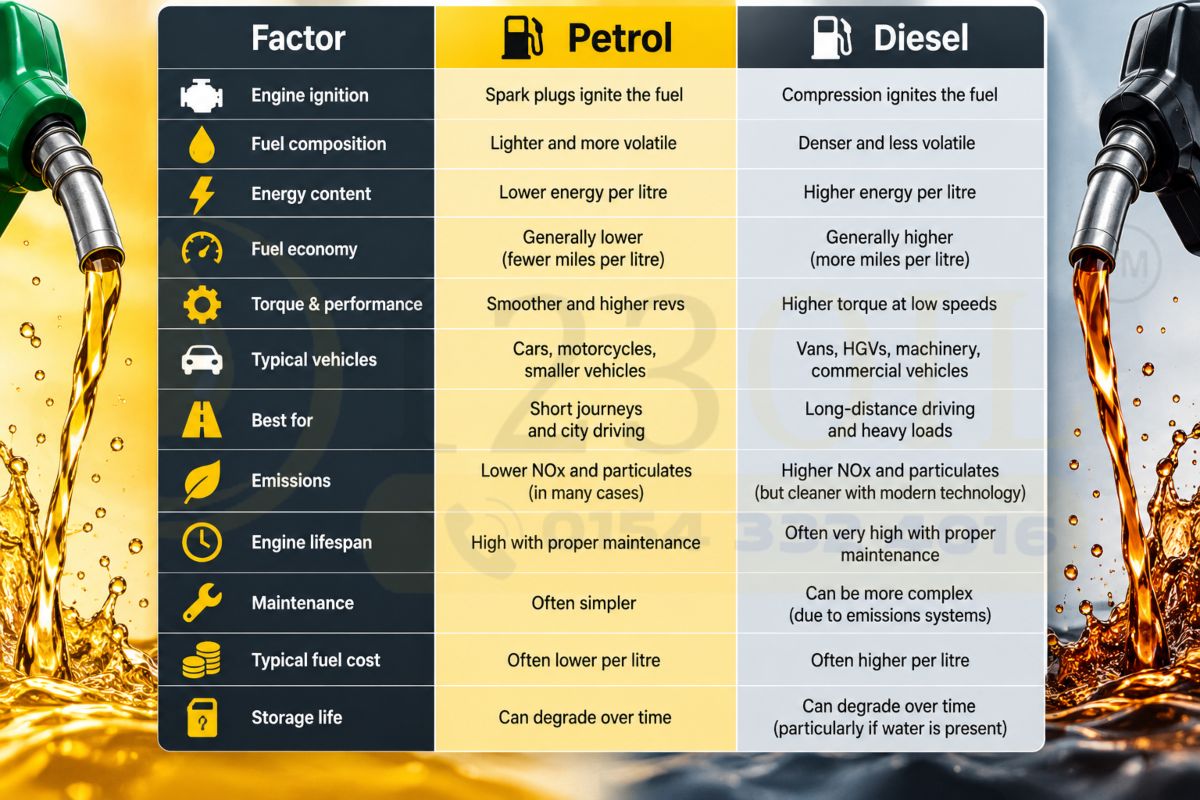
Petrol and diesel are different fuels with different engine designs. Petrol engines use spark plugs to ignite the fuel, while diesel engines use compressed air to ignite the fuel. Diesel generally offers better fuel economy, higher low-speed torque and stronger performance for heavy loads, whereas petrol engines are usually smoother and better suited to short journeys and everyday driving.
Petrol and diesel are two of the most widely used road fuels in the UK, but they are not interchangeable. Although both are made from crude oil and are used to power internal combustion engines, they work in very different ways.
The biggest difference is how the fuel is ignited inside the engine. Petrol engines use spark plugs to ignite a mixture of air and petrol, while diesel engines rely on the heat created by compressing air to ignite the fuel. This fundamental difference affects engine design, fuel economy, performance, maintenance, emissions and the types of vehicles each fuel is best suited to.
Diesel has traditionally been associated with HGVs, vans, agricultural machinery and high-mileage driving, while petrol is common in cars, smaller vehicles and urban driving. Modern engines, however, have become much more advanced, so the decision between petrol and diesel is no longer quite as simple as it once was.
This guide explores the main differences between petrol and diesel, including how the engines work, fuel economy, performance, costs, maintenance, emissions, storage, commercial applications and which option may be more suitable for different driving conditions.
Petrol and Diesel at a Glance
Before getting into the technical details, here is a simple overview.
Feature | Petrol | Diesel |
Engine ignition | Spark ignition | Compression ignition |
Main fuel | Petrol | Diesel |
Spark plugs | Yes | No traditional spark ignition |
Fuel economy | Generally lower | Generally higher |
Low-speed torque | Lower | Higher |
Typical users | Cars, motorcycles, smaller vehicles | Vans, HGVs, machinery |
Short journeys | Generally, well suited | Can be less suitable |
Long-distance driving | Good | Excellent |
Heavy loads | Less suitable in comparable engines | Excellent |
Engine design | Generally lighter | Generally, more robust |
Fuel system | High pressure on modern engines | Very high pressure |
Typical maintenance | Often simpler | Can be more complex |
Fuel storage | Can degrade over time | Can also degrade, particularly if contaminated |
Common UK diesel label | Not applicable | B7 |
How Does a Petrol Engine Work?
A petrol engine uses a process known as spark ignition.
The engine draws air into the cylinder, where it is mixed with petrol. The mixture is compressed and then ignited by a spark plug.
This produces combustion, which pushes the piston downwards.
The piston is connected to the crankshaft, which converts the up-and-down movement into rotational movement that eventually turns the vehicle’s wheels.
A simplified petrol engine cycle consists of:
- Air and fuel enter the cylinder.
- The mixture is compressed.
- A spark ignites the mixture.
- Combustion pushes the piston down.
- Exhaust gases are expelled.
- The cycle repeats.
Modern petrol engines can use sophisticated fuel injection and engine-management systems to control the exact amount of fuel and air entering the engine.
How Does a Diesel Engine Work?
Diesel engines operate differently.
Instead of mixing petrol and air and then using a spark, a diesel engine first compresses air inside the cylinder.
The compression ratio is significantly higher than that of a typical petrol engine.
As the air is compressed, its temperature rises substantially.
Diesel fuel is then injected into the hot compressed air.
The fuel ignites without requiring a conventional spark plug.
The basic process is:
- Air enters the cylinder.
- The air is compressed heavily.
- Compression causes the air temperature to rise.
- Diesel fuel is injected.
- The fuel ignites from the heat.
- Combustion pushes the piston down.
- Exhaust gases are released.
This compression ignition system is one of the biggest reasons diesel engines behave differently from petrol engines.
The Difference in Compression
Compression ratio is an important part of the petrol versus diesel comparison.
Diesel engines generally use higher compression ratios because they rely on compressed air becoming hot enough to ignite the fuel.
Petrol engines use lower compression ratios because the fuel-air mixture is ignited by a spark.
Higher compression contributes to diesel’s strong efficiency, although modern petrol engines have developed considerably and now use technologies such as turbocharging, direct injection and variable valve timing to improve performance.
Petrol vs Diesel Fuel
The fuels themselves are also different.
Petrol is lighter and more volatile than diesel.
Diesel is denser and contains more energy per litre.
These differences affect how the fuels are transported, stored and burned.
Petrol evaporates relatively easily and is highly flammable.
Diesel has a much higher flash point and behaves differently when exposed to heat or ignition sources.
Neither fuel should be stored casually. Appropriate containers, tanks and safety procedures are essential.
Fuel Economy: Which Is More Efficient?
One of the biggest advantages traditionally associated with diesel is fuel economy.
Diesel engines generally use less fuel to travel the same distance than comparable petrol engines.
There are several reasons for this.
Diesel fuel contains a high amount of energy per litre, while diesel engines operate using high compression and can convert a relatively large proportion of the fuel’s energy into useful mechanical work.
For drivers covering large annual mileages, this difference can become significant.
For example, a driver travelling tens of thousands of miles each year may notice the difference between a diesel vehicle achieving a high miles-per-gallon figure and a comparable petrol vehicle using more fuel.
However, modern petrol engines have become much more efficient, and hybrid petrol vehicles can be exceptionally economical in certain driving conditions.
Diesel Has More Low-Speed Torque
Another major difference is torque.
Diesel engines typically produce strong torque at lower engine speeds.
Torque is the twisting force that helps a vehicle accelerate and pull heavy loads.
This makes diesel particularly useful for:
- HGVs
- Vans
- Towing
- Agricultural machinery
- Construction equipment
- Commercial vehicles
A diesel engine can deliver substantial pulling power without needing to operate at very high revolutions.
Petrol engines can also produce strong torque, particularly turbocharged petrol engines, but diesel remains particularly well suited to heavy-load applications.
Petrol and Acceleration
Petrol engines are often associated with smoother and more responsive acceleration.
They can operate effectively at higher engine speeds, which makes them suitable for applications where drivers want quick acceleration and a broader high-revving power range.
Modern turbocharged petrol engines have made this difference less obvious.
A small turbocharged petrol engine can produce substantial torque while remaining relatively compact.
Therefore, engine design matters just as much as fuel type when comparing performance.
Petrol vs Diesel for Long-Distance Driving
Diesel has traditionally been the preferred option for long-distance driving.
This is mainly because of its combination of:
- High fuel efficiency
- Strong torque
- Long-range capability
- High energy density
- Suitability for sustained operation
A diesel vehicle travelling long motorway journeys can often deliver excellent fuel economy.
This is one reason diesel remains popular in commercial transport.
Businesses covering large distances may arrange Nationwide Oil Delivery to maintain their fleet or site fuel supplies rather than relying entirely on forecourt purchases.
Petrol vs Diesel for Short Journeys
Petrol can be more suitable for drivers who mainly complete short journeys.
Modern diesel vehicles often use sophisticated emissions-control equipment, including diesel particulate filters and exhaust gas recirculation systems.
Repeated short journeys may prevent the engine and exhaust system from reaching ideal operating conditions.
This can contribute to problems such as incomplete DPF regeneration.
Petrol engines can also experience problems from short journeys, but they generally do not face the same DPF-related concerns.
If most journeys are only a few miles around town, petrol can therefore be a practical choice.
Diesel Particulate Filters
Modern diesel vehicles commonly use Diesel Particulate Filters, or DPFs.
A DPF captures soot particles from the exhaust.
Over time, soot builds up inside the filter.
The vehicle must then regenerate the filter by raising the exhaust temperature sufficiently to burn off the accumulated soot.
Regular longer journeys can help support this process.
If regeneration repeatedly fails, the DPF can become blocked.
This is one of the reasons diesel cars may be less suitable for people who spend most of their time driving short urban journeys.
Petrol Emissions Systems
Petrol vehicles also have sophisticated emissions-control systems.
These can include:
- Catalytic converters
- Oxygen sensors
- Particulate filters on some modern petrol engines
- Exhaust gas recirculation on certain designs
- Evaporative emissions systems
Modern petrol engines are considerably cleaner than older petrol engines.
Vehicle emissions should therefore be considered in the context of engine age and technology rather than simply assuming that every petrol engine produces the same emissions.
Diesel Emissions Systems
Modern diesel engines can use several technologies to reduce harmful emissions.
These may include:
- Diesel particulate filters
- Selective catalytic reduction
- AdBlue systems
- Diesel oxidation catalysts
- EGR systems
- NOx sensors
These technologies allow modern diesel engines to meet increasingly strict emissions requirements.
However, they also make diesel vehicles mechanically more complicated.
A fault involving an emissions component can sometimes result in a substantial repair bill.
Petrol vs Diesel Maintenance
Maintenance requirements vary from vehicle to vehicle, but diesel vehicles can have additional components that petrol vehicles may not have.
Potential diesel components include:
- High-pressure fuel pumps
- Diesel injectors
- DPF
- EGR valve
- Turbocharger
- SCR system
- NOx sensors
- AdBlue system
Petrol vehicles can also have expensive components, particularly modern turbocharged and direct-injection systems.
Therefore, it is inaccurate to say that diesel is always expensive to maintain.
The correct comparison depends on the specific engine.
Diesel Engine Longevity
Diesel engines have a long-standing reputation for durability.
Their robust construction and high compression requirements mean many diesel engines are built to withstand substantial mechanical stress.
This is particularly true of commercial diesel engines.
HGVs, agricultural equipment and industrial machinery may operate for thousands of hours.
A properly maintained diesel engine can therefore achieve exceptionally high mileage.
However, longevity depends on:
- Servicing
- Oil quality
- Driving conditions
- Fuel quality
- Engine design
- Cooling
- Load
- Operating temperature
A poorly maintained diesel can fail much earlier than a well-maintained petrol engine.
Petrol Engine Longevity
Modern petrol engines can also be extremely durable.
Advances in materials, lubrication, engine management and manufacturing have improved petrol engine reliability.
A petrol engine that receives regular servicing can achieve a very high mileage.
Factors that influence petrol engine longevity include:
- Oil changes
- Cooling-system maintenance
- Spark plug replacement
- Air filter condition
- Fuel quality
- Driving style
- Timing system maintenance
So, while diesel often has an advantage in traditional engine longevity, petrol should not be dismissed as an unreliable alternative.
Petrol vs Diesel Fuel Cost
The price per litre of petrol and diesel changes over time.
Diesel has often been more expensive per litre, although this is not guaranteed.
Fuel prices depend on:
- Crude oil prices
- Refinery capacity
- Supply and demand
- Taxes
- Distribution costs
- Seasonal demand
- Global events
- Currency movements
A higher diesel price does not necessarily mean diesel is more expensive to operate.
Fuel economy must also be considered.
If a diesel vehicle uses significantly less fuel per mile, its running cost can still be competitive despite a higher price per litre.
Purchase Price Differences
Historically, diesel vehicles have often carried a higher purchase price than comparable petrol versions.
This can be due to the additional engineering required for:
- High-pressure fuel injection
- Turbocharging
- Stronger engine components
- Emissions systems
- Diesel after-treatment
The gap varies considerably between manufacturers and models.
When buying a vehicle, drivers should therefore compare the entire ownership cost rather than looking only at fuel prices.
Diesel and Heavy Loads
Diesel engines are particularly effective for heavy-load applications.
This includes:
- HGVs
- Tippers
- Delivery trucks
- Tractors
- Excavators
- Loaders
- Generators
The combination of high torque and fuel efficiency makes diesel highly practical for work that demands continuous pulling power.
For some off-road applications, Red Diesel may be relevant where its use is legally permitted. However, the rules surrounding rebated fuel are specific, so businesses should always check that their intended application qualifies.
Diesel in Agriculture
Agriculture has historically relied heavily on diesel.
Tractors and other machinery require fuel capable of powering equipment for long periods while operating under significant loads.
Agricultural applications include:
- Ploughing
- Harvesting
- Cultivation
- Haulage
- Irrigation
- Material handling
Diesel’s energy density and torque make it particularly suitable for these demanding operations.
Diesel in Construction
Construction sites often depend on diesel-powered machinery.
Excavators, dumpers, telehandlers, generators and other equipment can require substantial quantities of fuel.
Unlike passenger cars, these machines can operate under heavy loads for extended periods.
Reliable fuel availability is therefore essential.
Large sites may use bulk storage tanks and scheduled deliveries.
Heating Oil and Diesel
Heating oil is another fuel that is sometimes confused with diesel.
Although both are petroleum-derived middle-distillate fuels, they are not automatically interchangeable for every application.
Heating Oil is generally intended for heating systems rather than road vehicles.
Fuel specifications, taxation, permitted uses and equipment requirements can differ.
Businesses that rely on Heating Oil for Industries need to ensure they are purchasing the correct product for their heating systems and complying with the relevant regulations.
Diesel vs Heating Oil
Feature | Road Diesel | Heating Oil |
Primary use | Road vehicles and machinery | Heating |
Vehicle use | Yes, where approved | Not for ordinary road vehicles |
Tax treatment | Standard road fuel rules | Different depending on product/use |
Specification | Road diesel standards | Heating fuel specification |
Typical users | Fleets, motorists, machinery | Homes and businesses |
Storage | Fuel storage requirements | Fuel storage requirements |
The names may sound similar, but the intended applications are different.
Fuel Storage: Petrol vs Diesel
Both fuels can degrade during storage.
Petrol Storage
Petrol is volatile and should be kept in properly approved containers or tanks.
Long-term storage can lead to:
- Evaporation of volatile components
- Oxidation
- Fuel degradation
- Deposits
- Starting problems
Diesel Storage
Diesel can also deteriorate, particularly when water enters the storage tank.
Potential problems include:
- Microbial growth
- Sludge
- Filter blockage
- Oxidation
- Sediment
Bulk diesel users should inspect storage tanks regularly and manage water contamination.
Which Fuel Is Better for Commercial Fleets?
The answer depends on the fleet.
Diesel is generally well suited to fleets that:
- Cover high annual mileage
- Carry heavy loads
- Travel long distances
- Tow regularly
- Operate HGVs
- Need strong low-speed torque
Petrol may be more appropriate for fleets that:
- Mainly operate in cities
- Complete short journeys
- Have lower annual mileage
- Use smaller vehicles
- Prefer simpler powertrains
There is no universal winner.
Which Fuel Is Better for the Environment?
This is a more complicated comparison.
Modern petrol and diesel engines have become substantially cleaner than older generations.
Diesel engines generally produce lower carbon dioxide emissions per mile because of their efficiency, but they can produce nitrogen oxides and particulates that require sophisticated after-treatment systems.
Modern diesel technology has reduced these pollutants significantly.
Petrol engines generally produce less NOx and particulate pollution in many applications, but fuel consumption and CO₂ emissions can be higher.
The environmental impact therefore depends on:
- Vehicle efficiency
- Engine technology
- Driving conditions
- Vehicle weight
- Fuel source
- Emissions-control technology
- Annual mileage
E5, E10 and B7
Fuel labels can also help drivers understand the difference between petrol and diesel.
E5
Petrol containing up to 5% ethanol.
E10
Petrol containing up to 10% ethanol.
B7
Diesel containing up to 7% biodiesel, typically FAME.
The easiest way to remember this is:
- E = ethanol petrol blend
- B = biodiesel blend
Never assume E5, E10 and B7 are interchangeable.
What Happens If You Put Petrol in a Diesel Car?
Putting petrol into a diesel vehicle can cause serious problems.
Diesel fuel provides lubrication for components within the diesel fuel system.
Petrol has different properties and may reduce the lubrication available to high-pressure fuel-system components.
If petrol has been added to a diesel vehicle, the safest approach is generally to avoid starting the engine and seek professional fuel-drain assistance.
Starting the engine can circulate the incorrect fuel through the fuel system and potentially increase the damage.
What Happens If You Put Diesel in a Petrol Car?
Diesel in a petrol engine can also cause problems.
The engine may:
- Misfire
- Run poorly
- Produce smoke
- Lose power
- Stall
- Fail to start
If the mistake is noticed before the engine is started, professional fuel drainage can usually prevent the situation from becoming more complicated.
Diesel vs Petrol: Pros and Cons
Petrol Advantages
- Smooth engine operation
- Good for short journeys
- Often lower purchase price
- Usually simpler emissions systems
- Good high-speed performance
- Widely available
- Suitable for many everyday drivers
Petrol Disadvantages
- Usually lower fuel economy
- Higher fuel consumption in many heavy-use applications
- Less low-speed torque
- Can be less economical for very high annual mileage
Diesel Advantages
- Excellent fuel economy
- Strong low-speed torque
- Good for heavy loads
- Suitable for long-distance driving
- Often capable of high mileage
- Excellent for commercial applications
Diesel Disadvantages
- More complex emissions systems
- Potentially higher repair costs
- Can be less suitable for repeated short journeys
- DPF and EGR issues can occur
- Often higher purchase cost
- Fuel may cost more per litre
Petrol vs Diesel: Which One Should You Choose?
The answer depends on your driving habits.
Choose Petrol If:
- You mainly drive short distances.
- Most driving takes place in towns or cities.
- Your annual mileage is relatively low.
- You want a smooth and responsive driving experience.
- You prefer a simpler powertrain.
Choose Diesel If:
- You cover high annual mileage.
- You regularly drive on motorways.
- You tow heavy loads.
- You operate commercial vehicles.
- You need strong low-speed torque.
- Fuel economy is particularly important.
How Businesses Can Manage Fuel Costs
For businesses operating vehicles or machinery, fuel choice is only one part of the equation.
Fuel costs can be reduced through:
- Regular vehicle servicing
- Driver training
- Route optimisation
- Reducing unnecessary idling
- Maintaining correct tyre pressures
- Monitoring fuel consumption
- Buying fuel strategically
- Proper tank maintenance
Businesses requiring regular deliveries may also arrange planned Emergency Oil Delivery support when unexpected shortages threaten operations.
Good fuel management can make a noticeable difference to operating costs over the course of a year.
The Role of Alternative Fuels
The fuel market is changing.
Alternatives such as:
- HVO
- Biodiesel
- Renewable fuels
- Electric vehicles
- Hybrid vehicles
are becoming increasingly important.
HVO, for example, can provide a renewable alternative for certain diesel-compatible vehicles and machinery where the manufacturer has approved its use.
However, diesel and petrol remain important because millions of vehicles and machines still depend on them.
Final Thoughts
So, what’s the difference between petrol and diesel?
The biggest difference is the way the engines use the fuels.
Petrol engines use spark ignition, while diesel engines use compression ignition.
That fundamental distinction affects almost everything else.
Diesel engines generally offer better fuel economy, stronger low-speed torque and excellent performance under heavy loads, which makes them particularly useful for HGVs, vans, agriculture, construction and long-distance driving.
Petrol engines are generally smooth, responsive and well suited to short journeys and everyday driving, making them a popular choice for passenger cars and smaller vehicles.
Neither fuel is universally better.
The right choice depends on how a vehicle is used, how many miles it covers, whether it carries heavy loads, the type of journeys involved and the driver’s priorities.
For a high-mileage motorway driver, diesel can make considerable sense.
For someone making short urban journeys, petrol may be the more practical option.
And for businesses, the decision can involve much more than the price at the pump. Fuel storage, delivery, equipment compatibility, maintenance and operational demands all need to be considered.
Ultimately, petrol and diesel are different tools for different jobs. Understanding those differences makes it much easier to choose the right fuel, avoid costly misfuelling and manage long-term running costs.
Frequently Asked Questions
The main difference is how the fuel is ignited. Petrol engines use spark plugs, while diesel engines use compression ignition. Diesel engines generally offer better fuel economy and higher low-speed torque.
Generally, yes. Diesel engines typically use less fuel per mile than comparable petrol engines. However, actual fuel economy depends on the vehicle, engine, driving style, load and road conditions.
Petrol can be a better option for drivers who mainly complete short journeys. Modern diesel vehicles use emissions systems such as DPFs that may be less suited to repeated short trips.
Diesel is generally well suited to long-distance driving because of its fuel efficiency, strong torque and high energy density. Petrol can also perform well over long distances, particularly in modern efficient vehicles.
If referring to engine lifespan, diesel engines can often achieve very high mileages when properly maintained. If referring to fuel storage, both petrol and diesel can degrade over time, so proper storage and fuel management are important.
No. Petrol and diesel are chemically and mechanically different fuels. Putting the wrong fuel into a vehicle can cause serious damage, particularly if the engine is started and the incorrect fuel circulates through the fuel system.
Yes, diesel is generally better suited to heavy vehicles because diesel engines produce strong low-speed torque and are designed to operate efficiently under substantial loads. This is why diesel remains widely used in HGVs, buses, agricultural machinery and construction equipment.