


Directional drilling in oil and gas is a technique used to steer a wellbore along a planned underground path instead of drilling vertically. Engineers use specialised drill bits, steering systems and measurement tools to reach oil and gas reservoirs beneath difficult locations. It enables horizontal drilling, improved reservoir access and multiple wells from one drilling site.
Oil and gas reservoirs are not always located directly beneath a drilling rig. Some extend for considerable distances underground, while others lie beneath areas where drilling from the surface is difficult, impractical or restricted. Reaching these deposits requires more than simply drilling straight down into the earth. This is where directional drilling becomes an important part of modern petroleum exploration and production.
Directional drilling allows engineers to control the path of a well as it moves through different rock formations. Instead of following a vertical route, the wellbore can gradually curve, travel at an angle or continue almost horizontally through a hydrocarbon-bearing formation. This flexibility enables operators to access underground resources from carefully selected surface locations.
The technique has become particularly important in offshore oil fields, shale formations and projects where several reservoirs can be reached from a single drilling site. However, directional drilling also introduces technical challenges involving equipment, geological uncertainty, wellbore stability and accurate underground navigation.
This guide explains what directional drilling means in oil and gas, how the process works, the equipment involved and the differences between directional, vertical and horizontal drilling. It also explores the benefits, limitations and applications of the technology throughout the petroleum industry.
What Is Directional Drilling in the Oil and Gas Industry?
Directional drilling is the controlled process of drilling a well along a predetermined three-dimensional path. Unlike conventional vertical drilling, where the intended well path travels primarily downwards, directional drilling allows operators to change the inclination and direction of the wellbore as drilling progresses.
The purpose is to reach a specific underground target while controlling the well’s position relative to geological formations, existing wells and surface constraints.
For example, an oil reservoir may extend beneath a coastal area were installing a drilling rig directly above the target is impractical. Engineers can position the rig at a suitable location on land and use directional drilling to steer the well towards the offshore reservoir.
Similarly, several wells can be drilled from one offshore platform, with each following a different underground trajectory to reach separate parts of the reservoir.
Directional drilling uses sophisticated steering equipment, measurement systems and geological information to maintain the intended well path. The process requires continuous monitoring because even a relatively small directional error can cause the well to miss its intended target.
Main Features of Directional Drilling
The following characteristics distinguish directional drilling from conventional well construction:
- Controlled wellbore direction: Engineers deliberately change the angle and heading of the drilling path.
- Underground target access: Wells can reach reservoirs that are not directly beneath the surface location.
- Specialised drilling equipment: Steering assemblies, downhole motors and directional sensors help control the drill bit.
- Real-time monitoring: Measurement systems provide information about the well’s position and geological surroundings.
- Flexible well design: Operators can construct inclined, horizontal, extended-reach and multilateral wells.
- Multiple wells from one location: Several wellbores can originate from a single drilling pad or offshore installation.
The most suitable approach depends on reservoir geometry, geological conditions, equipment capability and the project’s commercial objectives.
Why Is Directional Drilling Used in Oil and Gas?
Traditional vertical wells remain useful in many petroleum developments, particularly when the target reservoir lies directly beneath an accessible surface location. However, underground geology is rarely uniform, and the most productive part of a reservoir may not align with the drilling site.
Directional drilling allows operators to design well paths around these limitations.
One important advantage is the ability to reach hydrocarbon reserves beneath locations where a surface drilling installation cannot be built. These may include populated areas, environmentally sensitive locations, existing industrial infrastructure or offshore fields located near the coastline.
The technique can also increase the length of a wellbore that remains in contact with productive reservoir rock. This is particularly useful where hydrocarbons are distributed through relatively thin or laterally extensive formations.
Directional drilling is commonly used to:
- Reach oil and gas reservoirs located away from the drilling rig.
- Drill multiple wells from a single surface pad or offshore platform.
- Increase contact with suitable hydrocarbon-bearing formations.
- Navigate around geological faults or other underground obstacles.
- Create sidetracks when an existing well encounters drilling problems.
- Access separate reservoir compartments from a planned location.
- Construct horizontal wells in appropriate unconventional reservoirs.
- Drill relief wells as part of specialised well-control operations.
Although these applications can improve reservoir access, they do not guarantee higher production or lower costs. Their effectiveness depends on the reservoir, drilling design and operational conditions.
How Does Directional Drilling Work?
Directional drilling combines mechanical steering, geological interpretation and continuous measurement to control the path of a well underground.
Most directional wells begin with a vertical section before gradually changing direction towards the intended target. However, some designs start deviating relatively close to the surface, depending on the drilling programme.
The drilling team uses a planned trajectory as a reference and adjusts the equipment as the well progresses.
Step 1: Geological Survey and Reservoir Identification
Before drilling begins, geologists and geophysicists investigate the underground formations to identify potential hydrocarbon reservoirs.
They may analyse seismic surveys, geological maps, historical well records and rock properties to understand the location and structure of the target formation.
Seismic interpretation helps identify faults, folded rock layers and other geological features that could influence the well path.
Engineers use this information to select a suitable surface drilling location and estimate the underground route required to reach the reservoir.
However, geological models contain uncertainty. The actual conditions encountered during drilling may differ from the original interpretation, so the well plan must allow for appropriate adjustments.
Step 2: Designing the Wellbore Trajectory
Once the target has been identified, directional drilling engineers prepare a three-dimensional well plan.
The trajectory defines how the well will change direction as it travels underground. Engineers consider the target depth, horizontal displacement, expected rock formations and limitations of the drilling equipment.
The plan also accounts for existing wells to reduce the risk of an underground collision.
Important planning measurements include:
- Measured depth (MD): The total distance measured along the wellbore.
- True vertical depth (TVD): The vertical distance from a reference point to the underground location.
- Inclination: The angle of the wellbore relative to vertical.
- Azimuth: The compass direction of the well path.
- Dogleg severity: The rate at which the wellbore changes direction over a specified distance.
- Horizontal displacement: The lateral distance between the surface location and an underground point.
These measurements help engineers define a route that the equipment can follow without exceeding its mechanical limits.
Step 3: Drilling the Initial Well Section
The drilling rig begins creating the wellbore using a rotating drill bit. Drilling fluid circulates through the system to cool the bit, carry rock cuttings towards the surface and help manage pressure within the well.
As drilling progresses, steel casing may be installed and cemented to support the well and isolate underground formations.
The initial well section is often drilled vertically, although the actual arrangement depends on the design.
Once the well reaches the planned point where directional steering should begin, the team prepares to change its trajectory.
Step 4: Reaching the Kickoff Point
The kickoff point, commonly abbreviated to KOP, is the location where a planned directional change begins.
At this stage, specialised drilling equipment is used to steer the bit away from the initial trajectory.
The inclination is increased gradually within the capabilities of the drilling assembly and the surrounding formation.
This controlled change is called building angle.
A well path may include several sections where inclination is increased, maintained or reduced to reach the target while avoiding excessive curvature.
Step 5: Steering the Drill Bit
The drilling team controls the direction of the bit using equipment such as a steerable mud motor or rotary steerable system.
With a conventional bent-motor arrangement, the drillstring may be held stationary while the downhole motor turns the bit in the chosen direction. This operation is often called sliding.
Alternatively, a rotary steerable system can adjust the drilling direction while the drillstring continues rotating.
The appropriate method depends on the required trajectory, equipment availability, geological conditions and drilling objectives.
Step 6: Monitoring the Underground Well Path
Directional drilling requires regular measurements to confirm the position and direction of the wellbore.
Measurement-while-drilling systems provide information about inclination, azimuth and other drilling conditions. Logging-while-drilling tools can supply additional information about the surrounding rock formations.
Engineers compare this information with the planned trajectory and make corrections where necessary.
The objective is to maintain suitable control of the well while avoiding unintended deviations and geological hazards.
Step 7: Reaching the Reservoir
As the well approaches the target, the drilling team may use geological measurements to refine the final trajectory.
In horizontal wells, the path gradually turns towards the reservoir’s productive interval and then continues laterally through the formation.
Once the planned wellbore has been drilled, the operator carries out the required evaluation, casing, cementing and completion activities according to the well design.
The well may then be prepared for production if the reservoir and project conditions support commercial extraction.
Main Types of Directional Drilling
Directional drilling includes several well designs that are selected according to reservoir structure, surface access and production objectives.
Directional drilling type | Main feature | Typical application |
Inclined drilling | Well travels at a controlled angle | Reaching reservoirs away from the rig |
Horizontal drilling | Well includes a near-horizontal section | Increasing exposure to a productive formation |
Extended-reach drilling | Well travels a substantial horizontal distance | Accessing distant offshore or onshore targets |
Multilateral drilling | Multiple branches extend from a primary wellbore | Contacting several reservoir intervals |
Sidetrack drilling | New path branches from an existing well | Avoiding obstacles or reaching another target |
Relief-well drilling | Specially directed well intersects or approaches a problem well | Specialist well-control operations |
These techniques can overlap. For example, an extended-reach well may also contain a horizontal section, while a multilateral well can include several directional branches.
Inclined Directional Wells
Inclined wells are drilled at an angle rather than following a purely vertical path.
They are useful when the reservoir lies laterally away from the surface drilling location or when obstacles make a direct route unsuitable.
The well may maintain an angled section for a considerable distance before reaching its target.
This approach is common in developments where multiple wells originate from the same offshore platform or onshore drilling pad.
Horizontal Wells
Horizontal drilling is a specialised form of directional drilling in which the wellbore approaches a horizontal orientation.
Rather than simply passing through a reservoir vertically, the well travels along a selected formation for an extended distance.
This increases the length of the well in contact with the reservoir and can improve production in suitable geological conditions.
Horizontal wells are widely associated with shale and tight oil developments, although they are also used in conventional reservoirs.
Extended-Reach Wells
Extended-reach drilling allows operators to reach targets located a considerable horizontal distance from the drilling site.
This can be valuable where a reservoir extends beneath the sea but the operator can reach it from a suitable land-based facility.
Extended-reach wells require careful management of friction, torque, drilling fluid circulation and wellbore stability.
Their complexity generally increases as the well becomes longer and more difficult to control.
Multilateral Wells
Multilateral drilling involves creating two or more branches from a primary wellbore.
These branches may contact different sections of the same reservoir or separate productive intervals.
The approach can increase reservoir contact without requiring a completely separate surface well for every target.
However, multilateral wells introduce additional complexity during drilling, completion and future maintenance.
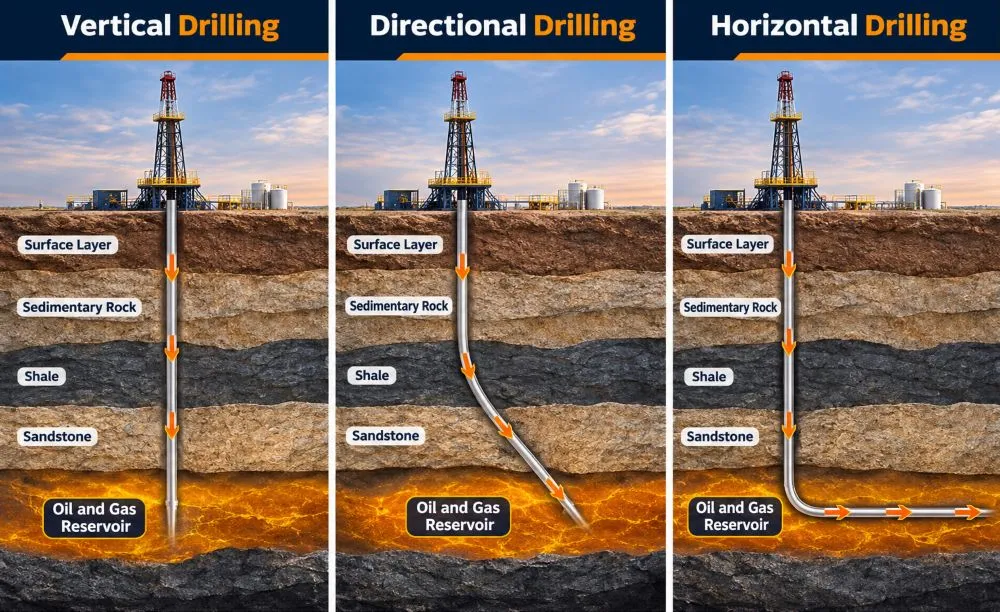
Directional Drilling vs Vertical Drilling vs Horizontal Drilling
Although the three terms are closely related, they describe different drilling approaches.
Vertical drilling follows a predominantly downward trajectory, directional drilling allows the path to be intentionally steered, and horizontal drilling creates a well section that travels approximately parallel to the earth’s surface.
Feature | Vertical drilling | Directional drilling | Horizontal drilling |
Well path | Mainly vertical | Controlled three-dimensional trajectory | Includes a near-horizontal section |
Steering complexity | Usually, lower | Depends on trajectory | Often relatively high |
Surface location flexibility | More limited | Greater flexibility | Greater flexibility |
Reservoir contact | Depends on formation thickness | Can be increased through positioning | Can provide extended contact |
Equipment requirements | Conventional drilling equipment | Specialist steering and survey systems | Directional equipment and suitable completion systems |
Typical application | Directly accessible targets | Offset or complex targets | Laterally extensive reservoirs |
Is Horizontal Drilling the Same as Directional Drilling?
Horizontal drilling is a type of directional drilling, but not every directional well becomes horizontal.
A directional well may remain inclined throughout its route, while a horizontal well is deliberately steered towards a near-horizontal orientation.
This difference matters because the drilling equipment, trajectory planning and production strategy can vary substantially.
Horizontal drilling may offer greater reservoir contact in suitable formations, but it also creates additional technical requirements that are not necessary for every development.
Equipment Used in Directional Drilling
Accurate well placement depends on several specialised tools working together. Some control the drill bit, while others measure its position, collect geological information or transmit data to surface engineers.
Directional Drill Bits
The drill bit cuts through underground rock as drilling progresses.
Different bit designs are selected according to formation hardness, drilling conditions and the required well trajectory.
The bit must work with the steering system while providing suitable drilling performance.
Downhole Mud Motors
A mud motor uses the energy of circulating drilling fluid to rotate the drill bit.
Steerable motor assemblies may include a slight bend near the bit, allowing the drilling team to direct the well along a selected path.
Mud motors can be particularly useful when controlled directional changes are required.
Rotary Steerable Systems
Rotary steerable systems, or RSS, allow the well to be steered while the drillstring continues rotating.
This can improve hole cleaning, reduce some friction-related difficulties and support smoother wellbore trajectories under suitable conditions.
However, rotary steerable tools can be expensive and require specialised personnel and equipment.
Measurement While Drilling
Measurement-while-drilling, or MWD, tools collect information about the well’s position and selected operating conditions while drilling continues.
These measurements help engineers determine whether the bit is following the intended route.
Data may be transmitted to the surface using pressure pulses in the drilling fluid or other telemetry systems.
Logging While Drilling
Logging-while-drilling, or LWD, tools measure properties of the surrounding geological formations.
Depending on the equipment, these measurements can include natural gamma radiation, resistivity and other formation characteristics.
The information helps geologists understand the rock being drilled and supports decisions about the well’s position relative to the reservoir.
Drilling Fluids and Circulation Systems
Drilling fluid performs several essential functions, including transporting rock cuttings, cooling the bit and helping maintain pressure control.
Its composition and circulation must be appropriate for the well’s geological conditions and drilling design.
Directional wells may create additional challenges because cuttings can accumulate in inclined or horizontal sections if circulation and hole cleaning are not managed properly.
The wider machinery also depends on suitable maintenance practices and equipment-specific industrial lubricants, particularly for rotating and mechanically loaded components. These products serve machinery maintenance needs and should not be confused with the specialist drilling fluids circulated through the well.
Benefits of Directional Drilling in Oil and Gas
Directional drilling offers several potential advantages when the reservoir and surface conditions make conventional vertical drilling less suitable.
Improved Access to Underground Reserves
One of its most important benefits is the ability to reach reservoirs that cannot be accessed conveniently from directly above.
This allows drilling locations to be selected according to surface restrictions, infrastructure availability and geological targets.
For example, offshore reserves may sometimes be reached from a suitable land-based drilling location, reducing the need for additional offshore drilling infrastructure.
Multiple Wells from One Drilling Site
Directional drilling makes it possible to drill several wells from a shared surface location.
Each well can follow a separate underground path while using the same general drilling area.
This arrangement can reduce the need for additional well pads, access roads and supporting infrastructure compared with developing the same targets from numerous dispersed sites.
However, the scale of any surface reduction depends on the field design and the number of wells required.
Greater Contact with Productive Rock
In suitable reservoirs, inclined and horizontal wells can remain in contact with productive formations for longer distances than a vertical well.
This may improve access to hydrocarbons and support higher production rates.
The benefit depends on rock permeability, reservoir pressure, well completion and other geological factors.
Flexibility Around Underground Obstacles
Directional drilling can help operators avoid certain geological or mechanical obstacles.
For example, a sidetrack may allow a well to continue towards a target after encountering equipment that cannot be recovered from the original wellbore.
Directional planning also helps operators manage the relative positions of nearby wells.
Potential Infrastructure Savings
A field developed from fewer surface locations may require less duplicated infrastructure.
In suitable circumstances, this can reduce some construction and logistical costs.
However, directional wells often require more sophisticated equipment, planning and monitoring. The savings must therefore be evaluated against the additional drilling costs.
Challenges and Limitations of Directional Drilling
Directional drilling offers flexibility, but it is not automatically the best option for every reservoir. Complex well paths introduce engineering problems that can affect cost, safety and drilling performance.
Increased Technical Complexity
The drilling team must maintain accurate knowledge of the well’s underground position.
This requires specialist survey tools, modelling software and experienced personnel.
A trajectory that deviates significantly from the plan may become difficult or expensive to correct.
Torque and Drag
As the wellbore changes direction, the drillstring can experience increased contact with the surrounding formation.
This may create friction that makes rotation and movement more difficult.
Long horizontal sections and sharply curved well paths can increase these challenges.
Wellbore Stability
Certain rock formations may become unstable during drilling.
Inclined and horizontal wells can experience problems related to collapsing formations, fluid circulation and the accumulation of rock cuttings.
The drilling programme must account for geological conditions and appropriate fluid properties.
Higher Equipment Costs
Directional drilling may require specialised motors, steering systems, downhole sensors and additional engineering support.
These requirements can increase the cost of drilling compared with a relatively straightforward vertical well.
The financial benefit depends on whether improved reservoir access and production justify the investment.
Well Collision Risks
Fields containing many wells require careful planning because underground trajectories may pass close to one another.
Survey uncertainty and incorrect positioning can create collision risks.
Anti-collision modelling and appropriate survey procedures are essential for managing these hazards.
Common Directional Drilling Problems and Their Causes
The following table summarises several challenges encountered during directional drilling.
Problem | Possible cause | Potential consequence |
Excessive torque | Drillstring friction or difficult well geometry | Reduced drilling efficiency |
High drag | Contact between drillstring and wellbore | Difficulty moving drilling equipment |
Poor hole cleaning | Inadequate removal of drilled cuttings | Obstructions and stuck equipment |
Unplanned well deviation | Geological influences or steering limitations | Missing the intended target |
Borehole instability | Weak formations or unsuitable drilling conditions | Collapse or wellbore damage |
Survey uncertainty | Measurement limitations or interference | Reduced positioning accuracy |
Excessive dogleg severity | Rapid changes in inclination or direction | Mechanical stress and equipment difficulties |
These problems require engineering assessment rather than a single universal solution. Their management depends on the drilling system, well design and conditions encountered underground.
What Is Geosteering in Directional Drilling?
Geosteering is the process of adjusting the drilling trajectory using geological information collected as the well progresses.
It is particularly important in horizontal drilling, where the operator may want to keep the well within a relatively thin productive reservoir interval.
A geological model provides an initial prediction of where the target formation should be. However, actual rock boundaries may differ from the model because of faults, changes in thickness or other geological variations.
Logging-while-drilling data helps the team recognise these changes.
If measurements indicate that the well is approaching the edge of the desired formation, engineers can adjust the trajectory where equipment and conditions allow.
This helps keep the well within a suitable producing interval and reduces the risk of drilling into an unwanted formation.
Geosteering does not eliminate geological uncertainty, but it provides valuable information for making adjustments during drilling.
Directional Drilling in Onshore and Offshore Operations
Directional drilling is used in both land-based and offshore petroleum developments, although the surrounding infrastructure and operating constraints differ.
Onshore Directional Drilling
Onshore directional wells are drilled from land-based rigs.
They can be particularly useful where several underground targets are accessible from one drilling pad or where the available surface location does not align with the reservoir.
In some shale developments, multiple horizontal wells originate from a shared pad, allowing operators to reach different sections of the underlying formation.
Land access, geological conditions, local infrastructure and environmental requirements influence the final drilling plan.
Offshore Directional Drilling
Offshore platforms often drill numerous wells from a relatively limited surface area.
Directional drilling allows each well to follow a different route towards a specific part of the reservoir.
This is important because constructing additional offshore platforms can involve substantial engineering, marine logistics and financial investment.
Extended-reach wells may also provide access to offshore targets from land-based locations in suitable developments.
Understanding what is onshore and offshore in oil and gas helps explain the differences in drilling environments, equipment and operational challenges.
Environmental Considerations of Directional Drilling
Directional drilling can reduce some surface development requirements by allowing multiple wells to originate from shared drilling locations.
For example, using fewer well pads may reduce the number of access roads and separate surface installations required for a particular development.
However, this does not mean that directional drilling is environmentally harmless.
Oil and gas operations can still create impacts through land disturbance, drilling waste, water consumption, emissions, noise and potential accidental releases.
Environmental considerations include:
- Surface land requirements and access routes.
- Drilling fluid management and waste disposal.
- Protection of groundwater and surrounding formations.
- Equipment energy consumption and associated emissions.
- Noise and disturbance during drilling.
- Well integrity and pressure-control requirements.
- Spill prevention and emergency response planning.
The overall environmental impact depends on the complete project design, the number of wells drilled, local conditions and the effectiveness of regulatory and operational controls.
Directional drilling may reduce certain impacts in appropriate circumstances, but its benefits must be evaluated against the wider effects of hydrocarbon development.
Where Does Directional Drilling Fit in the Oil and Gas Supply Chain?
Directional drilling belongs primarily to the upstream sector of the petroleum industry.
Upstream activities involve exploration, well construction and the production of crude oil and natural gas from underground reservoirs.
Directional drilling contributes by helping engineers reach those reservoirs through planned well trajectories.
For a broader understanding of these activities, what is the upstream oil and gas industry explains how exploration, appraisal, drilling and production fit together.
Once oil and gas reach the surface, they may enter gathering, processing, storage and transportation infrastructure before moving towards refineries or other destinations.
These activities connect with the midstream oil and gas sector, which manages important stages between production and downstream use.
Directional drilling itself should not be confused with refining or commercial fuel delivery. It is an extraction-stage technology that helps access raw petroleum resources before they move through the wider supply chain.
How Technology Is Improving Directional Drilling
Directional drilling has evolved considerably since the introduction of basic wellbore surveying and mechanical steering methods.
Modern developments focus on improving positional accuracy, reducing unnecessary drilling time and helping operators respond more effectively to geological changes.
Improved Downhole Sensors
Advanced measurement tools provide increasingly detailed information about well position and selected formation properties.
Better data can support more informed steering decisions, particularly in complex geological environments.
Rotary Steerable Technology
Rotary steerable systems allow continuous rotation while changing the well trajectory.
In suitable applications, this can improve hole quality and reduce some of the operational limitations associated with conventional sliding techniques.
Digital Well Planning
Computer-based models allow engineers to simulate different well trajectories before drilling begins.
These systems help evaluate mechanical limitations, geological targets and potential collision risks.
Models can also be updated when new information becomes available during drilling.
Greater Automation
Some modern drilling systems use automated controls to support directional decisions and operational consistency.
However, trained engineers remain responsible for interpreting geological conditions, evaluating risks and overseeing the drilling programme.
Automation can support decision-making, but it does not remove the need for experienced personnel or appropriate safety procedures.
How Much Does Directional Drilling Cost?
Directional drilling costs vary substantially, making it difficult to provide one meaningful price for every project.
A relatively simple inclined onshore well may require less specialised equipment than a long horizontal offshore well with complex geological conditions.
The total cost depends on several factors:
- Well depth and length: Longer wellbores generally require more drilling time and materials.
- Trajectory complexity: Sharp curves and difficult targets can increase engineering requirements.
- Geological conditions: Hard rock, unstable formations and unexpected faults may create additional work.
- Equipment selection: Rotary steerable systems and advanced measurement tools can affect expenditure.
- Rig operating costs: Land rigs and offshore drilling installations have different cost structures.
- Personnel requirements: Specialist directional drillers and technical support may be necessary.
- Well completion: Casing, cementing and completion requirements influence the total project budget.
It is important to distinguish drilling cost from cost per unit of oil or gas recovered.
A directional well may cost more to construct than a simple vertical well but still be economically attractive if it provides better access to a productive reservoir.
The appropriate comparison is therefore based on the complete project economics rather than drilling expenditure alone.
Is Directional Drilling Better Than Vertical Drilling?
Neither technique is universally better. The most suitable drilling method depends on reservoir geometry, location, geological conditions and commercial objectives.
Vertical drilling may be appropriate when the target lies directly beneath an accessible surface location and a relatively simple trajectory provides adequate reservoir contact.
Directional drilling becomes more useful when the well must reach an offset target, navigate around obstacles or extend through a particular reservoir interval.
Horizontal drilling may provide additional advantages in suitable formations, but its increased complexity can make it unnecessary for other reservoirs.
The decision should be based on geological studies, engineering feasibility, safety considerations and economic evaluation.
The Role of Directional Drilling in Modern Energy Production
Directional drilling has become an important technique because it allows petroleum engineers to adapt well paths to complex underground geology.
The ability to reach several targets from one drilling location can influence how fields are developed, particularly where surface access is limited or offshore infrastructure is expensive.
However, directional drilling is only one part of petroleum production. Once oil and gas are recovered, they still require suitable handling, processing and transportation before reaching commercial users.
123 Oil operates within the UK fuel and lubricant supply market, a downstream part of the wider petroleum industry. Understanding upstream technologies such as directional drilling provides useful context for how the raw resources behind commercial petroleum products are originally accessed.
The connection between drilling and fuel supply is therefore part of a much larger industrial process involving exploration, extraction, processing, refining, storage and distribution.
Conclusion
Directional drilling is an advanced well-construction technique that allows engineers to guide a wellbore towards underground oil and gas reserves along a carefully planned route. By combining specialised steering equipment, geological information and continuous measurement, operators can reach offset targets, construct horizontal wells and develop reservoirs from fewer surface locations in suitable circumstances. Although the technique introduces additional costs and engineering challenges, its flexibility makes it an important part of modern petroleum exploration and production.
Frequently Asked Questions
The main purpose of directional drilling is to reach underground oil and gas reserves that cannot be accessed efficiently through a vertical well. It allows engineers to control the wellbore's direction; access offset targets and increase contact with suitable reservoir formations while using carefully selected surface drilling locations.
Directional drilling refers to deliberately steering a well along a planned trajectory rather than simply drilling vertically. Horizontal drilling is a specialised type of directional drilling in which the well includes a near-horizontal section. Not every directional well becomes horizontal, but horizontal wells require directional control.
Directional drilling depth depends on the drilling equipment, geological conditions and well design. Some wells extend several kilometres below the surface, while others travel considerable distances horizontally. Measured depth and true vertical depth are different, so a long wellbore does not necessarily reach the same distance vertically underground.
Engineers use steerable mud motors, rotary steerable systems and directional measurement tools to control the drilling path. Sensors provide information about the well's inclination and direction, allowing the team to compare its position with the planned trajectory and make adjustments as needed.
Directional drilling can be more expensive because it may require specialist steering equipment, additional monitoring and more complicated well planning. However, it can also improve access to productive reservoirs or reduce the number of surface drilling locations required. The overall economic benefit depends on the project.
Yes. Directional drilling is widely used in offshore oil and gas developments because multiple wells can be drilled from a single platform or installation. Each well follows a planned underground path towards a different reservoir target, allowing operators to access a wider area without necessarily constructing separate platforms.
Directional drilling can reduce certain surface impacts by allowing several wells to be drilled from a shared location. This may limit the number of drilling pads and access roads required. However, drilling still involves emissions, waste, water management and other environmental risks, so the overall impact depends on the complete development.