

FPSO stands for Floating Production, Storage and Offloading. It is a specialised offshore vessel that receives oil and gas from subsea wells, separates the production fluids and stores processed crude oil in onboard tanks. The oil is then transferred to shuttle tankers for transportation to terminals or refineries, reducing the need for a direct oil export pipeline.
Offshore oil and gas production requires sophisticated equipment to recover hydrocarbons from reservoirs located beneath the seabed. While some oilfields rely on fixed platforms and subsea pipelines, others use large floating vessels capable of processing, storing and transferring crude oil directly at sea. These specialised facilities are known as FPSOs, and they play an important role in offshore petroleum production.
An FPSO combines several industrial operations within a single floating structure. It receives fluids from subsea wells, separates oil from gas and water, processes the recovered hydrocarbons and stores crude oil until it can be collected by another vessel. This arrangement is particularly useful in offshore locations where constructing a conventional export pipeline would be technically difficult or commercially unattractive.
Although an FPSO may resemble a large oil tanker, it performs a much more complex function. Its deck contains processing equipment, pumps, compressors, control systems and safety installations, while the hull provides storage capacity and supports the entire production facility.
Understanding what FPSO means in oil and gas helps explain how offshore fields operate, why floating production systems are used and how crude oil moves from underwater reservoirs into the wider petroleum supply chain.
What Does FPSO Stand for in Oil and Gas?
FPSO stands for Floating Production, Storage and Offloading. Each part of the name describes one of the vessel’s main functions, creating a complete offshore facility that can operate without relying on a conventional fixed production platform.
The term can be broken down into four components:
- Floating: The facility remains on the sea surface and is held in position using a suitable mooring or station-keeping system.
- Production: Equipment onboard receives and processes oil, gas and water produced from offshore reservoirs.
- Storage: Processed crude oil is stored in dedicated tanks within the vessel’s hull.
- Offloading: Stored oil is transferred to a shuttle tanker or another suitable transportation system.
An FPSO is therefore both a production facility and a storage installation. It allows an oilfield to produce hydrocarbons while providing temporary storage until the crude oil can be transported away.
The vessel is usually connected to underwater production equipment through flowlines and risers. These systems carry the produced fluids from the seabed to the processing facilities onboard.
How Does an FPSO Work in Oil and Gas?
The operation of an FPSO begins beneath the seabed, where production wells recover hydrocarbons from underground reservoirs. These fluids travel through subsea equipment before reaching the floating vessel, where they undergo separation and treatment.
Although individual installations differ in design, a typical FPSO follows a series of interconnected production stages.
Step 1: Oil and Gas Are Produced from Subsea Wells
Offshore production begins when hydrocarbons flow from a reservoir through wells drilled beneath the seabed. The wells may produce oil, natural gas, water and small quantities of other substances.
Subsea wellheads and production trees control the flow from individual wells. Depending on the development, several wells may be connected to a common gathering system.
Production equipment on the seabed can be operated remotely from the FPSO through control systems and subsea umbilicals.
Step 2: Production Fluids Travel Through Flowlines and Risers
Once the hydrocarbons leave the wells, subsea flowlines transport them towards the floating production facility. These pipelines connect the underwater production equipment to a suitable gathering or riser system.
Risers carry the produced fluids from the seabed towards the FPSO. They must accommodate pressure, temperature and movement caused by waves and currents.
The design may include flexible risers, rigid risers or other arrangements selected according to water depth and operating conditions.
Step 3: The FPSO Separates Oil, Gas and Water
The incoming production stream usually contains a mixture of hydrocarbons and produced water. Onboard separation equipment divides these materials into different phases.
Oil is directed towards further treatment and storage, while natural gas may be processed for export, used to generate power or reinjected into the reservoir. Produced water requires suitable treatment before permitted discharge, reinjection or another approved management route.
The exact processing configuration depends on the composition of the reservoir fluids and the facilities installed onboard.
Step 4: Crude Oil Is Treated Before Storage
After initial separation, crude oil may still contain water, dissolved gas and other substances that need to be reduced to acceptable levels.
Processing equipment prepares the oil to meet the required storage and transportation specifications. This may involve further separation, dehydration, heating or other treatment methods.
The processed oil is then directed into dedicated storage tanks within the vessel’s hull.
Step 5: Oil Is Stored Inside the FPSO
One of the defining features of an FPSO is its onboard crude oil storage capacity. Rather than sending every barrel immediately through an export pipeline, the vessel can hold oil until a suitable tanker arrives.
Storage capacity varies considerably depending on the vessel’s size and design. Some FPSOs are converted from existing oil tankers, while others are purpose-built for particular field developments.
Operators monitor the storage tanks, cargo levels, vapour systems and other conditions to maintain safe operations.
Step 6: Oil Is Transferred to a Shuttle Tanker
When sufficient crude oil has accumulated, a shuttle tanker can approach the FPSO and connect through an approved offloading system.
Oil is transferred through suitable hoses and pumping equipment while the vessels maintain their required positions.
The shuttle tanker then transports the crude oil to an export terminal, storage facility or refinery.
This allows offshore production to continue without the oilfield necessarily requiring a direct crude oil export pipeline.
Main Components of an FPSO Vessel
An FPSO contains several interconnected systems that support production, storage, marine operations and personnel safety. Each component contributes to maintaining reliable operations in an offshore environment.
FPSO Components and Their Functions
Component | Main function | Why it matters |
Hull | Provides flotation and structural support | Supports the entire floating facility |
Production topsides | Processes incoming hydrocarbons | Separates and treats oil, gas and water |
Storage tanks | Hold processed crude oil | Provide capacity between export shipments |
Risers | Connect subsea systems to the vessel | Transport production fluids |
Mooring system | Holds the vessel in position | Controls movement under offshore conditions |
Turret system | Allows suitable vessels to rotate around a mooring point | Helps accommodate changing weather and sea conditions |
Offloading system | Transfers crude oil to tankers | Enables offshore export |
Power generation | Supplies electricity to onboard equipment | Supports continuous operation |
Safety and control systems | Monitor operations and manage hazards | Protect personnel, equipment and the environment |
Hull and Storage Tanks
The hull provides buoyancy and supports the production equipment above the waterline. In many ship-shaped FPSOs, the hull also contains the crude oil storage tanks.
Its design must withstand environmental conditions, operational loads and the stresses associated with long-term offshore service.
Storage tanks are equipped with appropriate cargo-handling and safety systems, although their exact arrangement differs between vessels.
Production Topsides
The term topsides refers to the processing facilities and supporting equipment installed above the hull.
These facilities may include separators, pumps, compressors, heat exchangers, gas treatment equipment, control rooms and power systems.
The complexity of the topsides depends on the reservoir fluids and the quantity of hydrocarbons the FPSO is designed to process.
Mooring and Turret Systems
An FPSO must remain within an acceptable operating area while connected to subsea pipelines and production equipment.
Many vessels use mooring chains, anchors and specialised turret systems to maintain their position.
A turret arrangement can allow the vessel to rotate around its mooring point in response to changing wind, wave and current directions. This movement is known as weathervaning.
Not every FPSO uses the same mooring design. Some installations rely on spread mooring systems, while station-keeping arrangements vary according to the field and environmental conditions.
Offloading Equipment
The offloading system transfers processed crude oil from storage tanks to a suitable tanker.
It may include cargo pumps, piping, transfer hoses, monitoring equipment and emergency disconnection arrangements.
Offloading procedures must account for weather conditions, vessel movement, transfer pressure and marine safety requirements.
Different Types of FPSO Vessels
FPSO facilities are designed around the requirements of individual offshore fields. The major differences usually involve vessel construction, hull configuration, processing capacity and mooring arrangements.
Converted FPSO Vessels
Some FPSOs are created by converting existing oil tankers into floating production facilities.
The conversion involves installing processing equipment, modifying the cargo systems and adding suitable mooring and safety arrangements.
This approach can be commercially attractive when an appropriate tanker is available and the vessel can meet the intended field requirements.
However, conversion projects must consider the condition of the existing hull, structural changes and the vessel’s remaining service life.
Purpose-Built FPSOs
Purpose-built FPSOs are designed specifically for offshore production rather than being converted from conventional tankers.
Their hulls, processing equipment and storage systems can be developed around the needs of a particular reservoir and operating environment.
This may provide greater design flexibility but can involve substantial construction costs and long project schedules.
Ship-Shaped FPSOs
Ship-shaped FPSOs resemble large tankers and are widely used in offshore production.
Their elongated hulls provide space for crude oil storage and support extensive processing equipment.
The mooring arrangement is selected according to environmental conditions, field requirements and the vessel’s design.
Alternative Hull Designs
Although ship-shaped vessels are common, some floating production facilities use alternative hull arrangements.
These may include cylindrical designs that respond differently to waves, wind and currents.
The appropriate configuration depends on water depth, processing requirements, storage capacity and other engineering considerations.
FPSO vs Offshore Oil Platform
FPSOs and fixed offshore platforms can both support hydrocarbon production, but their structures and operational arrangements differ considerably.
A fixed platform is supported by a structure connected to the seabed. An FPSO floats at the surface and remains in position through its mooring or station-keeping system.
Many fixed production platforms send crude oil through export pipelines, while FPSOs commonly store the processed oil onboard before transferring it to tankers.
FPSO vs Fixed Platform Comparison
Feature | FPSO | Fixed offshore platform |
Structure | Floating vessel | Supported by seabed-connected structure |
Crude oil storage | Usually integrated into the hull | May be limited or require separate infrastructure |
Oil export | Commonly shuttle tankers | Often pipelines |
Water depth suitability | Can be used in deep-water developments | Depends on platform type and engineering limits |
Relocation | Some vessels can be redeployed | Generally not designed for straightforward relocation |
Station keeping | Mooring or other approved arrangements | Structural connection to seabed |
Production equipment | Onboard topsides | Platform topsides |
Project suitability | Frequently attractive for remote fields | Often suitable where fixed infrastructure is practical |
Neither approach is universally superior. A fixed platform may be appropriate in a mature producing region with existing pipelines, while an FPSO may offer advantages for a remote field without export infrastructure.
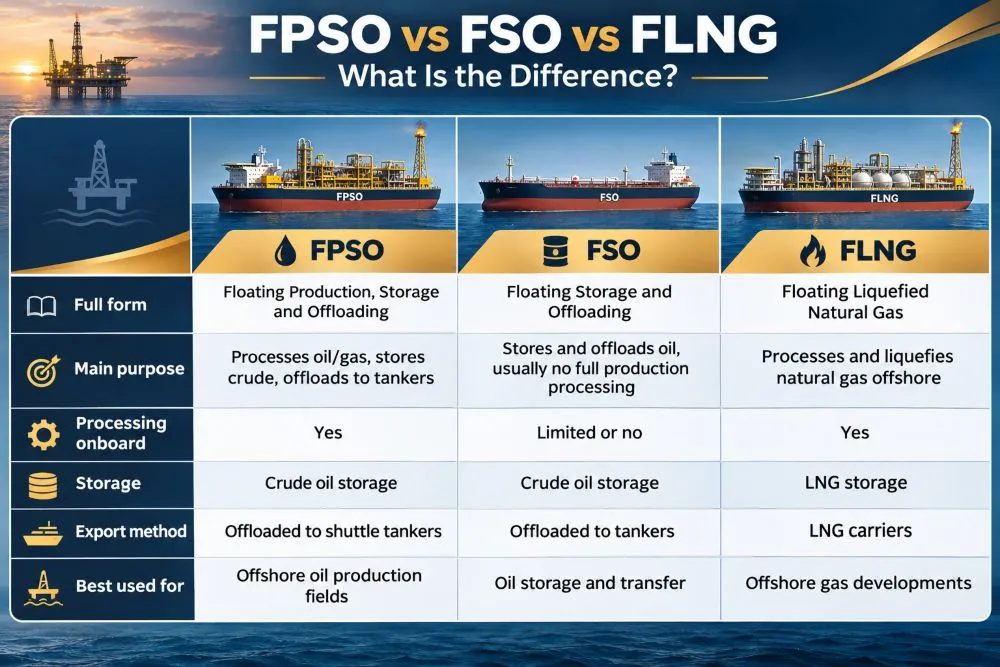
FPSO vs FSO vs FLNG: What Is the Difference?
Several offshore vessel abbreviations can appear similar, but they refer to facilities with different functions.
An FPSO combines production processing, storage and offloading. An FSO mainly provides storage and offloading, while an FLNG facility processes and liquefies natural gas offshore.
Facility | Full form | Main purpose |
FPSO | Floating Production, Storage and Offloading | Processes hydrocarbons, stores crude oil and transfers it |
FSO | Floating Storage and Offloading | Stores and transfers oil without full production processing |
FLNG | Floating Liquefied Natural Gas | Processes and liquefies natural gas offshore |
FPS | Floating Production System | General category of floating production facilities |
FPU | Floating Production Unit | Produces or processes hydrocarbons, often without integrated crude storage |
These distinctions are important when comparing offshore projects. A storage vessel should not automatically be assumed to contain the same processing equipment as an FPSO.
Why Are FPSOs Used in Offshore Oil and Gas?
An FPSO can offer several advantages when offshore fields are located far from established infrastructure or where constructing permanent facilities is difficult.
Reducing Dependence on Export Pipelines
One of the main attractions of an FPSO is its ability to store processed crude oil onboard.
Instead of requiring a long oil export pipeline to the coastline, operators can arrange for shuttle tankers to collect production.
This can be particularly useful in remote fields where pipeline construction would involve substantial cost or technical difficulty.
However, gas export may still require a pipeline or another suitable solution, depending on the development.
Supporting Deep-Water Production
Floating production systems are important in offshore areas where conventional fixed structures may be impractical.
An FPSO can be connected to subsea wells and equipment in deep water, allowing hydrocarbons to be processed at the surface.
The design must account for riser movement, vessel stability, mooring loads and the challenging offshore environment.
Providing Onboard Storage
Integrated storage creates flexibility between production and transportation.
Oil can accumulate in the vessel’s tanks while waiting for the next tanker collection, reducing the need for a separate floating storage facility.
However, the storage capacity must be carefully managed. If tankers are delayed and the tanks approach their operating limits, production may need to be reduced.
Potential for Redeployment
Certain FPSOs can be disconnected and redeployed after an oilfield reaches the end of its productive life.
This may allow equipment or the vessel itself to be used on another development, provided its condition and design remain suitable.
Redeployment is not automatic. It may require substantial modification, inspection and requalification.
Flexible Field Development
FPSOs can support fields where production volumes, infrastructure access or commercial conditions make other development options less attractive.
Their flexibility can be particularly valuable in remote offshore regions, but the most suitable solution must be determined through engineering and economic assessment.
What Are the Disadvantages of FPSOs?
Despite their advantages, FPSOs involve significant technical and operational challenges.
Their floating design exposes them to vessel movement, harsh weather conditions and the requirements of marine operations.
Weather-Related Operating Restrictions
High waves, strong winds and challenging currents can affect tanker approach, offloading and maintenance activities.
Depending on the vessel and transfer system, operators may need to postpone oil transfers until conditions improve.
Extended delays can affect storage levels and production planning.
Complex Maintenance Requirements
FPSOs contain both marine equipment and petroleum processing systems.
Maintenance may involve the hull, cargo tanks, pumps, compressors, valves, electrical equipment and subsea connections.
Because the vessel is operating offshore, access to specialist personnel and replacement parts may be more difficult than at an onshore facility.
High Initial Investment
Large FPSOs can require substantial capital investment for construction, conversion, equipment installation and commissioning.
The total cost depends on the vessel design, processing capacity, water depth, field conditions and project requirements.
An FPSO may still be commercially attractive if it avoids expensive alternative infrastructure.
Marine and Production Risks
FPSO operations involve pressurised hydrocarbons, marine traffic, vessel movement, heavy equipment and complex processing systems.
These hazards require integrated safety arrangements and continuous operational monitoring.
A failure involving production equipment, cargo transfer or station keeping can have serious consequences.
How Is Crude Oil Offloaded from an FPSO?
Offloading is one of the defining activities of FPSO operations. The process transfers crude oil from onboard storage tanks to a separate tanker that transports it towards the receiving terminal.
The operation requires careful coordination between the FPSO crew, tanker personnel and marine support systems.
A typical transfer follows these stages:
- Pre-transfer planning: Personnel review weather conditions, tanker readiness, cargo specifications and operating procedures.
- Tanker approach: The shuttle tanker moves into the approved position under controlled marine operations.
- Connection: Suitable transfer hoses and associated equipment are connected according to the system design.
- Safety checks: Teams verify communications, equipment readiness and emergency shutdown arrangements.
- Cargo transfer: Pumps move crude oil from the FPSO storage tanks into the receiving tanker.
- Completion and disconnection: The transfer is stopped, equipment is secured and the tanker departs when authorised.
Offloading may use tandem or side-by-side arrangements depending on the installation.
Because oil is being transferred between large vessels in an offshore environment, operating procedures must account for both marine and process safety risks.
What Happens to Natural Gas on an FPSO?
Although FPSOs are commonly associated with crude oil production, incoming well fluids can also contain significant quantities of natural gas.
After separation, the gas may undergo treatment and compression according to the field’s requirements.
Depending on the facilities available, operators may:
- Export gas through a subsea pipeline.
- Use suitable treated gas to generate electricity onboard.
- Reinject gas into the reservoir for pressure support or other approved purposes.
- Send gas for further processing where appropriate infrastructure exists.
- Use controlled flaring for specified operational or safety situations.
Routine handling should not be confused with uncontrolled gas release. Gas management is an important part of FPSO design because hydrocarbon vapours present environmental and safety considerations.
The appropriate solution depends on gas composition, reservoir requirements and available export infrastructure.
How Are FPSOs Kept in Position at Sea?
An FPSO cannot simply drift while connected to subsea production equipment. It must remain within a defined operating area so that risers, moorings and other systems are not exposed to unacceptable movement.
Station keeping is therefore essential.
Turret Mooring
Turret-moored FPSOs can rotate around a fixed mooring arrangement in response to changing environmental forces.
This helps the vessel align with prevailing conditions and manage loads on the hull and mooring system.
Spread Mooring
Spread mooring systems use several anchor lines connected to different points on the vessel.
They are designed to maintain the vessel’s orientation and position within specified limits.
These systems may be appropriate where the environmental conditions and field layout support their use.
Dynamic Positioning
Some offshore units use thrusters and computer-controlled systems to maintain position.
However, dynamically positioned facilities require careful consideration of power, redundancy and operating conditions. Mooring remains common for FPSOs intended to remain at one production location for extended periods.
The choice of station-keeping method is a major engineering decision because it affects vessel movement, riser design and offshore safety.
Safety Systems Used on FPSO Vessels
FPSOs combine the hazards of an industrial processing plant with those of a marine vessel.
Safety systems must therefore address hydrocarbon leaks, fires, explosions, structural problems, adverse weather and evacuation requirements.
Important safeguards include:
- Fire and gas detection: Monitoring for hazardous gas releases and indications of fire.
- Emergency shutdown systems: Isolating equipment and stopping relevant processes during specified emergencies.
- Fire protection equipment: Suppression and firefighting systems suitable for identified hazards.
- Pressure protection: Preventing equipment from operating beyond allowable conditions.
- Cargo monitoring: Supervising storage tank conditions and transfer activities.
- Emergency response plans: Establishing procedures for incidents involving personnel and equipment.
- Lifeboats and evacuation arrangements: Providing suitable emergency escape and rescue measures.
- Inspection and maintenance: Identifying deterioration before it compromises equipment integrity.
The correct arrangements depend on the vessel, its classification, applicable regulations and field-specific risk assessment.
Environmental Impact of FPSO Operations
FPSOs allow offshore hydrocarbons to be recovered and processed, but they can also create environmental risks.
Potential impacts include greenhouse gas emissions, accidental oil releases, produced-water discharge, marine traffic and operational waste.
Environmental performance depends on the design of the facility, the fluids being produced and the effectiveness of monitoring and control systems.
Oil Spill Prevention
Accidental releases can occur during production, storage or tanker transfer if equipment fails or operating controls are ineffective.
FPSOs therefore require suitable containment, inspection, transfer procedures and emergency response planning.
Produced Water Management
Produced water is separated from incoming reservoir fluids and may contain oil droplets, dissolved substances and treatment chemicals.
It must be managed according to applicable environmental requirements.
Depending on the project, treated water may be reinjected or discharged under an appropriate permit.
Energy Use and Emissions
FPSO processing equipment requires substantial energy for pumping, compression, heating and electrical systems.
Power may be generated using onboard gas turbines or other systems.
Some developments consider alternative power arrangements, including offshore electrical connections where technically feasible.
Environmental improvements must be evaluated across the full production system rather than assuming that floating facilities inherently produce fewer emissions than fixed platforms.
FPSO Operations in the North Sea and UK Offshore Industry
The UK offshore petroleum industry operates in challenging marine conditions, particularly in parts of the North Sea and west of Shetland.
Offshore developments may involve fixed platforms, subsea installations, pipelines and floating production facilities, depending on the field.
FPSOs have been used in UK waters where their storage capacity and operational flexibility suit the development.
A well-known example is the Schiehallion field west of Shetland, which has used FPSO-based production infrastructure.
The UK regulatory environment also requires operators to consider offshore safety, environmental protection, well integrity and appropriate management of installation risks.
For a broader explanation of offshore production environments, what is onshore and offshore in oil and gas provides useful context about the differences between land-based and marine petroleum operations.
Where Do FPSOs Fit in the Oil and Gas Supply Chain?
FPSOs sit mainly within the upstream production sector, although they perform functions that overlap with activities commonly associated with midstream operations.
Upstream includes exploration, drilling and the recovery of hydrocarbons from reservoirs.
An FPSO receives produced fluids and processes them sufficiently for onboard storage and transportation.
After crude oil is transferred to a shuttle tanker, it may enter terminals, storage facilities and refineries.
Understanding what is midstream in oil and gas helps explain how transportation, storage and processing connect offshore production facilities with downstream markets.
The typical journey of crude oil may involve:
- Oil and gas are recovered from subsea wells.
- An FPSO receives and processes the production stream.
- Stabilised crude oil is stored onboard.
- A shuttle tanker transports the oil to a receiving facility.
- The crude enters a terminal or refinery.
- Refining produces suitable petroleum fractions and finished fuels.
- Distribution networks supply those products to commercial and domestic customers.
This journey illustrates how an offshore floating facility connects with the broader petroleum industry.
How Are FPSO Engines and Processing Equipment Maintained?
An FPSO relies on numerous rotating and mechanically loaded systems, including pumps, compressors, power-generation equipment and auxiliary machinery.
Maintenance programmes must address wear, vibration, corrosion, lubrication and equipment performance.
Depending on the system, maintenance activities may include:
- Inspection of pumps, seals and rotating components.
- Checking bearings and lubrication systems.
- Monitoring vibration and operating temperatures.
- Testing safety-related equipment.
- Maintaining compressors and power-generation machinery.
- Inspecting marine machinery and cargo-handling systems.
- Checking hydraulic and mechanical components.
- Replacing consumable materials according to the equipment manufacturer’s requirements.
Suitable industrial lubricants help reduce friction and wear in machinery where their specifications match the equipment’s requirements.
However, different machines require different lubricant properties, and products must be selected according to manufacturer recommendations and operating conditions.
FPSO maintenance is a specialist offshore activity. Routine lubricant supply should not be confused with responsibility for the engineering or operation of the entire floating production facility.
How Much Does an FPSO Cost?
There is no universal price for constructing, converting or operating an FPSO because installations vary enormously in scale and complexity.
A smaller converted vessel may have different capital requirements from a newly built FPSO designed for a large deep-water development.
Factors influencing cost include:
- Vessel construction or conversion requirements.
- Crude oil storage capacity.
- Oil and gas production processing capacity.
- Water depth and mooring system design.
- Subsea connections and risers.
- Power-generation and gas-treatment equipment.
- Safety and environmental control systems.
- Offshore installation and commissioning.
- Maintenance, staffing and marine logistics.
- Expected field life and future redeployment potential.
Some operators own their FPSOs, while others use leasing arrangements with specialist floating production providers.
A leasing model may change how capital expenditure and operating costs are allocated, but it does not eliminate the underlying technical and commercial risks.
The most appropriate investment decision depends on reservoir production forecasts, field life, market conditions and comparisons with alternative development methods.
The Future of FPSO Technology
FPSO technology continues to evolve as offshore operators seek better reliability, improved monitoring and more efficient equipment.
Advances in digital systems allow engineers to monitor production conditions, machinery performance and structural behaviour using connected sensors and specialist software.
Automation may also support process control, planned maintenance and operational decision-making.
Several developments are influencing the design of future floating production facilities.
Digital Monitoring and Predictive Maintenance
Sensors can provide continuous information about machinery condition, production rates and selected structural loads.
Analysis of this data can help operators identify deterioration before it develops into a major failure.
Improved Energy Efficiency
Newer processing equipment and power systems may reduce energy consumption under suitable operating conditions.
Efficiency improvements depend on the complete facility design and the characteristics of the produced fluids.
Electrification
Some offshore developments are considering electricity supplied from external sources instead of relying entirely on onboard generation.
The feasibility of electrification depends on location, infrastructure availability, power requirements and wider environmental considerations.
Redeployment and Life Extension
Some FPSOs can be modified for use on other offshore fields after their original development reaches the end of production.
However, such projects require careful assessment of hull condition, equipment suitability and remaining service life.
Improved Offshore Safety Systems
Developments in monitoring, remote inspection and automated shutdown technology may strengthen hazard management.
Nevertheless, competent personnel, appropriate maintenance and effective operational procedures remain essential.
Why FPSOs Matter to the Wider Petroleum Industry
An FPSO demonstrates how offshore petroleum production combines reservoir engineering, marine technology, industrial processing and transportation.
Its ability to process and store crude oil in one floating facility can support field developments that might otherwise require extensive fixed infrastructure or direct export pipelines.
However, the oil recovered offshore is only the beginning of a much longer supply chain. Crude oil must still be transported, refined, stored and distributed before it becomes a finished product.
For businesses and readers interested in the broader energy sector, 123 Oil operates in the UK fuel and lubricant supply market, which is part of the downstream distribution system. This is distinct from operating an FPSO, but it illustrates how offshore production and commercial fuel supply are connected through refining and transportation.
Understanding the role of FPSOs provides useful insight into the infrastructure needed to move raw hydrocarbons from beneath the seabed towards the industries and customers that ultimately use petroleum products.
Conclusion
An FPSO is a floating offshore facility that combines hydrocarbon processing, crude oil storage and tanker offloading within one specialised vessel. It receives production from subsea wells, separates oil from gas and water, and stores treated crude until it can be transported to shore. This arrangement can provide valuable flexibility for remote and deep-water developments where conventional export infrastructure is impractical. Despite the complex engineering and maintenance requirements, FPSOs remain an important part of offshore oil and gas production and the wider petroleum supply chain.
Frequently Asked Questions
The main purpose of an FPSO is to process hydrocarbons produced from offshore wells, store treated crude oil onboard and transfer it to tankers for transportation. It combines production, storage and offloading functions within a floating facility, which can be useful where direct oil export pipelines are unavailable or uneconomical.
An FPSO contains production processing equipment and onboard storage facilities, allowing it to receive and treat hydrocarbons from offshore wells. A conventional oil tanker primarily transports petroleum cargo between locations. Although some FPSOs are converted from tankers, their equipment and operating requirements are considerably different.
Most FPSOs do not drill the wells themselves. They receive production from subsea wells or other connected facilities and process the recovered fluids. Drilling is normally carried out by suitable offshore drilling rigs or drillships, although specialised combined drilling and production concepts also exist.
An FPSO is usually held in position through a mooring system connected to anchors on the seabed. Some installations use turret arrangements that allow the vessel to rotate in response to changing wind, waves and currents. The exact station-keeping method depends on the vessel design and operating environment.
Processed crude oil is stored in the FPSO's tanks until it is transferred to a shuttle tanker or another suitable export system. The tanker transports the cargo to an oil terminal, where it may enter storage or pipeline infrastructure before being delivered to a refinery.
FPSO stands for Floating Production, Storage and Offloading, while FSO stands for Floating Storage and Offloading. An FPSO includes hydrocarbon production processing facilities, whereas an FSO primarily stores and transfers oil that has generally been processed elsewhere.
Yes, FPSO technology has been used in UK offshore developments, including fields west of Shetland. Floating facilities can be suitable where their storage, processing and marine capabilities meet field requirements. Their use depends on factors such as water depth, existing infrastructure and commercial viability.